The Shastrarth tradition is an ancient Indian system of structured philosophical debate relying on logic, evidence (Pramana), and ethical conduct. Recently revived by Nalanda University and supported by NEP 2020, it bridges India's classical intellectual heritage with modern education to foster critical thinking and democratic dialogue.
Why In News?
Prime Minister Narendra Modi highlights the revival of the ancient Indian debate system, Shastrarth, at Nalanda University during his 135th 'Mann Ki Baat' broadcast.
What is Shastrarth?
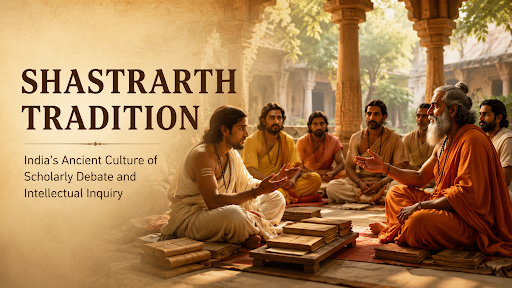
It is derived from 'Shastra' (scriptures/knowledge) and 'Artha' (interpretation), Shastrarth represents the ancient Indian philosophical system of disciplined, structured, and open public debate.
Vedic Origins: The practice traces its roots to early Vedic assemblies (Sabhas and Samitis) and the Brihadaranyaka Upanishad, where figures like King Janaka patronized debates featuring scholars like Gargi.
It served as the central pedagogical tool in ancient residential universities, including Nalanda, Vikramashila, Odantapuri, and Takshashila.
The 8th-century debate between Adi Shankaracharya and Mandana Misra remains a defining moment in Indian intellectual history.
Objectives of Shastrarth
Pursuit of Truth: It identifies objective philosophical or scientific truth through rigorous peer review, moving beyond personal opinion.
Intellectual Inquiry: The practice renews the Guru–Śiṣya Paramparā (teacher-disciple tradition) through deep intellectual engagement.
Systematic Testing: It tests new academic treatises and logic systems before their acceptance into mainstream curricula.
Critical Thinking: Participants learn to articulate positions backed by logic while actively listening to opposing perspectives.
Key Features
Purva Paksha Principle: Debaters must accurately state the opponent's worldview first, ensuring deep comprehension before rebuttal.
Uttara Paksha (Rebuttal): Scholars present counter-positions by systematically dismantling the opponent's logic using facts and evidence.
Pramana (Valid Knowledge): Every claim requires backing through Pratyaksha (direct perception) or Anumana (logical inference).
Strict Decorum: The tradition mandates Sila (ethical conduct); emotional outbursts or ad hominem attacks result in immediate disqualification.
Madhyastha (Neutral Jury): Learned referees monitor debates to evaluate logic and declare objective verdicts.
Interdisciplinary Scope: The "Śāstrārtha 2026" event featured 25 thematic areas, including Buddhist Studies, Archaeology, Ecology, Artificial Intelligence, and International Relations.
Significance
Bridging Eras: It provides ethical direction to India's knowledge systems amid the disruptive era of Artificial Intelligence.
Methodological Rigour: It counters passive knowledge consumption and rote memorization by fostering public accountability.
Cultural Continuity: It ensures societies remain connected to their intellectual roots while advancing technologically.
Democratic Dialogue: It establishes the groundwork for intellectual pluralism and tolerance, proving ancient Indian education was scientific rather than dogmatic.
Source: DDNEWS
|
PRACTICE QUESTION Q. With reference to the ancient Indian debate system of 'Shastrarth', consider the following statements: 1. The 'Purva Paksha' principle mandates that a debater must accurately state and validate the opponent's worldview before presenting a rebuttal. 2. The debates strictly rely on 'Pramana', which exclusively permits direct perception (Pratyaksha) while completely rejecting logical inference (Anumana). 3. The tradition was recently integrated into the academic calendar of Nalanda University to promote intellectual discourse. Which of the statements given above is/are correct? A) 1 and 2 only B) 1 and 3 only C) 3 only D) 1, 2, and 3 Answer: B Explanation: Statement 1 is correct: The 'Purva Paksha' principle requires a debater to first articulate the opponent's perspective (worldview) so accurately and fairly that the opponent acknowledges it as a correct representation before proceeding to the rebuttal (Uttara Paksha). Statement 2 is incorrect: While 'Pramana' (valid sources of knowledge) is indeed the basis of Shastrarth, the tradition does not reject logical inference (Anumana). On the contrary, Anumana is a critical component of valid knowledge alongside direct perception (Pratyaksha), textual evidence, and other means. Statement 3 is correct: Nalanda University formally integrated 'Shastrarth' into its academic calendar for the first time in May 2026 (specifically termed "Shastrarth 2026") to revive the ancient tradition of intellectual dialogue and logical reasoning. |
Shastrarth is an ancient, highly structured Indian tradition of philosophical and spiritual debate where scholars analyze, defend, or challenge diverse interpretations of sacred texts using rigorous rules of logic, grammar, and evidence.
The debate was conducted publicly in royal courts or assemblies under a neutral assembly of judges (Prashnikas), requiring a challenger to systematically state an opponent's view (Purvapaksha) before dismantling it with logical refutations (Uttarapaksha) to establish the final truth (Siddhanta).
The ancient Nalanda Mahavihara is famously associated with the tradition because it served as the global epicenter of intellectual discourse, mandating that every entering scholar pass an intense oral debate at the university gates and hosting daily, multi-disciplinary scholarly disputations.
The tradition holds deep contemporary relevance by fostering advanced critical thinking and dialectical reasoning, training students to engage in respectful, evidence-based academic disagreements, and aligning perfectly with the interactive learning goals of the National Education Policy (NEP) 2020.

© 2026 iasgyan. All right reserved