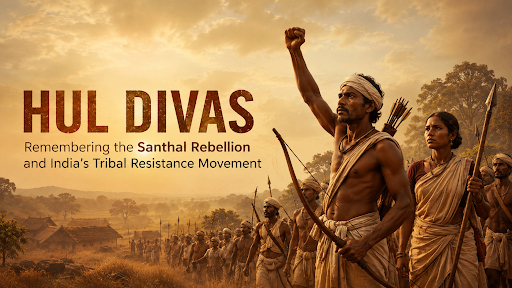
Hul Divas commemorates the 1855 Santhal Rebellion led by the Murmu siblings against British colonial oppression, corrupt moneylenders, and exploitative zamindars. This historic tribal uprising resulted in the creation of the Santhal Parganas district and protective land tenancy laws.
Why In News?
On June 30, the Prime Minister and President led national tributes to the Santhal warriors who revolted against colonial oppression during the Santhal Rebellion (1855–56).
What is Hul Divas?
Hul Divas marks the anniversary of the Santhal Rebellion (1855–56), representing one of the earliest organized tribal uprisings against British colonial rule.
Leadership: The rebellion features the leadership of Sidhu Murmu, Kanhu Murmu, Chand Murmu, and Bhairav Murmu, who mobilized against oppressive revenue systems.
Objectives: The commemoration honors tribal freedom fighters, recognizes tribal contributions to India’s freedom struggle, and preserves indigenous history and heritage.
Key Features of the Rebellion
Organized Tribal Resistance: Sido Murmu establishes an independent Santal government to collect taxes and enact tribal laws, directly defying the East India Company.
Guerrilla Warfare: Santhal warriors leverage deep knowledge of local terrain to ambush British patrols and disrupt supply lines using traditional bows, arrows, and battle axes.
Targeted Eradication: Rebels systematically destroyed colonial administrative machinery, including revenue offices, dak (postal) offices, and railway construction sites.
Dismantling Power Structures: The movement targets the properties and lives of corrupt Mahajans (moneylenders) and officials to dismantle oppressive local hierarchies.
Mass Mobilization: The uprising organized a force of roughly 60,000 Santhal warriors.
Cross-Community Solidarity: The Hul secures participation from 32 distinct communities, including non-tribal groups like Bengali smiths and low-caste laborers who provide essential intelligence.
Economic Rejection: The Santhals demand a return to a pre-monetary barter economy, rejecting the exploitative commercialization of their ancestral lands.
Female Leadership: Sisters Phulo and Jhano Murmu lead an army of 1,000 women, gathering intelligence and launching direct attacks on East India Company camps.
Causes of the Santhal Rebellion
Exploitative Zamindari System: The Permanent Settlement (1793) shatters traditional communal landholding, reducing Santhals to exploited tenant farmers.
Moneylender Exploitation: Mahajans trap tribals in cycles of debt and rank slavery through fraudulent measures and exorbitant interest rates.
Punitive Taxation: Under superintendent James Pontent, annual rent in the Damin-i-Koh region surges from 2,000 rupees (1838) to 44,000 rupees (1851), marking a 2200% increase.
Resource Scarcity: The population in Damin-i-Koh surged from 3,000 to 82,790 between 1838 and 1851, while the British cleared forests for railway expansion.
Judicial Corruption: The colonial legal system favors moneylenders, while the government ignores the exploitation and abuse of Santhal women by railway officials.
Significance of the Movement
Shattering Invincibility: The rebels break the myth of British military supremacy by defeating the East India Company army twice at Pirpainti and Birbhum.
Assertion of Identity: The Sonthal Parganas Act carves out the Santhal Parganas district, formally recognizing tribal geographic boundaries.
Inspiration for Movements: The Hul provides the ideological blueprint for future agrarian agitations, including the Chhotanagpur Tenancy Act of 1908.
Land Protections: The rebellion leads to the Santhal Parganas Tenancy Act of 1876, which legally prohibits the transfer of Adivasi land to non-Adivasis.
Conclusion
The Santhal Hul serves as a watershed moment in Indian history, symbolizing the spirit of indigenous resistance. By forcing structural administrative reforms and inspiring generations of freedom fighters, the movement remains a cornerstone of India's anti-colonial legacy.
Source: PIB
|
PRACTICE QUESTION Q. "The Santhal Rebellion was not merely a tribal uprising but a significant challenge to colonial exploitation." Discuss its causes, significance and legacy. (150 Words, 10 Marks) |
Hul Divas (observed on June 30) is an annual commemoration that honors the beginning of the Santhal Rebellion (1855-56). It celebrates the immense bravery, sacrifice, and heritage of the tribal communities who fought against British colonial rule and local exploitation.
The rebellion was famously led by four brothers from the Murmu family: Sido, Kanhu, Chand, and Bhairav. They were crucially supported by their sisters, Phulo and Jhano Murmu, who actively participated in combat and led troops against the British forces.
The Santhals revolted due to extreme economic exploitation by Mahajans (moneylenders) who charged up to 500% interest, oppressive Zamindari land policies, sudden 2200% spikes in colonial revenue taxes, mass land alienation due to British railway construction, and a corrupt legal system that failed to address severe social abuses against tribal women.
The uprising forced the British to recognize indigenous land rights, leading to the creation of the Santhal Parganas district in 1855 and the enactment of the Santhal Parganas Tenancy Act in 1876, which banned the transfer of tribal land to outsiders. It also shattered the myth of British military invincibility and inspired future anti-colonial movements.


© 2026 iasgyan. All right reserved