India's traditional water bodies, like Kundis and Johads, hold immense ecological and cultural significance. Facing threats from urbanization and climate change, grassroots initiatives like 'Jal Sahelis' and the '100 Warriors' integrate traditional ecological knowledge with modern tech for resilient water governance.
Why In News?
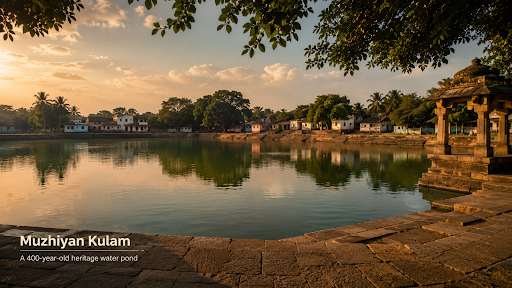
Union Finance Minister Nirmala Sitharaman officially inaugurated the restored 400-year-old Muzhiyan Kulam (Poornankuppam Agriculture Pond) in Puducherry.
What is Muzhiyan Kulam?
It is a pond that dates back to the ancient Pallava period, serving as a primary source of drinking water and agricultural irrigation for centuries.
Strategic Location: The waterbody sits near the Government Middle School in Poornankuppam (Thavalakuppam region) within the Union Territory of Puducherry.
Architectural Significance: The pond utilizes the 'Naangu Mozhi' (four wells) rainwater management system, which interconnects a primary surface tank to four natural spring-fed wells via underground chambers.
Storage Capacity: Meticulous desilting of the original bed contours allows the kulam to store nearly 5 crore litres of water, acting as a vital barrier against seawater intrusion.
Traditional Water Management Systems in India
Indigenous Structures: Communities historically utilized Kundis (Rajasthan) and Johads (community-built check dams) to capture rainfall and buffer against dry months.
Sacred Geographies: Temple tanks and rivers anchor seasonal rhythms, religious rituals, and artisanal economies like traditional boat-making.
Traditional Ecological Knowledge (TEK): Systems rely on strict customary laws to balance resource extraction with the natural regeneration of aquifers.
Advanced Hydrology: Ancient designs use interconnected subterranean systems to prevent evaporation and sustain groundwater levels during droughts.
Challenges Facing Traditional Water Bodies
Urbanisation: Unplanned infrastructure and land reclamation physically obliterate catchments and disrupt natural drainage.
Encroachment: Illegal construction on pond beds destroys water-holding capacities and increases urban flood risks.
Pollution: Unchecked discharge of sewage and industrial effluents degrades water quality and contaminates groundwater.
Administrative Neglect: Decades of apathy lead to massive siltation, choking natural springs and eroding structural embankments.
Climate Change: Rising sea levels and erratic rainfall patterns exacerbate the vulnerability of coastal ponds to evaporation and tidal flooding.
Government Initiatives
Amrit Sarovar Mission: The central government constructs and rejuvenates 75 water bodies in every district to augment rural water security.
Jal Shakti Abhiyan: The "Catch the Rain" campaign mandates aggressive rainwater harvesting across water-stressed blocks.
AMRUT 2.0: This mission funds the rejuvenation of urban water bodies through desilting, stone packing, and drain diversion.
Puducherry Regional Schemes: The UT administration utilizes the "Neerum Oorum" scheme and the 'Neer Padhivu-Jal Abhilekha' app to digitize and restore 454 ponds.
Way Forward
Community Participation: Governments must empower local stakeholders, such as 'Jal Sahelis' or the '100 Warriors' initiative, to lead grassroots water governance.
Heritage-Based Conservation: Urban planners must integrate TEK into modern master plans to ensure infrastructure complements ancient architectural designs.
Integrated Management: Authorities must execute watershed-level strategies combining afforestation, scientific desilting, and soil conservation.
Corporate Partnerships: Scaling up Public-Private Partnerships (PPP) and CSR initiatives provides the sustainable capital required for nationwide heritage restoration.
Source: NEWSONAIR
|
PRACTICE QUESTION Q. Consider the following traditional water management systems and their associated regions: 1. Kundi : Rajasthan 2. Johad : Maharashtra 3. Jal Sahelis : Bundelkhand How many pairs given above are correctly matched? A) Only one pair B) Only two pairs C) All three pairs D) None of the pairs Answer: B Explanation: 1. Kundi : Rajasthan (Correctly Matched) – A Kundi (or Kund) is a traditional, circular underground rainwater harvesting structure built in the arid and semi-arid regions of western Rajasthan to secure potable water. 2. Johad : Maharashtra (Incorrectly Matched) – A Johad is a traditional crescent-shaped earthen check dam used to capture rainwater and recharge groundwater. This system is natively practiced in Rajasthan (particularly famous in Alwar district) and parts of Haryana, not Maharashtra. 3. Jal Sahelis : Bundelkhand (Correctly Matched) – "Jal Sahelis" (Water Women Friends) is a highly successful community-led water management initiative driven by women water stewards in the drought-prone Bundelkhand region (spanning parts of Uttar Pradesh and Madhya Pradesh). They work actively to revive traditional water bodies and check dams. |
Muzhiyan Kulam (also known as Naangu Mozhi Kulam) is a historic, 400-year-old traditional water-harvesting pond spanning two acres in Pooranankuppam, Puducherry, originally constructed during the Pallava period to provide drinking water and irrigation for the village.
Traditional tanks secure regional water supplies by functioning as decentralised catchment basins that collect intense monsoon runoff, dramatically increase local groundwater tables through natural gravity percolation, and provide reliable water during severe dry spells.
Ancient reservoirs face severe destruction from rampant real-estate encroachments, heavy siltation accumulation that reduces water-holding capacity, urban pollution discharges, and prolonged administrative neglect that disrupts interconnected cascade channel networks.
Heritage water conservation drives sustainability by reviving time-tested, climate-resilient engineering designs that require zero carbon-intensive energy to store water, offering cost-effective community adaptation models to combat climate change, and reducing absolute dependence on over-exploited deeper tube wells.



© 2026 iasgyan. All right reserved