Rakhigarhi, India's largest Indus Valley site, spans 550 hectares in Haryana. Recent ASI excavations and aDNA analysis of 4,600-year-old skeletons by AnSI and leading geneticists prove indigenous Harappan origins, famously lacking Steppe pastoralist ancestry and redefining South Asian demographic history.
Why In News?
The Archaeological Survey of India (ASI) transfers 5,000-year-old human skeletal remains from the Rakhigarhi site to the Anthropological Survey of India (AnSI).
About Rakhigarhi
Situated in the Hisar district of Haryana, the site occupies the Ghaggar-Hakra river plain, representing the ancient dried-up Saraswati river basin.
Scale and Scope: Spanning 350 to 550 hectares, the site encompasses the modern villages of Rakhi Shahpur and Rakhi Khas.
Excavation Structure: Archaeologists identify seven to nine distinct mounds. ASI Excavation Branch-II recently unearthed eight burials at Mound No. 7, a designated ancient cemetery.
Cultural Sequence: The site preserves an unbroken record of the Indus Valley Civilization (IVC), transitioning from Early Harappan (c. 5000 BCE) to Mature Harappan (2600–1900 BCE) and Late Harappan phases.
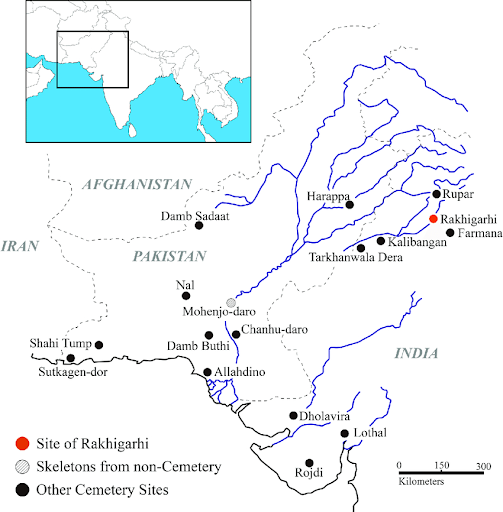
Features of the Site
Largest Settlement: Rakhigarhi surpasses Mohenjo-daro (250 hectares) as the largest known Harappan settlement, serving as the premier provincial capital of the eastern IVC.
Grid City Planning: Engineers constructed houses using standardized burnt and mud terracotta bricks along a network of paved public roads reaching widths of up to 1.92 meters.
Drainage Architecture: The city utilizes a complex, brick-lined covered wastewater system that channels effluent directly from individual households into main street sewage conduits.
Public Granary: This structure, located in the Mature Harappan layers, utilizes mud-brick construction and contains seven large rectangular chambers. Builders applied lime and decomposed grass to the lower walls to effectively repel moisture.
Manufacturing Hubs: Mound No. 1 functions as a specialized industrial zone, housing cloth-dyeing installations, terracotta firing kilns, and a gold foundry equipped with a furnace.
Gemstone Production: Excavators recovered over 3,000 unpolished semi-precious gemstones from the foundry area, confirming large-scale manufacturing activities.
Mound No. 7 Cemetery: This area serves as the primary burial ground for the settlement.
Burial Offerings: Recent digs uncover unprecedented funerary practices, where specific graves contain up to 40 distinct pottery offerings, signaling the high social status of the deceased.
Skeletal Alignment: The community traditionally lays skeletons in a strict north-south orientation.
Trade Tools: Excavations yield standardized chert trade weights and copper fish hooks, highlighting the site's integration into regional trade networks.
Ritual Sites: Archaeologists identify brick-lined fire altars used for civic rituals throughout the settlement.
Steatite Seals: The site produces unique steatite cylinder seals engraved with Harappan script symbols and distinct alligator motifs.
About Anthropological Survey of India (AnSI)
Collaborative Research: Established in 1945, AnSI partners with the Centre for Cellular and Molecular Biology (CCMB) and Banaras Hindu University (BHU) to map human genome evolution since 3000 BCE.
Scientific Protocols: Researchers deploy ancient DNA (aDNA) analysis and stable isotope studies to reconstruct migration patterns and environmental interactions.
Preservation: AnSI maintains a specialized ancient human skeletal repository in Kolkata to protect fragile biological samples from degradation.
Source: THEHINDU
|
PRACTICE QUESTION Q. Consider the following statements regarding the ancient DNA (aDNA) findings from the Rakhigarhi archaeological site:
Which of the statements given above is/are correct? A) 1 and 3 only B) 2 only C) 2 and 3 only D) 1, 2, and 3 Answer: B Explanation: Statement 1 is incorrect: The genetic analysis revealed that the Rakhigarhi individual (dated to approx. 2500 BCE, the Mature Harappan phase) lacked Steppe Pastoralist ancestry. The study indicates that Steppe ancestry (often associated with Indo-European speakers) was not present in the region during the Mature Harappan period and likely arrived later. Statement 2 is correct: The study found that the "Iranian-related" ancestry in the Indus Valley individual came from a lineage that split from the populations of the Iranian plateau more than 12,000 years ago. This separation occurred before the advent of farming in the Fertile Crescent, implying that this ancestry predates the Iranian farmers known to have spread agriculture. Statement 3 is incorrect: The findings contradict the theory that farming was brought by a migration of Anatolian farmers. The Rakhigarhi genome showed no detectable ancestry from Anatolian farmers. Instead, the study suggests that farming in South Asia likely arose from local foragers or through independent development, rather than large-scale migration from the West. |
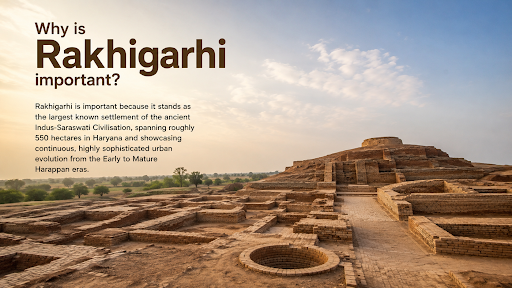
Rakhigarhi is important because it stands as the largest known settlement of the ancient Indus-Saraswati Civilisation, spanning roughly 550 hectares in Haryana and showcasing continuous, highly sophisticated urban evolution from the Early to Mature Harappan eras.
Human skeletal remains reveal the biological history, genetic ancestry, prehistoric diet, disease prevalence, ancient migration paths, and the exact physical appearance of the Harappan people through advanced DNA sequencing and facial reconstruction technology.
The Archaeological Survey of India (ASI) transferred the remains to the Anthropological Survey of India (AnSI) in Kolkata under a formal June 2026 Memorandum of Understanding to exploit their specialized ancient skeletal repository, palaeopathological expertise, and advanced multi-institutional research networks.
Rakhigarhi serves as the baseline for Indian archaeology by proving that the Harappan civilization possessed an indigenous origin devoid of early Steppe pastoralist genes, mapping unmatched prehistoric trade routes, and rewriting the structural scale of Bronze Age urban planning across the subcontinent.


© 2026 iasgyan. All right reserved