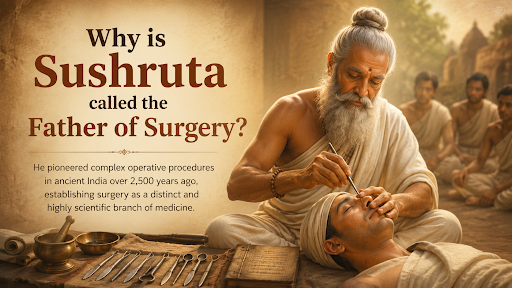
Maharishi Sushruta, the ancient Indian physician from 600 BCE, is globally recognized as the Father of Surgery. His treatise, the Sushruta Samhita, pioneered rhinoplasty, cataract extraction, and anatomical study while establishing strict bio-ethical frameworks for surgeons centuries before modern medicine.
Why In News?
The Royal College of Surgeons of Edinburgh (RCSEd), the world’s oldest surgical college, unveils a bronze statue of Maharishi Sushruta in its Playfair Auditorium.
Who Was Sushruta?
Maharishi Sushruta practiced medicine and surgery in the sacred city of Kashi (Varanasi). He receives his foundational Ayurvedic knowledge from Divodasa, who inherits the wisdom from Dhanvantari, the deity of Ayurveda.
The international medical community identifies him as the "Father of Surgery" and the "Father of Plastic Surgery."
Time Period: Scholars date his life between 600 BCE and 7th century BC, placing his medical advancements a full millennium before Hippocrates and two millennia before Celsius and Galen.
The Sushruta Samhita
Composition: The Sushruta Samhita serves as the definitive Sanskrit treatise on surgical teachings, operative techniques, and bio-ethics.
Structure: The text contains 184 chapters divided into the Purva-tantra and Uttara-tantra.
Medical Scope: The compendium catalogs 1,120 illnesses, 700 medicinal plants, 64 mineral preparations, and 57 animal-based preparations.
Lifestyle Diseases: He identifies conditions resembling modern diabetes, obesity, and cardiovascular disorders, prescribing physical activity as a primary treatment.
Contributions to Surgery
Plastic Surgery: He pioneers Nasa-sandhana (Rhinoplasty), using forehead skin flaps to reconstruct amputated noses.
Cataract Surgery: He performs specialized extracapsular lens extraction to remove cataracts without modern anesthesia.
Fracture Management: He classifies surgical procedures into seven categories: Chedya (excision), Lekhya (scarification), Vedhya (puncturing), Esya (exploration), Ahrya (extraction), Vsraya (evacuation), and Sivya (suturing).
Surgical Instruments: He invents 124 distinct surgical tools, modeling them after the anatomy of animals and birds to ensure maximum efficiency.
Legacy
Anatomy: He mandates the study of human anatomy through the observation of cadavers, utilizing a seven-day river-softening process to expose internal organs without damaging tissues with sharp knives.
Surgical Training: The Yogyasutreeya Adhyaya requires students to practice surgical cuts on vegetables, leather bags, and animal parts to achieve proficiency before treating human patients.
Medical Ethics: He establishes the Upanayana Vidhi and the Pratijna Svikara (oath-taking), demanding high standards of integrity and hygiene. He explicitly condemns Taskara Vaidya (quacks) and mandates compassionate care for the terminally ill.
Evidence-Based Framework: He organizes care into the Trividha Karma system: pre-operative assessment (including informed consent), operative precision, and post-operative care (Samsarjana Karma).
Source: INDIATODAY
|
PRACTICE QUESTION Q. With reference to the history of medicine in India, the term Taskara Vaidya mentioned in ancient texts refers to: (a) Specialized surgeons who performed cataract extractions. (b) Quack practitioners or unqualified doctors operating without formal training. (c) The ethical code of conduct administered to medical students. (d) Ancient surgical instruments modeled after animal and bird beaks. Answer: (b) Explanation: In ancient Indian medical texts like the Sushruta Samhita (Sutra Sthana), the term Taskara translates to a thief, impostor, or robber. The text strictly states that medical knowledge must be learned systematically from a qualified teacher (Guru). Practitioners who bypassed formal training and administered treatments without proper qualifications were condemned as Taskara Vaidya (quacks), operating like thieves who threatened the lives of the unsuspecting public. |


© 2026 iasgyan. All right reserved