Prambanan, a 9th-century Indonesian Hindu temple, highlights deep Indo-Indonesian ties. Scholars note that its Karana dance sculptures mirror those at Thanjavur, tracking back to the Natyasastra. India’s 2026 restoration initiative showcases cultural diplomacy, preserving shared heritage and religious harmony.
Why In News?
India and Indonesia launched a joint restoration initiative for the 9th-century Prambanan Temple complex in Yogyakarta, Java, with the Archaeological Survey of India (ASI) leading the conservation operations.
What is the Prambanan Temple Complex?
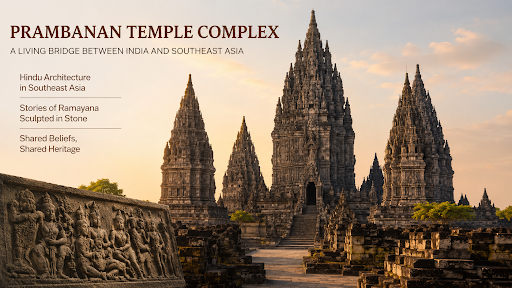
The Prambanan Temple (locally known as Roro Jonggrang) is the largest and most architecturally complex Hindu temple compound in Indonesia, representing the pinnacle of classical Shaivite art and dry-stone building technology.
Location: The monument stands on the fertile volcanic plains of Java Island, straddling the border between the Special Region of Yogyakarta and Central Java.
Dynastic Origins: Artisans constructed the temple around 850 CE during the Sanjaya Dynasty of the Mataram Kingdom as a Hindu response to the nearby Buddhist Borobudur temple.
Abandonment & Rediscovery: Earthquakes, eruptions from Mount Merapi, and political shifts force the abandonment of the complex by the 10th century; British surveyor Colin Mackenzie formally rediscovers the ruins in 1811.
UNESCO Status: The United Nations designated Prambanan as a UNESCO World Heritage Site in 1991.
Key Features of the Complex
Hindu Trimurti: The inner sacred zone contains three towering shikharas dedicated to Brahma (Creator), Vishnu (Preserver), and Shiva (Destroyer).
Ramayana Reliefs: Artisans carve extensive bas-reliefs along inner gallery walls, which devotees read sequentially via pradakshina (clockwise circumambulation).
Shiva Temple: The 47-metre high central shrine symbolizes Mount Meru and houses statues of Shiva, Ganesha, Agastya, and Durga Mahisasuramardini.
Seismic Resilience: Builders apply the Indian Mandala layout integrated with local Austronesian punden (terraced) concepts, using mortar-free andesite stone with interlocking joints for flexibility.
Compound Layout: The site features a geometric arrangement of 240 structures, including the Trimurti shrines, Vahana temples (Nandi, Garuda, Hamsa), and 224 Perwara (ancillary) shrines.
Indian Cultural Influence
Religious Synthesis: The complex manifests the peaceful coexistence of Shaivite Hinduism and Mahayana Buddhism.
Sanskrit Legacy: The 856 CE Shivagrha inscription identifies the site as Shiva-grha (House of Shiva), proving the historical adoption of Sanskrit epistemology.
Epic Traditions: The local population indigenizes the Ramayana, staging the Ramayana Ballet on full-moon nights.
Artistic Parallels: The 62 Karana dance sculptures align with Bharatamuni’s Natyasastra, showing a 1-to-1 correlation with poses at the Brihadeeswara Temple in Thanjavur.
Maritime Networks: Architectural motifs like the Makara highlight the sea-faring dialogues connecting the Indian subcontinent to the Java Sea.
Source: INDIANEXPRESS
|
PRACTICE QUESTION Q. Consider the following statements regarding the Prambanan Temple Complex: 1. It was constructed during the reign of the Buddhist Sailendra dynasty in the 9th century. 2. The central and tallest shrine of the complex is dedicated to Lord Shiva. 3. The Archaeological Survey of India (ASI) is involved in its structural restoration. Which of the statements given above is/are correct? A) 1 and 2 only B) 2 and 3 only C) 1 and 3 only D) 1, 2, and 3 Answer: B Explanation: Statement 1 is incorrect: The Prambanan Temple Complex was built in the 9th century CE by the Hindu Sanjaya dynasty of the Mataram Kingdom, not the Buddhist Sailendra dynasty. Statement 2 is correct: The towering central shrine of the complex is the Candi Shiva Mahadeva, standing at 47 meters and dedicated entirely to Lord Shiva. Statement 3 is correct: The Archaeological Survey of India (ASI) is actively involved in the structural restoration of the Prambanan Temple Compounds, in collaboration with the Indonesian government. |
The temple complex is located on Java Island, Indonesia. It sits on the fertile volcanic plains straddling the administrative boundary between the Special Region of Yogyakarta and Central Java.
Prambanan stands as a physical manifestation of ancient India-Southeast Asia civilisational ties. It highlights the spread of Hindu architectural styles (like the Pallava and Chola influences), the transmission of Sanskrit, and the integration of Indian epics like the Ramayana into Javanese culture.
The main complex is dedicated to the Hindu Trimurti—Shiva (the Destroyer), Vishnu (the Preserver), and Brahma (the Creator). The central and tallest shrine is dedicated to Shiva, and the complex also includes shrines for their vahanas (vehicles): Nandi, Garuda, and Hamsa.
India, through the Archaeological Survey of India (ASI), is involved in the restoration project as a core component of its "Act East" policy and cultural diplomacy. By conserving shared historical monuments, India aims to deepen its strategic partnership, exercise soft power, and preserve the 1,000-year-old civilisational heritage it shares with Indonesia.



© 2026 iasgyan. All right reserved