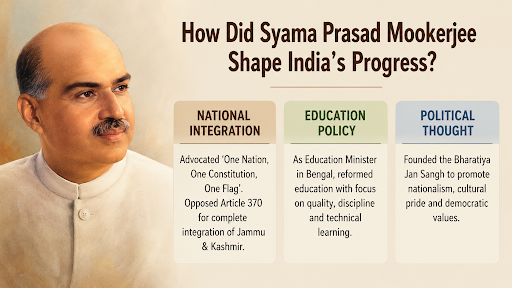
Dr. Shyama Prasad Mookerjee drives India's national integration, pioneers critical educational reforms, and lays robust industrial foundations. His relentless opposition to Article 370 and formation of the Bharatiya Jana Sangh permanently shapes modern Indian political thought and constitutional governance.
Why In News?
The nation commemorates the 125th birth anniversary of Dr. Shyama Prasad Mookerjee.
Who Was Shyama Prasad Mookerjee?
He was an educationist, parliamentarian, and the founder of the Bharatiya Jana Sangh (BJS) in 1951.
Born on July 6, 1901, he became the youngest Vice-Chancellor of Calcutta University at age 33, serving from 1934 to 1938.
As India's first Minister for Industry and Supply (1947-1950), he laid the foundation for heavy industries and indigenous manufacturing.
Core Values and Legacy
Humanitarianism: During the 1943 Bengal Famine, he demonstrated exceptional leadership by mobilizing relief organizations and community kitchens to save lives.
Constitutional Advocacy: He consistently prioritizes parliamentary debate and public mobilization over unconstitutional methods, setting a high standard for democratic participation.
Major Contributions to Nation-Building
National Integration: He led the movement against the permit system in Jammu & Kashmir, popularizing the slogan: "Ek desh mein do vidhan, do nishan aur do pradhan nahin chalenge" (One Nation, One Flag, One Constitution).
Industrial Infrastructure: He led the establishment of gigaprojects, including the Damodar Valley Corporation (DVC), Chittaranjan Locomotive Works, and the Sindri Fertilizer Plant.
Institutional Reform: He revitalizes the small-scale sector by establishing the All India Handicrafts Board, the All India Handloom Board, and the Central Silk Board.
Democratic Opposition: He resigned from the Union Cabinet in April 1950 to protest the Nehru-Liaquat Pact, subsequently emerging as the primary voice of the opposition in Parliament.
Relevance for Contemporary India
Constitutional Unity: The Jammu and Kashmir Reorganisation Act, 2019 serves as the institutional validation of his struggle against dual governance.
Educational Vision: His emphasis on integrating Bharatiya sanskriti with modern scientific learning informs contemporary policy frameworks like the National Education Policy (NEP).
Conclusion
Dr. Shyama Prasad Mookerjee’s life exemplifies uncompromising patriotism, vision-driven institution building, and a relentless pursuit of a united, self-reliant Indian republic.
Source: THEHINDU
|
PRACTICE QUESTION Q. Consider the following statements regarding Dr. Shyama Prasad Mookerjee: 1. He served as the first Minister for Industry and Supply in Independent India. 2. He resigned from the Union Cabinet in protest against the Nehru-Liaquat Pact. 3. He was a strong advocate for the inclusion of Article 370 in the Indian Constitution. Which of the statements given above is/are correct? A) 1 and 2 only B) 2 and 3 only C) 1 and 3 only D) 1, 2, and 3 Answer: A Explanation: Statement 1 is correct: Dr. Shyama Prasad Mookerjee was inducted into Independent India's first Cabinet by Prime Minister Jawaharlal Nehru and served as the first Minister for Industry and Supply. Statement 2 is correct: He resigned from the Union Cabinet in April 1950 in fierce protest against the Nehru-Liaquat Pact, which he believed did not adequately protect the rights of minorities in East Pakistan. Statement 3 is incorrect: He was not an advocate for Article 370; rather, he was one of its staunchest opponents. He viewed the special status granted to Jammu and Kashmir as a threat to national unity. |
Dr. Shyama Prasad Mookerjee was a prominent Indian politician, barrister, educationist, and the founder of the Bharatiya Jana Sangh. He served as the youngest Vice-Chancellor of Calcutta University and was Independent India's first Minister for Industry and Supply.
He is recognized as a champion of national integration because he fiercely opposed the special status of Jammu & Kashmir under Article 370, coined the slogan "One Nation, One Flag, One Constitution," and sacrificed his life protesting the permit system in Kashmir.
As the youngest Vice-Chancellor of Calcutta University, he promoted Indian languages alongside English, expanded science and agricultural education, strengthened teacher training, and integrated Indian cultural values with modern scientific education.


© 2026 iasgyan. All right reserved