The Rung community of Uttarakhand recently halted a three-tonne Shivling's installation near Om Parvat, citing their nature-worshipping traditions. This highlights the critical intersection of indigenous land rights, sacred geography, and the need for community-led ecological and cultural conservation.
The indigenous Rung community in Uttarakhand protested against the installation of a three-tonne Shivling near the sacred Om Parvat, due to socio-religious concerns.
The mountain is located in the Vyans valley of Pithoragarh district, Uttarakhand, near the Lipu Lekh pass at Navidhang, adjacent to the sensitive Indo-Nepal and Sino-Indian borders.
Religious Significance: Snow deposits naturally form the shape of the sacred 'Om' symbol within the mountain's geological folds, leading devotees to revere it as a natural manifestation of Lord Shiva.
Kailash-Mansarovar Route: The mountain sits on the historic Mahakali route, a timeless nature-culture linkage used by generations of pilgrims traveling toward the Tibet Autonomous Region, as noted in the UNESCO World Heritage Tentative List.
Indigenous Identity: The Rung (or Rang) community represents a Tibeto-Burman ethnic group, legally recognized as a Scheduled Tribe in India and Nepal.
Settlement Areas: They inhabit high-altitude border valleys, including Johar, Darma, Chaudans, and Vyans. In Johar, they are also known as the Shauka.
Traditional Livelihoods: The community practices transhumance, migrating between winter and summer settlements, and collects rare medicinal herbs like Yartsa Gumbu (caterpillar fungus), Kutki, and Gandrayan.
Cultural Heritage: As nature worshippers, they speak distinct dialects such as Vyansi, Chaudangsi, and Darma, and celebrate ecological festivals like the Kandali festival, which occurs every 12 years.
Trans-Himalayan Trade: The community historically controlled trade networks, exchanging pearls, corals, and glass beads for salt, wool, and borax.
Economic Rupture: The 1962 Sino-Indian War permanently halted these trade routes, forcing the community to adapt to new economic realities.
Traditional Governance: The community utilizes non-state institutions to regulate resource extraction, including grazing rights and the harvesting of Ophiocordyceps sinensis.
Source: PTINEWS
|
PRACTICE QUESTION Q. With reference to the Rung (Shauka) community of Uttarakhand, consider the following statements:
Which of the statements given above is/are correct? A) 1 and 2 only B) 2 and 3 only C) 1 and 3 only D) 1, 2, and 3 Answer: A Explanation: Statement 1 is Correct: The Rung (also known as Shauka) community is an indigenous Tibeto-Burman ethnic group. They primarily inhabit the high-altitude valleys of Johar, Darma, Vyans, and Chaudans in the Pithoragarh district of Uttarakhand. Statement 2 is Correct: Historically, the Rung community was a trans-Himalayan trading community. They facilitated trade between India and Western Tibet, exchanging goods like wool, salt, and borax for grains and cloth. This flourishing trade came to an abrupt halt following the 1962 Sino-Indian War, which led to the closure of the border. Statement 3 is Incorrect: The community did not promote the installation of an artificial Shivling; rather, they strongly opposed it. In June 2026, the Rung community blocked a proposal by the "Adi Kailash 20-20 Trust" to install a 3-tonne artificial Shivling and Nandi statue near Om Parvat. The community, represented by the Rung Kalyan Sanstha, argued that they are nature worshippers who revere the Himalayas in their natural form and that installing artificial idols violates their sacred traditions. |
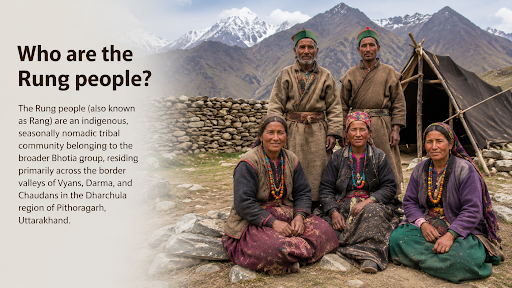
The Rung people (also known as Rang) are an indigenous, seasonally nomadic tribal community belonging to the broader Bhotia group, residing primarily across the border valleys of Vyans, Darma, and Chaudans in the Dharchula region of Pithoragarh, Uttarakhand.
Om Parvat is deeply sacred because its natural snow deposition pattern spontaneously forms the sacred Hindu 'Om' (ॐ) symbol, serving as a revered, unaltered natural manifestation of Lord Shiva for both mainstream pilgrims and local tribal nature worshippers.
The Rung community opposed the installation because they are devout nature worshippers who strictly reject artificial or man-made religious structures on their sacred land, leading them to block a trust's unauthorized attempt to install a three-ton concrete Shivling and Nandi idol in front of the mountain.
The Constitution of India protects tribal communities through Article 342 (Scheduled Tribe notification), Article 46 (safeguarding educational and economic interests), and Fifth and Sixth Schedule frameworks that guarantee autonomous administrative control over their traditional lands and customary practices.


© 2026 iasgyan. All right reserved