The National Intelligence Grid, created after 26/11 to break agency silos, integrates data from 21 sources for counter-terrorism. Its linkage with the National Population Register raises privacy concerns. A strong legal framework, independent oversight, and privacy-by-design safeguards are vital to balance security with fundamental rights.

Copyright infringement not intended
Picture Courtesy: THE HINDU
Government has integrated the National Intelligence Grid (NATGRID) with the National Population Register (NPR), allowing security and intelligence agencies to access family-wise details for around 1.19 billion residents.
It is a powerful, technology-driven intelligence gathering and sharing mechanism established, under the Ministry of Home Affairs, after the 26/11 Mumbai terrorist attacks in 2008 to address gaps in inter-agency information exchange.
It is not a new intelligence agency; it functions as a secure, integrated platform that provides authorized law enforcement and intelligence agencies with real-time access to a vast array of citizen data.
NATGRID utilizes a federated database architecture to connect the query with the databases of 21 government departments and private providers, allowing authorized users a complete suspect profile without centralized data storage.
This tool is restricted to 11 central security and law enforcement agencies, recently expanded usage now granted to state police forces for officers of SP rank and above.
|
Authorized User Agencies |
Key Data Sources Integrated |
|
|
NATGRID has been enhanced by its integration with two databases:
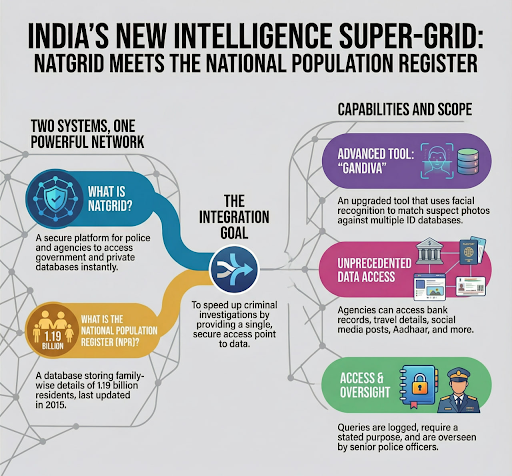
The integration of identity and transactional data in NATGRID enhances counter-terrorism by enabling advanced analytical techniques like predictive profiling and continuous monitoring, but also raises surveillance and privacy concerns.
The Puttaswamy Judgment (2017)
The Supreme Court, in K.S. Puttaswamy v. Union of India (2017), affirmed the Right to Privacy as a fundamental right under Article 21. Any state action infringing on this right must satisfy a crucial three-fold test.
Critics argue that NATGRID, in its current form, may not fully satisfy the "legality" test.
Governance and Oversight Gaps
NATGRID lacks robust, independent oversight, resulting in governance gaps due to executive-driven decision-making and operations.
Democracies like the UK often need judicial warrants for intelligence data access, guaranteeing judicial review. US post-9/11 intelligence reforms also established oversight to balance security and civil liberties.
Enact a Dedicated Statute: A specific NATGRID Act should be passed by Parliament to provide it with a clear legal mandate, defining its scope, powers, purpose limitations, and data retention policies.
Establish Independent Oversight: An independent oversight body, with judicial representation, should be created to audit NATGRID's operations, investigate misuse, and ensure compliance with the law.
Embed Privacy-by-Design: Technological safeguards like role-based access, data minimization (accessing only necessary information), and robust, unalterable access logs must be embedded into its core architecture.
Create Grievance Redressal Mechanisms: Citizens must have a clear and accessible mechanism to seek redress in cases of data misuse or wrongful profiling.
The success of NATGRID depends on balancing its power to provide timely intelligence for national security with the need for responsible governance and accountability to protect citizens' constitutional rights.
Source: THE HINDU
|
PRACTICE QUESTION Q. Critically analyze the role of the National Intelligence Grid (NATGRID) in strengthening India's internal security architecture. 150 words |
NATGRID, or the National Intelligence Grid, is an integrated technology platform designed to connect the databases of various government departments and private entities. Its purpose is to provide security and intelligence agencies with real-time, actionable intelligence to counter terrorism and crime.
NATGRID was conceptualized in the aftermath of the 26/11 Mumbai terror attacks in 2008. The attacks exposed major gaps in information sharing between different security agencies. The primary goal of NATGRID is to break these "information silos" and allow agencies to "connect the dots" from scattered data points to prevent future attacks.
NATGRID itself does not store any data. It acts as a secure IT platform that links disparate databases from 21 provider organizations (like banks, telecom companies, immigration, etc.). It provides a unified interface for law enforcement agencies to access this information.







© 2025 iasgyan. All right reserved