Despite the PC-PNDT Act, illegal sex determination has moved online, using encrypted apps, social media, and cross-border blood testing. This digital shift risks reversing SRB gains and sustaining son preference. Effective response needs cyber policing, intermediary accountability, global cooperation, and sustained social change nationwide campaigns.

Copyright infringement not intended
Picture Courtesy: THE HINDU
The issue of "unwanted daughters" due to sex selection is evolving, with the illegal practice increasingly moving to online platforms, complicating enforcement efforts for Indian agencies.
"Unwanted daughter" is a term used to describe a female child who is born into a family that either did not desire a child at that time or preferred a son due to socio-cultural biases.
Preference for sons, once practiced in clinics, has moved online, creating a new, anonymous threat to the nation's demographics as demand for sex selection grows on the internet.
Evolving Challenges
Digital Disguise: Encrypted messaging apps, social media groups, and online forums are used to offer illegal sex determination services, making it difficult for law enforcement to track offenders.
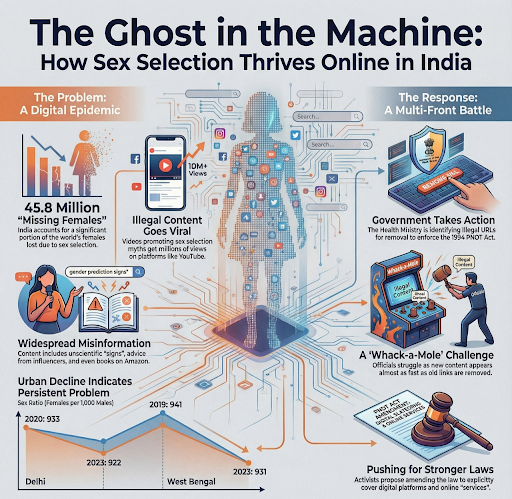
Widespread Misinformation: Unscientific content, such as videos on predicting a baby's gender based on myths, receives millions of views. The content normalizes the criminal mindset of son preference.
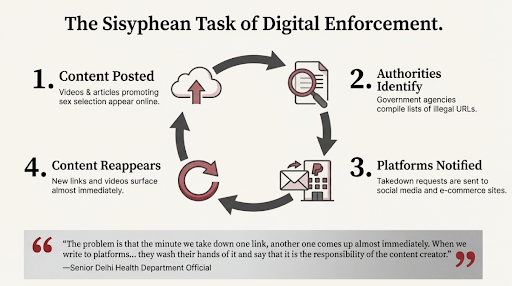
Evasion of Law: Content creators and tech platforms frequently avoid responsibility. The removal of one illegal link or video is quickly followed by the emergence of many others, complicating enforcement efforts.
Son preference causes a demographic imbalance
"Missing Females": An estimated 45.8 million females were 'missing' in India over the past 50 years due to pre- and post-natal sex selection. (Source: UNFPA)
National Sex Ratio at Birth (SRB): According to the National Family Health Survey (NFHS) conducted in 2019-20, the sex ratio at birth has improved from 919 females per 1,000 males in 2015-16 to 929 females per 1,000 males in 2019-20.
The Pre-Conception and Pre-Natal Diagnostic Techniques (Prohibition of Sex Selection) Act, 1994, aims to combat female foeticide. Its key provisions are:
The Supreme Court in the Dr. Sabu Mathew George vs Union of India (2017) case, issued directives to curb online advertisements for sex determination.
Deep-Rooted Socio-Cultural Factors: Laws alone have not been enough to overcome deeply ingrained patriarchal norms that fuel son preference. Key reasons include:
Implementation and Technological Challenges
The government has adopted a multi-faceted approach focusing on both enforcement and behavioural change.
Tackling online sex selection requires a comprehensive strategy that combines legal, technological, and social interventions.
To eradicate the discriminatory practice of illegal sex selection from both the real and virtual worlds, India needs a comprehensive strategy that includes legislative updates, technological vigilance, sustained social campaigns, and a deep commitment to women's empowerment.
Source: THEHINDU
|
PRACTICE QUESTION Q. "While legal frameworks are essential, the deep-rooted socio-cultural issue of son preference cannot be addressed by law alone." Critically analyze. 250 Words |
The Pre-Conception and Pre-Natal Diagnostic Techniques (PC-PNDT) Act, 1994, is the primary Indian law aimed at combating female foeticide. Its main purpose is to ban sex selection before or after conception and to regulate the use of prenatal diagnostic techniques to prevent their misuse for sex determination.
They use coded advertisements on social media to attract clients. Communication happens via encrypted apps like WhatsApp. Agents arrange for a blood sample to be collected from the pregnant woman, which is then couriered to labs. Results are communicated back using codes after online payment.
The main challenges are jurisdictional complexity (offenders, clients, and labs in different countries), the anonymity provided by encryption and VPNs, slow cooperation from social media platforms in removing content, and the persistent, deep-rooted societal preference for sons.





© 2026 iasgyan. All right reserved