The new Chief Information Commissioner assumes office amid rising RTI challenges, including huge pendency, vacancies and reduced autonomy after the 2019 amendment. The DPDP Act, 2023 further weakens transparency through broad personal data exemptions, making harmonisation, timely appointments and administrative reforms essential to revive India’s RTI regime.

Copyright infringement not intended
Picture Courtesy: THE HINDU
Shri Raj Kumar Goyal was sworn in as the new Chief Information Commissioner (CIC) of India.
|
Read all about: Status of CIC and ICs in India l Central Information Commission (CIC) |
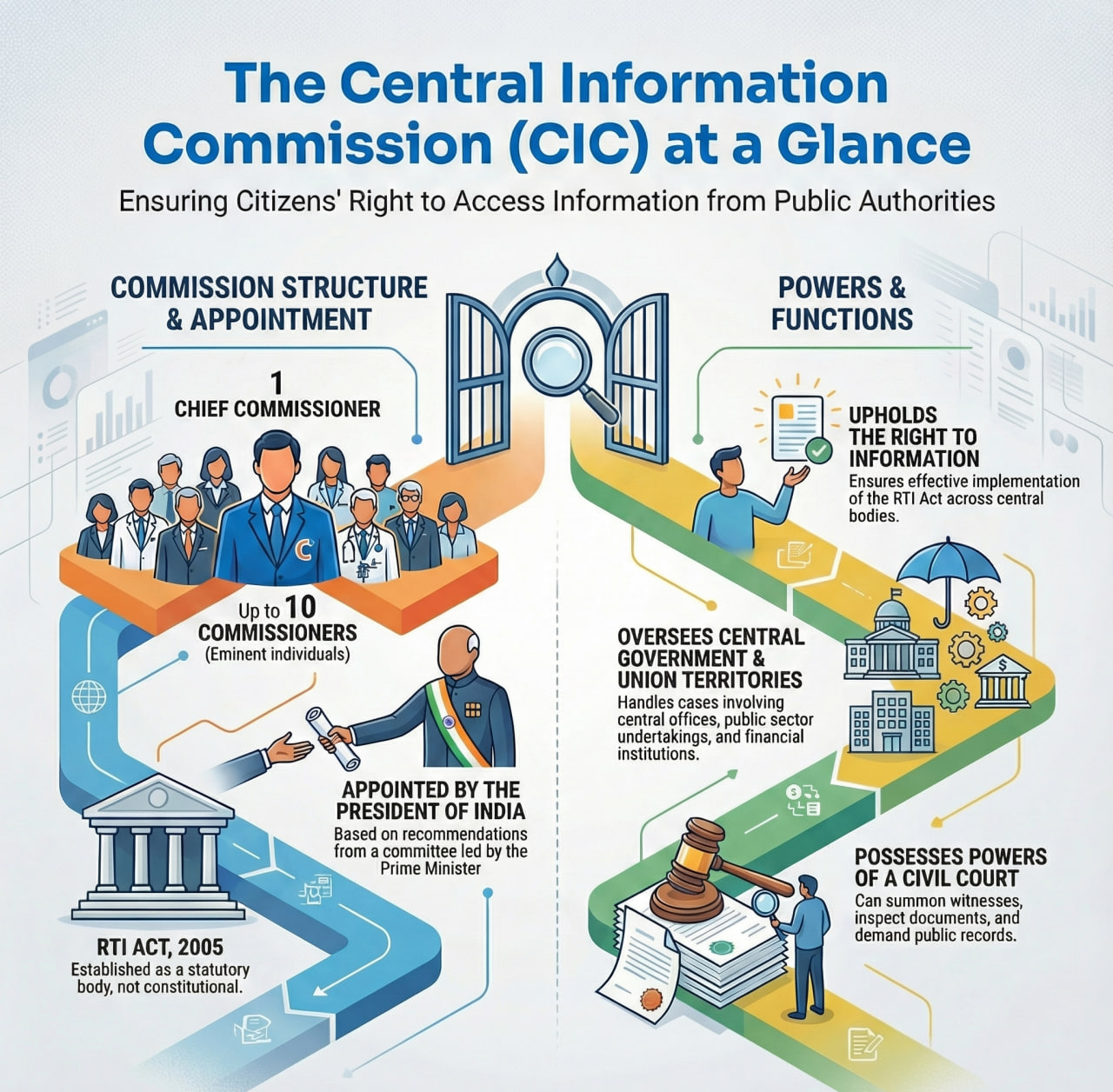
It was established by the Central Government as a statutory body under the Right to Information (RTI) Act, 2005.
It acts as the final appellate authority for citizens who have been denied access to information by a public authority under the Central Government or Union Territories.
Its jurisdiction extends over all Central Public Authorities. Its headquarters is located in New Delhi.
Structure of the Commission
The Commission is headed by a Chief Information Commissioner (CIC).
CIC is assisted by a maximum of ten Information Commissioners (ICs).
Appointment Process
The Chief Information Commissioner and Information Commissioners are appointed by the President of India.
The appointment is made based on the recommendation of a high-powered selection committee, which includes:
Eligibility Criteria
They must be persons of eminence in public life with extensive knowledge and experience in fields like law, science and technology, social service, management, journalism, mass media, or administration and governance.
They cannot be a Member of Parliament (MP) or a Member of the Legislature (MLA/MLC) of any State or Union Territory.
They are barred from holding any other office of profit, being connected to any political party, or conducting any business or profession during their tenure.
Term of Office
The RTI (Amendment) Act, 2019 altered the tenure and service conditions of the commissioners. The key changes are:
Salaries and Allowances
The 2019 amendment empowered the Central Government to determine the salaries, allowances, and other service conditions for the CIC and ICs.
Earlier the CIC's salary was equivalent to the Chief Election Commissioner.
Powers and Functions of the CIC
The CIC functions as a powerful quasi-judicial body with a wide range of powers to ensure compliance with the RTI Act. Its primary functions are detailed below.
Complaint Adjudication
Investigate and address complaints from individuals regarding denial, incomplete, false, or unreasonably priced information, or obstacles in filing an RTI request.
Appellate Jurisdiction
Acts as the second and final appellate authority for appeals against the decisions of the First Appellate Authority within a public authority.
Suo Motu Powers
The Commission can initiate an inquiry on any matter on its own (suo motu) if there are reasonable grounds to do so, without waiting for a formal complaint.
Powers of a Civil Court
During an inquiry, the CIC possesses the powers of a civil court, which include:
Penalty Imposition
Can impose penalties on the concerned Public Information Officer (PIO) for persistent delays, providing incorrect/misleading information, or malafidely denying information.
Ensuring Compliance
Can order a public authority to take specific steps to conform with the RTI Act, such as appointing a PIO, publishing information, or making changes to record management practices.
 Conclusion
The Central Information Commission is the ultimate guardian of the Right to Information, essential for transparency, accountability, and strengthening grassroots democracy.
Source: THE HINDU
|
PRACTICE QUESTION Q. Who among the following is not a part of the committee that recommends the appointment of the Chief Information Commissioner (CIC)? (a) The Prime Minister (b) The Leader of the Opposition in the Lok Sabha (c) The Chief Justice of India (d) A Union Cabinet Minister nominated by the Prime Minister Answer: C Explanation: The selection committee for the CIC consists of the Prime Minister as Chairperson, the Leader of the Opposition in the Lok Sabha, and a Union Cabinet Minister nominated by the Prime Minister. |
The Chief Information Commissioner is appointed by the President of India based on the recommendation of a committee comprising the Prime Minister (Chairperson), the Leader of the Opposition in the Lok Sabha, and a Union Cabinet Minister nominated by the Prime Minister.
The Central Information Commission (CIC) is the top appellate body for the RTI Act. Its main role is to handle appeals and complaints from citizens denied information or facing RTI issues.
The 2019 amendment empowered the Central Government to prescribe the tenure, salary, and service conditions of the Chief Information Commissioner and Information Commissioners.





© 2026 iasgyan. All right reserved