The 2025 review by the Ministry of Ayush highlights mainstreaming of traditional medicine, marked by inclusion in WHO ICD-11, infrastructure growth, and mass outreach. Rapid market expansion and global ties coexist with challenges of scientific validation, regulation, integration with modern medicine, and critical human resource gaps.
Copyright infringement not intended
Picture Courtesy: knnindia
Context
In 2025, the Ministry of Ayush strengthened India's global standing in traditional medicine through evidence-based research, global integration, digital transformation, and public health outreach, fitting Ayush systems into the Viksit Bharat@2047 vision.
Ministry of Ayush Achievements/initiatives in 2025
Global Collaboration and Diplomacy
2nd Global Summit on Traditional Medicine: India and WHO's second New Delhi summit (Dec 2025) concluded with the Delhi Declaration, establishing a global consensus to integrate evidence-based, quality, and equitable traditional medicine.
ICD-11 Update: The WHO added a module for Ayurveda, Siddha, and Unani (ASU) to the 2025 update of the International Classification of Diseases (ICD-11), thereby boosting their global credibility and integration into mainstream health systems.
WHO GCTM, Jamnagar: The WHO Global Centre for Traditional Medicine (GCTM), a global hub for research and policy, was established in Jamnagar, Gujarat, with a $250 million investment from India.
AI in Traditional Medicine: India's integration of AI with Ayush, highlighted by the Ayush Grid and the Traditional Knowledge Digital Library (TKDL), has been globally recognized by the World Health Organization (WHO) as a benchmark for innovation.
BIMSTEC: India has announced the establishment of a Centre of Excellence for Traditional Medicine for BIMSTEC nations to promote regional cooperation in research and capacity building.
Group of Friends of Traditional Medicine (GFTM): India plays a leading role in this Geneva-based group to advance the integration of traditional medicine into national health systems and achieve Universal Health Coverage.
Policy, Digital Transformation, and Innovation
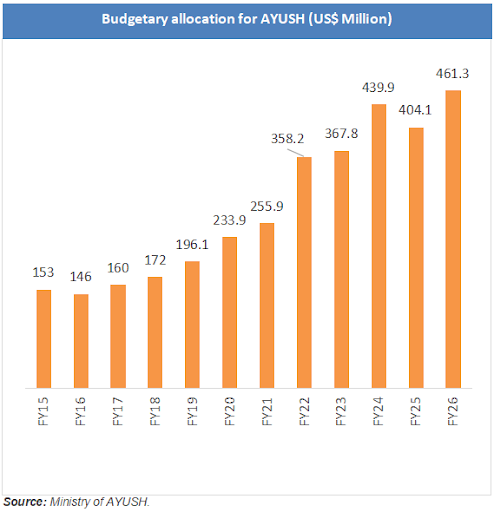
Ayush Market Growth: Indian Ayush market was valued at over $43.3 billion in 2022 and is projected to reach $200 billion by 2030, reflecting its increasing economic significance (Source: IBEF).
Ayush Mark: Launched as a global benchmark for quality and authenticity of Ayush products and services, enhancing their credibility and acceptance worldwide.
Ayush Nivesh Saarthi Portal: Unified portal (developed with Invest India) facilitates global/domestic investment in the Ayush sector by offering information on policies, incentives, and projects.
My Ayush Integrated Services Portal (MAISP): Launched as the master digital platform under the Ayush Grid, integrating all Ayush services for seamless access.
DRAVYA Portal: A new portal dedicated to medicinal plants, likely focusing on database management, conservation, and supply chain.
Major Public Health and Outreach Initiatives
International Day of Yoga (IDY) 2025
The theme for the 11th International Day of Yoga (IDY) in 2025, celebrated on June 21st, was "Yoga for One Earth, One Health" The 100-day countdown was launched with the 'Yoga Mahotsav 2025' event in New Delhi.
Ayush Services at Maha Kumbh
The Ministry provided healthcare services at the Maha Kumbh in Prayagraj, benefiting over 9 lakh pilgrims.
National Days and Conferences
Infrastructure and Research Development
Source: PIB
|
PRACTICE QUESTION Q. Critically analyze the government's initiatives to integrate Ayush systems into the mainstream public health architecture. 150 words |
AYUSH stands for Ayurveda, Yoga & Naturopathy, Unani, Siddha, and Homeopathy. These are the six traditional systems of medicine recognized and promoted by the Government of India.
NAM is a Centrally Sponsored Scheme launched to improve access to AYUSH services through upgrading hospitals, strengthening educational institutions, and ensuring the quality control of drugs.
These are upgraded AYUSH dispensaries and health centers aimed at providing primary healthcare and wellness services, including yoga and herbal gardens, particularly in rural areas.




© 2026 iasgyan. All right reserved