The National Intelligence Grid operates nationwide, linking travel, financial, and telecom databases to give agencies a real-time view of suspects. It strengthens counter-terrorism and breaks intelligence silos, but raises privacy, cybersecurity, and accountability concerns due to limited legislative backing under the Puttaswamy framework today.

Copyright infringement not intended
Picture Courtesy: THE HINDU
Context
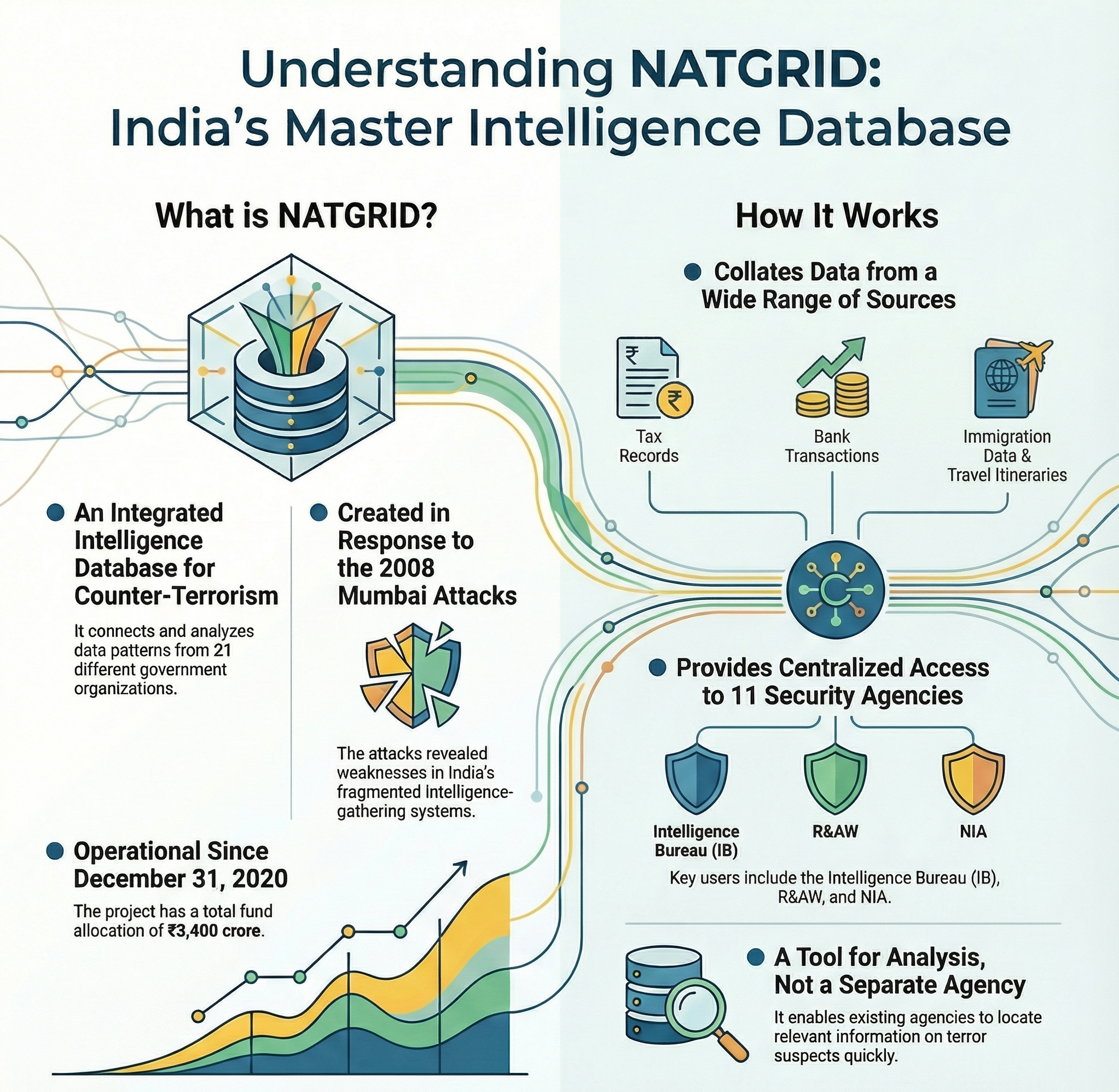
The National Intelligence Grid (NATGRID) is now fully operational and handling approximately 45,000 data requests per month.
It is an integrated intelligence database designed to enhance counter-terrorism and crime-fighting capabilities.
Conceptualized after the 26/11 Mumbai terror attacks, it connects databases of various government departments and private entities.
It allows security and intelligence agencies to access real-time information to track suspects, prevent terrorist attacks, and combat organized crime.
Core Mandate and Functioning
Information Aggregator, Not a Storage Agency: NATGRID doesn't store data directly; it's a secure portal linking databases to offer a comprehensive "360-degree profile" of a suspect.
Breaking Information Silos: It breaks down traditional information silos, allowing agencies to swiftly connect critical intelligence.
Real-time Access: It offers authorized agencies a single access point for consolidated information, vital for time-sensitive investigations and operations.
Integrated Databases and User Agencies
NATGRID links various databases to create a comprehensive profile of suspects, helping to track terror financing, cross-border infiltration, organized crime, and other illicit activities.
|
Data Providing Agencies |
User Agencies (Accessing Information) |
|
|
 NATGRID vs Other Security Databases
|
Feature |
NATGRID |
CCTNS (Crime and Criminal Tracking Network & Systems) |
NIA's Database |
|
Primary Objective |
Integrated intelligence gathering for counter-terrorism and serious crimes. |
To create a comprehensive national database of crimes and criminals for state police. |
Focused specifically on investigating and prosecuting terrorism-related cases. |
|
Data Scope |
Broad: Financial, travel, telecom, immigration, tax, etc. |
Narrow: FIRs, charge sheets, case diaries, and criminal profiles. |
Specific: Data related to terror suspects, organizations, and incidents. |
|
Nature of Agency |
Backend data integrator and facilitator. |
A Mission Mode Project to connect all police stations in India. |
A central counter-terrorism law enforcement agency with its own investigative wing. |
Reduces Investigation Time: By providing consolidated data on a single platform, it cuts down the time required for investigators to gather preliminary information.
Enhances National Security: It serves as a critical backbone for India’s counter-terrorism efforts, enabling proactive threat identification and disruption of terror financing networks.
Ensures Accountability: Robust security, including end-to-end encryption and a detailed audit trail for every query, ensures data is used only for legitimate investigations.
Data Quality & Integration: Ensuring uniform data quality and format across different ministries and departments is a technical hurdle.
State-Level Integration: While central agencies are integrated, the process of bringing state police forces into the NATGRID framework is slower and more complex.
Cybersecurity Risks: As a high-value target, NATGRID faces constant threats from state and non-state actors, requiring state-of-the-art security protocols.
Lack of Independent Oversight: There is no independent body to review NATGRID's operations, leading to concerns about accountability and potential misuse.
Provide Statutory Backing: Enacting a specific law in Parliament to define NATGRID's powers, scope, and limitations would provide it with a clear legal foundation.
Establish Independent Oversight: Establish an independent oversight body, including judicial members, to audit its operations and investigate misuse complaints.
Enhance Data Analytics Capability: Train law enforcement in responsible data analytics and AI use.
Strengthen Federal Trust: Ensure better coordination and trust between central and state agencies for seamless data sharing.
The NATGRID strengthens internal security by integrating data from various silos to help law enforcement efficiently counter modern threats such as terrorism and financial crimes.
Source: THE HINDU
|
PRACTICE QUESTION Q. Analyze how NATGRID attempts to resolve the problem of intelligence fragmentation in India. 150 words |
NATGRID is a real-time, integrated intelligence-sharing network under the Ministry of Home Affairs. It acts as a secure platform allowing authorized law enforcement and intelligence agencies to access data from various government and private databases to get a comprehensive view of a suspect.
NATGRID was conceptualized after the 26/11 Mumbai terror attacks to address the critical gaps in intelligence sharing among different agencies. The attacks highlighted how crucial information existed in isolated silos, and NATGRID was designed to connect these "dots" to prevent future attacks.
The primary concern is that aggregating vast amounts of personal data could lead to mass surveillance, infringing upon the fundamental Right to Privacy. Critics argue that its architecture for bulk data access may not meet the "proportionality" test established by the Supreme Court.

© 2026 iasgyan. All right reserved