Description
Copyright infringement not intended
Picture Courtesy: PIB
Context:
India’s highways are no longer just roads—they are becoming smart, digital corridors that connect not only cities but also data, people, and services. With over 63 lakh kilometres of roads, including 1.46 lakh km of national highways, the country is transforming its transport network with technology, efficiency, and sustainability.
Current Status:
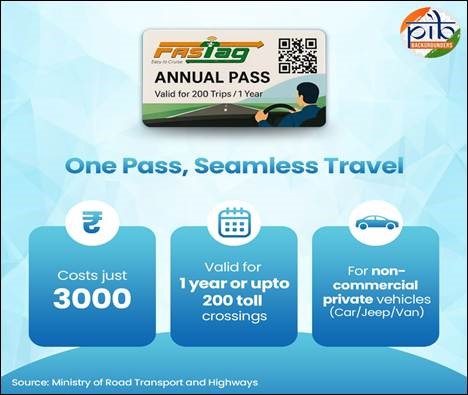
- FASTaghas revolutionized the country’s Electronic Toll Collection system with nearly 98% penetration and over 8 crore users.
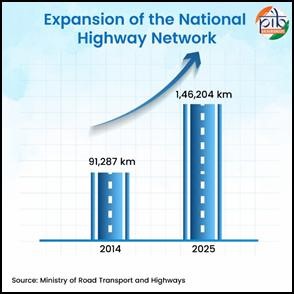
- National Highway network has grown to 1,46,204 kilometres, up from 91,287 kilometres in 2013–14, a remarkableincrease of about 60%.
- To push digital payments and reduce cash transactions at toll plazas, the government has amended the National Highways Fee Rules, 2008, under the revised rules,non-FASTag users paying tolls in cash will be charged double the standard fee.
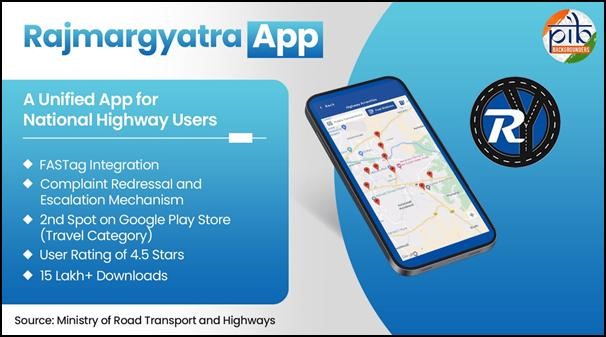
- Rajmargyatra, a citizen-centric mobile application aimed at enhancing the overall experience of commuters on national highways. Rajmargyatraserves as a digital travel companion, offering a wealth of information such as details about highways, toll plazas, nearby amenities, including petrol pumps, hospitals, EV charging stations, and even live weather updates.
Picture Courtesy: PIB
What are broader implications of India’s expanding highway network?
- Trade and Logistics Efficiency: Highways reduce travel time, logistics costs, and fuel consumption. According to NITI Aayog, improved logistics through better highways could reduce logistics costs from 14% to 8% of GDP.
- Industrial and Regional Development: Corridors like the Delhi–Mumbai Expressway and Golden Quadrilateral have spurred growth in manufacturing hubs, logistics parks, and small industries along their routes.
- Employment Generation: The highway sector supports millions of direct and indirect jobs — from construction to maintenance and roadside services.
- Case Study – Delhi–Mumbai Expressway (1,386 km): Expected to reduce travel time from 24 to 12 hours, this project connects 6 states and will spur new economic zones, saving around ₹1 lakh crore annually in logistics and fuel.
- Connectivity and Accessibility: Highways link remote regions to cities, enabling access to education, healthcare, and markets.
- Urban–Rural Integration: Rural roads under the PM Gram Sadak Yojana (PMGSY) and national highways together have improved rural incomes and migration patterns.
- Safety and Inclusivity: Smart systems like ATMS (Advanced Traffic Management System) and Rajmargyatra app improve road safety, grievance redressal, and user experience. Example: The Bengaluru–Mysuru Expressway has reduced accidents by nearly 20% after ATMS deployment, highlighting social benefits through safer mobility.
- Sustainable Construction: Use of recycled materials like fly ash, plastic, and reclaimed asphalt (over 631 lakh metric tonnes used in 2023–24) supports circular economy goals.
- Afforestation and Water Conservation: The Green Highways Mission has planted 69 crore trees, while Mission Amrit Sarovar revived 467 water bodies, reducing soil erosion and enhancing local ecology.
- Smart Tolling & Data Systems: With 98% FASTag penetration and 8 crore users, India leads in digital tolling, reducing congestion and leakages.
Picture Courtesy: PIB
What are key concerns?
- Acquiring land remains the biggest bottleneck in infrastructure projects. According to NHAI, over 70% of project delays stem from land acquisition disputes.
- Highway expansion demands massive funding. While PPP models help, private investment has slowed due to delayed returns and legal disputes. The Bharatmala Pariyojana alone requires ₹5.35 lakh crore, straining fiscal space.
- Highway expansion often cuts through forest areas, affecting biodiversity. The Char Dham Highway Project in Uttarakhand faced criticism for ecological degradation and landslides in sensitive Himalayan zones.
- Focus has largely been on construction, but maintenance funding and monitoring remain weak. Nearly 40% of India’s national highways are reported to be in need of periodic repair or resurfacing.
- Adopting systems like GIS mapping, ATMS, and MLFF tolling requires robust internet and data infrastructure, which is uneven across states. Increased digitization (e.g., FASTag, Rajmargyatra) raises concerns over data security, privacy, and system reliability.
- Lack of awareness, speeding, and inadequate enforcement limit the effectiveness of smart systems like ATMS. India records over 1.68 lakh road fatalities annually (MoRTH 2023), many occurring on national highways.
Way Forward:
- Use GIS mapping, PM Gati Shakti, and AI-based traffic forecasting for route optimization and faster approvals. Integrate highways with rail, ports, and logistics hubs to create multimodal corridors for efficient freight movement. The PM Gati Shakti National Master Plan already integrates over 550 data layers for seamless infrastructure coordination.
- Promote the Green Highways Mission by increasing tree plantation, use of recycled materials, and solar-powered lighting.
- Incorporate climate-resilient design standards to withstand floods, landslides, and extreme temperatures.
- Expand Public–Private Partnerships (PPP) and explore new models like Toll–Operate–Transfer (TOT) and Infrastructure Investment Trusts (InvITs) for long-term funding.
- Strengthen transparency and risk-sharing mechanisms to attract private investment.
- Implement Vision Zero principles — aiming for zero fatalities through better road engineering, signage, and enforcement.
- Increase deployment of Intelligent Transport Systems (ITS), ATMS, and real-time monitoring for traffic management.
- Ensure fair land acquisition and effective rehabilitation under transparent frameworks.
- Involve local communities and Panchayats in highway maintenance, plantation drives, and monitoring.
- Expand the use of Rajmargyatra and NHAI One apps for citizen feedback, complaint redressal, and field management.
Conclusion:
India’s expanding highway network is more than a transport project—it is a driver of economic growth, social inclusion, and technological advancement. However, to make this transformation sustainable, focus must shift from mere construction to smart planning, safety, green practices, and community participation. By integrating technology with sustainability, India can ensure that every highway becomes a pathway to progress, connectivity, and national development.
Source: PIB
|
Practice Question
Q. India’s expanding highway network is transforming the nation’s connectivity landscape. Discuss the multidimensional implications of this transformation and highlight the key challenges in ensuring sustainable highway development. (250 words)
|
Frequently Asked Questions (FAQs)
The primary goal is to create safe, smart, and sustainable highways that enhance mobility, reduce travel time, support logistics, and drive economic growth through digital integration and green infrastructure.
FASTag is a Radio Frequency Identification (RFID)-based electronic toll collection system that allows automatic payment without stopping at toll plazas. With 98% penetration and over 8 crore users, it has reduced congestion, fuel use, and cash handling at toll booths.
Rajmargyatra is a citizen-friendly mobile app launched by NHAI that provides real-time information about highways, tolls, amenities, and traffic. It also enables users to report complaints like potholes or maintenance issues with geo-tagged photos.