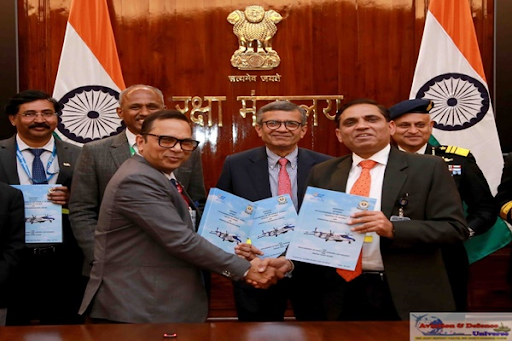
The Defence Acquisition Council chaired by the Defence Minister. It approves major military purchases, promotes indigenisation under Make in India, and streamlines acquisition processes to strengthen national security, transparency, and modernization of the armed forces.
Copyright infringement not intended
Picture Courtesy: NEWSONAIR
Context
The Defence Acquisition Council (DAC) cleared proposals worth ₹3.60 lakh crore, including the acquisition of 114 Rafale fighter jets for the IAF and six P-8I aircraft for the Navy.
What is Defence Acquisition Council (DAC)?
It is the highest decision-making body in the Ministry of Defence for all matters related to defence procurement.
It was formed in 2001, based on recommendations from the Kargil Review Committee and the Group of Ministers (GoM), to fix defense procurement delays exposed during the Kargil War.
It is chaired by the Union Minister of Defence and includes top officials from the Ministry of Defence and the armed forces, ensuring integrated decision-making.
Core Mandate: Ensure the timely procurement of military equipment for the armed forces while promoting transparency, accountability, and self-reliance in the defence sector.
Key Functions and Powers
Acceptance of Necessity (AoN)
The DAC grants the 'Acceptance of Necessity' (AoN) for capital acquisitions, which is the first step in the procurement process, formally accepting the need for equipment.
Policy Formulation
It approves the guiding policy document for all defence acquisitions, the Defence Acquisition Procedure (DAP). The latest version is DAP-2020.
Categorisation
The DAC decides the procurement category, such as 'Buy (Indian-IDDM)', 'Make-I', 'Make-II', or 'Buy (Global)', prioritising indigenous manufacturing.
Long-Term Planning
It approves the Long-Term Integrated Perspective Plan (LTIPP) for the armed forces, which outlines capability requirements over a 15-year period.
Defence Acquisition Procedure (DAP) 2020
Promoting Indigenisation
Introduced specific, highest-priority procurement categories, such as Buy (Indian-IDDM), which signifies Indigenously Designed, Developed, and Manufactured.
Positive Indigenisation Lists
The government, guided by DAC, has issued 'Positive Indigenisation Lists' (formerly 'Negative Import Lists') which ban the import of specified items, requiring domestic sourcing.
Ease of Doing Business
The aim is to simplify procedures, reduce timelines, and promote private sector participation, including MSMEs and start-ups, via initiatives like Innovations for Defence Excellence (iDEX).
New Acquisition Categories
It introduced concepts like Leasing for short-term equipment acquisition without ownership, and Buy (Global – Manufacture in India) to encourage foreign OEMs to establish manufacturing in India.
Challenges Faced by DAC
Bureaucratic Delays
The long acquisition cycle, often taking years from AoN to contract, risks technological obsolescence before induction, despite reforms.
R&D and Production Gap
A disconnect exists between DRDO-developed technologies and their large-scale production by Defence PSUs or private industries.
Single-Vendor Situations
Many tenders end up with a single qualified vendor, which undermines competitive pricing and transparency.
User-Industry Disconnect
The armed forces' Service Qualitative Requirements (SQRs) are sometimes seen as overly ambitious, making it difficult for domestic industry to meet the specifications.
Way Forward
Focus on Disruptive Technologies
The Council's future priorities must include creating dedicated procurement frameworks for emerging and critical technologies such as:
Strengthening the Defence Industrial Ecosystem
Boost Defence Exports: Simplifying procedures and maintaining quality, the DAC can help India shift from a defence importer to a respected exporter.
Strengthen Supply Chains: DAC policy decisions must target minimizing foreign reliance for vital components and sub-systems to enhance strategic self-reliance.
Cultivate an Innovation Ecosystem: The DAC must promote cooperation between the armed forces, DRDO, academia, and private industry (especially start-ups) to build a robust innovation framework.
Conclusion
The Defence Acquisition Council (DAC) driving strategic autonomy, indigenisation, and military modernization. To enhance its effectiveness in developing military capabilities, the DAC must resolve procedural delays and quickly adapt to rapid technological advancements.
Source: NEWSONAIR
|
PRACTICE QUESTION Q. With reference to the Defence Acquisition Council (DAC), consider the following statements: 1. It is chaired by the Prime Minister of India. 2. It is the highest decision-making body in the Ministry of Defence regarding new policies and capital acquisition. 3. The Chief of Defence Staff (CDS) is a member of the DAC. Which of the statements given above is/are correct? A) 1 and 2 only B) 2 and 3 only C) 1 and 3 only D) 1, 2, and 3 Answer: B Explanation: Statement 1 is incorrect: The DAC is chaired by the Union Minister of Defence, not the Prime Minister. The Prime Minister chairs the Cabinet Committee on Security (CCS), which is a separate higher-level body. Statement 2 is correct: The Defence Acquisition Council (DAC) is the apex decision-making body in the Ministry of Defence. Its primary mandate is to decide on new policies and capital acquisitions for the Indian Army, Navy, Air Force, and the Indian Coast Guard. Statement 3 is correct: The Chief of Defence Staff (CDS) is a permanent member of the DAC. Other members include the Chiefs of the three Services (Army, Navy, and Air Force) and the Defence Secretary. |
The Defence Acquisition Council is chaired by the Defence Minister.
The DAC was created in 2001 following the recommendations of the Group of Ministers on National Security post-Kargil War. Its purpose was to address the lack of an integrated decision-making structure and reduce delays in procuring vital military equipment.
These are lists notified by the Ministry of Defence comprising items (like weapon systems and sensors) that are banned for import after specific timelines. These items must be sourced from the Indian domestic industry to boost self-reliance.

© 2026 iasgyan. All right reserved