India’s rising female LFPR masks a leadership deficit caused by the motherhood penalty and tokenism. To unlock economic growth, India must decouple the Women’s Reservation Act from delimitation, expand manufacturing, and mandate critical board representation, ensuring authentic empowerment beyond participation.
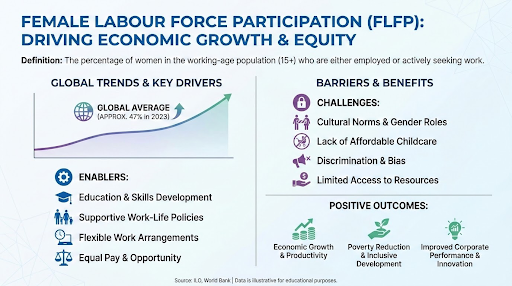
The female Labour Force Participation Rate (LFPR) has risen from 33.9% in 2022 to 40% in 2025, driven primarily by rural employment.
It is defined as the percentage of women within the working-age population ( 15 years and older) who are either currently employed or are unemployed but actively seeking work.
Components: It includes both the employed (those doing any work for pay or profit) and the unemployed (those available for and seeking work).
Significance: It serves as a primary indicator of women’s economic empowerment and their integration into the formal and informal economy.
Overall Participation Rates: The FLFPR rose to 40% in 2025, marking a significant increase from 33.9% in 2022.
Geographic Breakdown: The rise in participation is largely driven by rural women, engaged in agriculture and self-employment.
Representation in Leadership: Despite the rise in general participation, women's presence in high-level decision-making roles is still limited.
Dominance of Self-Employment: Approximately 64.2% of working women are self-employed, with many acting as unpaid helpers in family-run enterprises.
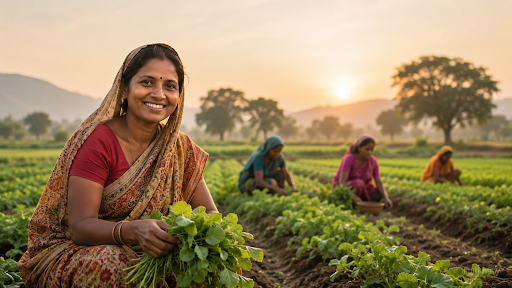
Sectoral Concentration in Agriculture: Agriculture remains the largest employer of women, with roughly 76.7% of rural working women engaged in this sector.
Informality of Work: Over 90% of the female workforce is engaged in the informal sector, which lacks legal protections and social security benefits.
The "U-Shaped" Curve: Participation is highest among women with no formal education (who work out of economic necessity) and those with very high education, while those with middle-level schooling often remain outside the workforce.
Low Occupational Diversity: Most women are concentrated in "feminised" sectors such as primary education, healthcare (nursing/ASHA workers), and textiles.
The Burden of Unpaid Care Work
Social Norms and the "Marriage Penalty"
Safety and Mobility Issues
Lack of Labour-Intensive Manufacturing
Gender Wage Gap
Inadequate Workplace Infrastructure
GDP Loss: India's GDP could be 27% higher if women’s participation in the labour force was equal to that of men. (Source: International Monetary Fund)
Slower Transition to Developed Economy: For India to reach "Developed Country" status by 2047, it needs an annual growth rate of 8%, which is unattainable if half the population remains economically inactive. (Source: World Bank)
Increased Poverty Vulnerability: Households with only one male earner are more susceptible to falling into poverty during economic shocks or health crises compared to dual-income households.
Lower Human Capital Investment: Higher female income is directly linked to better nutrition, health, and education outcomes for children, meaning low FLFP stunts the quality of the future workforce.
Reduced Bargaining Power: Lack of independent income limits a woman's "agency" or decision-making power within the family, leading to poorer health outcomes for women.
Legislative & Policy Reforms
Maternity Benefit (Amendment) Act, 2017: Increased paid maternity leave from 12 weeks to 26 weeks and mandated creche facilities for establishments with 50+ employees.
Code on Wages, 2019: Prohibits gender discrimination in wages and recruitment for the same or similar work.
Women’s Reservation Act (Nari Shakti Vandan Adhiniyam): Provides 33% reservation for women in the Lok Sabha and State Assemblies to enhance gender-sensitive policymaking.
Skill Development & Entrepreneurship
Pradhan Mantri Mudra Yojana (PMMY): Approximately 68% of all loan accounts under this scheme belong to women entrepreneurs. (Source: PIB)
Stand-Up India Scheme: Specifically targets women and SC/ST entrepreneurs, providing loans between ₹10 lakh and ₹1 crore for greenfield enterprises.
National Skill Development Mission: Targets training women in "non-traditional" roles like electronics, logistics, and manufacturing.
Support Infrastructure & Safety
Mission Shakti: An integrated women empowerment programme that includes 'Sambal' (for safety/security) and 'Samarthya' (for empowerment).
National Creche Scheme: Provides day-care facilities to children (6 months to 6 years) of working mothers in the community.
Working Women Hostels: Provides safe and affordable accommodation to working women in urban, semi-urban, and rural areas.
Rural Specific Measures
MGNREGA: Mandates that at least one-third of the beneficiaries shall be women; in practice, women's participation has consistently exceeded 50%. (Source: PIB)
Deendayal Antyodaya Yojana (DAY-NRLM): Organises rural women into Self-Help Groups (SHGs) to provide micro-finance and livelihood support.
Investment in the "Care Economy": Public investment in childcare and elderly care infrastructure (2% of GDP) could create nearly 11 million jobs, many of which would benefit women. (Source: PIB)
Promotion of Labour-Intensive Manufacturing: Shifting focus toward sectors like textiles, electronics assembly, and food processing provides entry-level formal jobs for women with moderate education.
Gender-Neutral Parental Leave: Moving from "maternity" to "parental" leave encourages men to share domestic responsibilities, reducing the "hiring bias" against women.
Enhancing Urban Mobility: Providing free or subsidised safe public transport for women (as seen in states like Delhi and Karnataka) expands their "job search radius".
Digital and Financial Literacy: Expanding the reach of PM DISHA and Mudra loans to ensure rural women can transition from "unpaid helpers" to independent entrepreneurs.
Formalisation of ASHA and Anganwadi Workers: Providing formal employee status and social security to these frontline workers would immediately improve the quality of female employment.
Conclusion
India’s female labour participation increased over 40% in 2025, yet remains low globally. Driven by rural agriculture, women still face hurdles like unpaid care work and low representation in leadership, requiring structural reforms for economic development.
Source: INDIANEXPRESS
|
PRACTICE QUESTION Q. Despite a steady rise in the Female Labour Force Participation Rate (LFPR), women remain glaringly absent from top leadership roles in India. Analyze. 150 words |
According to the 2025 Periodic Labour Force Survey (PLFS) data, India's female LFPR has risen to 40%, marking a significant improvement from 33.9% in 2022. However, it still lags behind emerging market peers like Brazil (53%) and Vietnam (69%).
Corporate tokenism refers to companies doing the bare minimum to comply with the SEBI mandate of having at least one woman on their board of directors. Around 77% of top Indian firms have only 1 to 2 female directors, failing to achieve the 30% "critical mass" needed to genuinely influence board culture and decision-making.
Indian women spend an average of 299 minutes daily on unpaid domestic care, compared to just 97 minutes by men. This disproportionate burden, known as the motherhood penalty, often forces women to drop out mid-career, stripping them of the continuous tenure required to reach senior management or legislative leadership.




© 2026 iasgyan. All right reserved