The Nari Shakti Vandan Adhiniyam marks a watershed moment by decoupling the 33% quota from the post-Act Census for the 2029 elections. Success depends on resolving delimitation friction, implementing OBC sub-quotas, and preventing proxy representation to ensure substantive political empowerment.
Why In News?
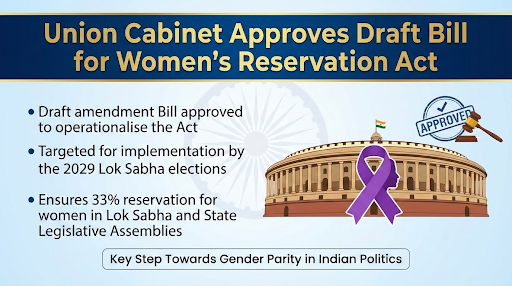
The Union Cabinet approved a draft amendment Bill to operationalise the Women’s Reservation Act by the 2029 Lok Sabha elections.
|
Read all about: WOMEN'S RESERVATION l UNION CABINET CLEARED THE WOMEN'S RESERVATION BILL |
What is the Women's Reservation Bill?
Officially titled the Constitution (106th Amendment) Act 2023, this legislation mandates that 33% (one-third) of seats in the Lok Sabha, State Legislative Assemblies, and the Delhi Legislative Assembly be reserved for women.
Key Provisions of the 2026 Amendment
Significance of the Bill
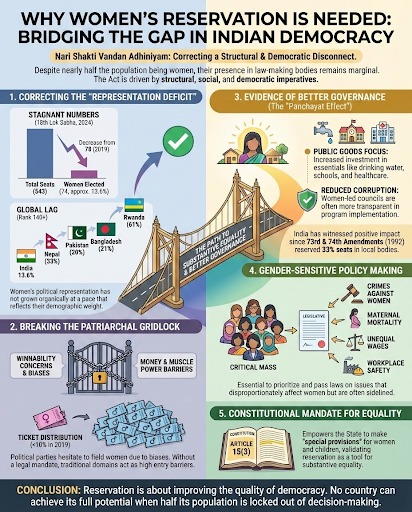
Political Empowerment: Women's Lok Sabha representation will rise from under 14% to at least 33%, strengthening their legislative influence.
Gender-Sensitive Policy: More female legislators will likely focus on neglected issues like gender violence, maternal health, and pay equity.
Breaking Barriers: Mandatory reservation overcomes structural biases and "winnability" excuses used to exclude women from politics.
Challenges in Implementing the Women's Reservation Bill
The Delimitation Dilemma & Federal Friction
North-South Divide: Increasing the Lok Sabha to 816 seats using 2011 population data alarms Southern states like Tamil Nadu and Kerala. They raised concern of losing political influence to populous Northern states despite their success in population control.
Data Validity: Conducting 2029 delimitation based on 2011 Census data is legally challenging. Critics argue this 18-year-old data fails to reflect current demographics, inviting potential Supreme Court challenges.
The "OBC Sub-Quota" Gridlock
Opposition parties demand an OBC "quota within a quota" to prevent urban, upper-caste women from monopolizing the reservation and ensuring representation for marginalized backward communities.
As the current bill limits vertical reservation to SCs and STs, this omission remains a primary source of parliamentary stalemate.
Rotation of Seats & Accountability
Rotating reserved seats after each delimitation creates structural disincentives. Incumbent MPs may neglect their constituencies if they anticipate their seat category will change, undermining long-term development.
Proxy Representation
Lack of capacity building raises concern that the "Pradhan-Pati" system—where male relatives control elected women in Panchayats—may replicate in Parliament, turning women MPs into mere rubber stamps.
Way Forward
No-Penalization
To maintain national unity, the government should legally guarantee that Southern states' seat proportion remains constant during expansion. A "Federal Balance Protection" clause could decouple political representation from raw population growth.
Consensus on Social Justice
Establishing a parliamentary committee to study OBC women's representation and providing transparent data on the caste composition of women MPs could resolve debates regarding an OBC sub-quota.
Capacity Building & Mentorship
Parties should prioritize grooming independent women leaders over mere "winnability." Essential training for first-time female MPs on parliamentary and policy procedures is vital to prevent proxy representation.
Timely Execution of Delimitation
The Delimitation Commission must be constituted immediately to ensure the complex task of redrawing 816 constituencies is completed well before the 2029 elections.
Conclusion
The Cabinet's decision to fast-track the Nari Shakti Vandan Adhiniyam for 2029 marks a transformative leap toward global gender parity, though its ultimate success depends on balancing the complexities of caste representation and federalism.
Source: THEHINDU
|
PRACTICE QUESTION Q. With reference to the Nari Shakti Vandan Adhiniyam (106th Constitutional Amendment Act), consider the following statements: 1. It provides a 33% horizontal reservation for women across all categories in the Lok Sabha. 2. The reservation includes a sunset clause making it initially valid for 15 years. Which of the statements given above is/are correct? a) 1 only b) 2 only c) Both 1 and 2 d) Neither 1 nor 2 Answer: b Explanation: Statement 1 is incorrect: While the Act provides for a 33% reservation for women in the Lok Sabha, state legislative assemblies, and the Delhi Assembly, it is not "across all categories" in the sense of including a separate quota for OBC women. Statement 2 is correct: The Act includes a "sunset clause" (inserted via Article 334A), which mandates that the reservation will initially remain in force for a period of 15 years from the date of its commencement. |
The Nari Shakti Vandan Adhiniyam, officially known as the 106th Constitutional Amendment Act, is a landmark legislation that mandates a 33% reservation for women in the Lok Sabha, State Legislative Assemblies, and the National Capital Territory of Delhi.
The Union Cabinet recently approved a draft amendment to operationalize the quota in time for the 2029 Lok Sabha elections. This significantly advances the timeline from the previously expected 2034 rollout by relying on 2011 Census data.
This refers to a situation where elected female representatives act merely as rubber stamps, while their husbands or male relatives wield the actual decision-making power. It is a challenge commonly seen in local Panchayati Raj Institutions. Without proper capacity building and training, experts fear this proxy culture could replicate in the Parliament.


© 2026 iasgyan. All right reserved