

The Lok Sabha defeated the Constitution (131st Amendment) Bill, 2026, which sought to increase parliamentary seats to 850 and expedite women's reservation, due to a lack of the required two-thirds special majority.
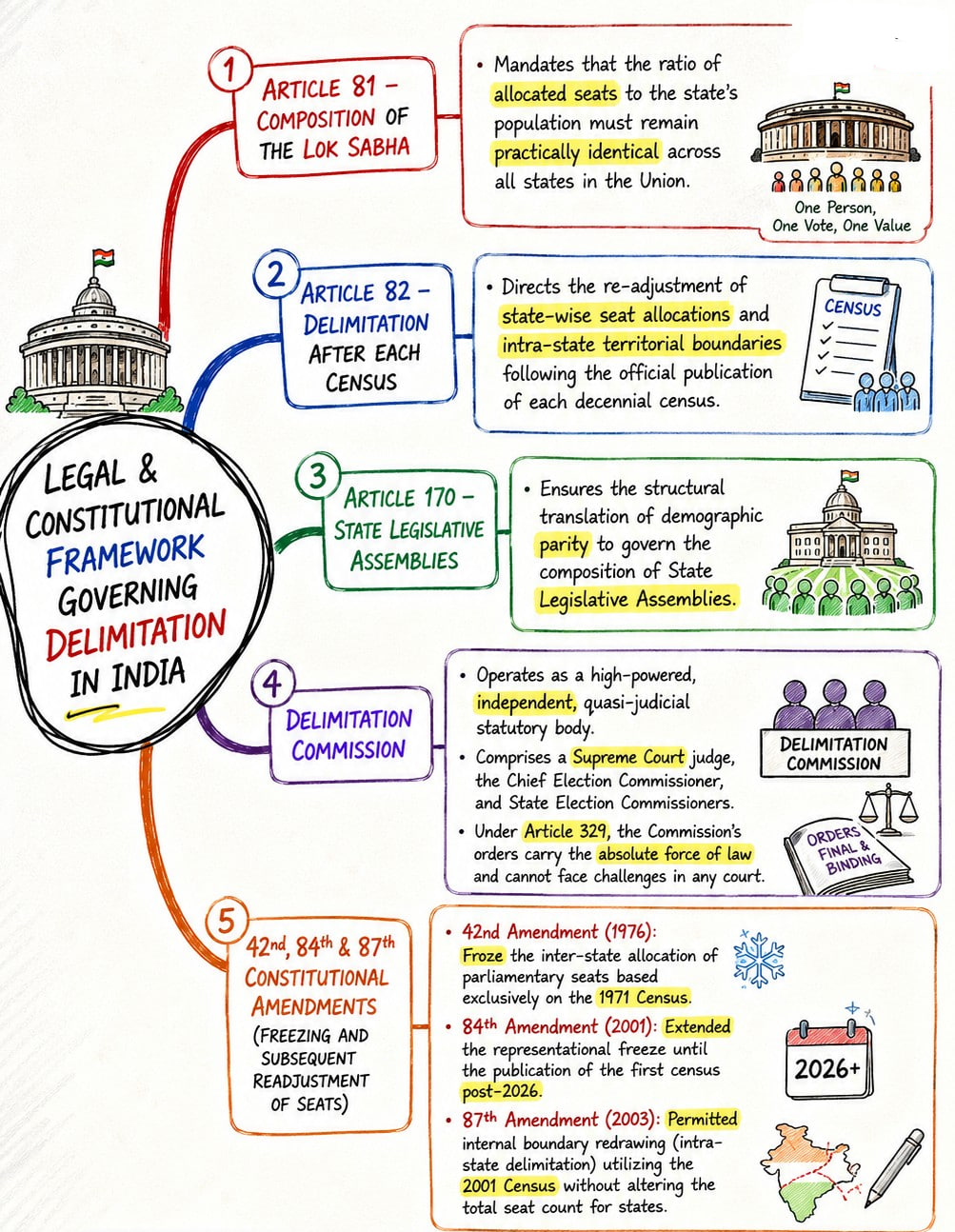
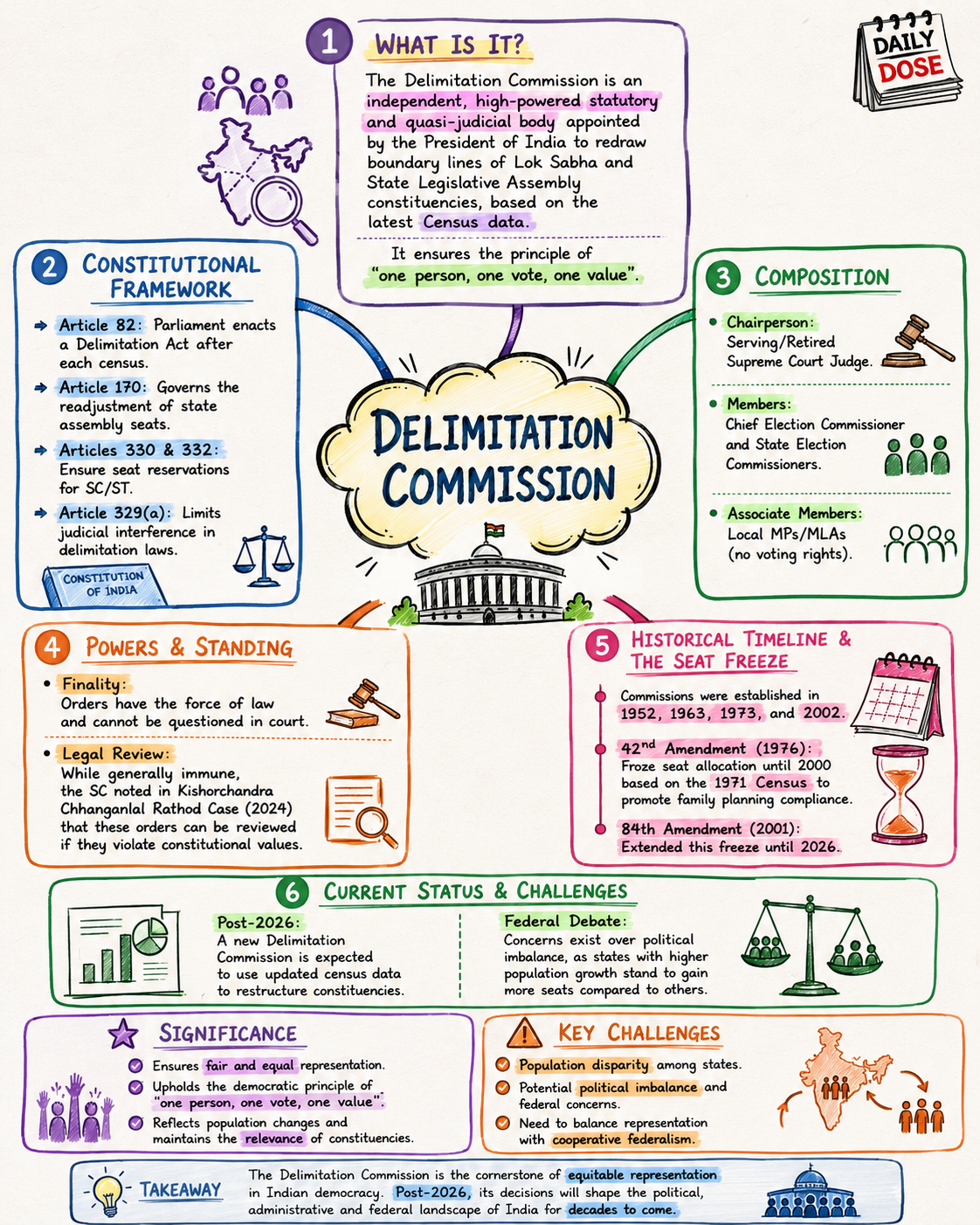
Delimitation is the precise and methodical process of redrawing boundaries of territorial constituencies to ensure that population changes accurately reflect in electoral representation.
 Why is Delimitation Necessary?
Upholds the Principle of "One Person, One Vote"
Delimitation operationalizes democratic equality by translating the "one person, one vote" ideal into "one vote, one value", ensuring absolute equal weightage for every citizen's franchise nationwide.
Reflects Demographic Changes
India's population increased from 548 million in 1971 to 1.21 billion in 2011. Periodic delimitation realigns political maps with these immense shifts to prevent vote dilution.
Strengthens Representative Democracy
Optimal demarcation strikes a harmonious balance among equal voting rights, safeguards community representation, and guarantees an equitable ratio of parliamentary seats to population across the nation.
Core Issue is the Total Size of the Lok Sabha
Experts argue the debate incorrectly fixates on which census year to apply, while it should address whether raw population alone must remain the sole determinant of representation.
India Has One of the Highest Population-to-MP Ratios
The average Lok Sabha MP currently represents 2.7 million people, compared to just 780,000 in the United States.
Expanding Parliament Could Reduce Distributional Conflict
Calculations reveal that expanding the Lok Sabha to 775 or 850 seats ensures underrepresented populous states gain seats without forcing demographically stable states to surrender their existing absolute seat count.
Population Growth Differences Among States
A massive demographic divergence exists; Bihar's population grew by roughly 215% since 1971, while Kerala's population expanded by a mere 70%.
Federal Balance Concerns
Southern states successfully implemented national family planning policies and now face a "demographic penalty".
Reapportionment strictly by population shifts an estimated 24 to 26 seats away from Southern states and transfers them directly to Northern states like Uttar Pradesh and Bihar.
Fiscal and Political Implications
A dual asymmetry persists: Southern states like Tamil Nadu and Karnataka contribute approximately 20% to 30% of the national tax revenues and GDP, but face diminishing political voice.
Conversely, populous Northern states receive extensive fiscal devolution while consolidating legislative hegemony.
 What are the Major Challenges in the Current Delimitation Debate?
Balancing Equality of Vote with Federal Equity
The crisis requires reconciling the democratic doctrine of absolute electoral equality with the constitutional imperative of cooperative federalism.
Regional Political Sensitivities
Opposition groups highlight the existential threat to Southern and North-Eastern states, fostering deep political mistrust regarding majoritarian domination by Hindi-heartland states.
Representation of Rapidly Urbanising Areas
Unprecedented internal migration demands intra-state boundary adjustments; for example, the Malkajgiri constituency (Telangana) holds 3.7 million electors, surpassing the smallest constituency, Lakshadweep, which has a mere 57,000 electors.
Infrastructure Requirements for a Larger Parliament
Expanding the Lok Sabha to 850 members creates an unwieldy and unworkable legislative chamber, demanding twice the time for Question Hour and risking the silencing of individual MPs.
Building Political Consensus Across States
The legislative defeat of the 131st Amendment signifies a state of "functional unamendability"; structural reform requires cross-regional negotiation rather than unilateral top-down mandates.
Increase the Overall Strength of the Lok Sabha
Adopt a "moderated expansion" strategy to guarantee that no state loses its existing representation while high-growth states gain proportional seats.
Preserve Cooperative Federalism
Implement the Demographic Performance (DemPer) Principle, allocating extra seats to reward states that successfully dropped Total Fertility Rates (TFR) below 2.1 before 2005.
Strengthen Independent Delimitation Institutions
Enhance the operational powers of the Inter-State Council to mediate boundary disputes, and structurally empower the Delimitation Commission to conduct expansive, multi-stakeholder consultations.
Improve Representation of Urban India
Leverage advanced demographic tools to resolve severe intra-state malapportionment triggered by rapid economic migration to urban hubs.
Use Updated Demographic and Geographic Data
Execute delimitation transparently based on the upcoming Census instead of the obsolete 1971 demographic figures, instituting constitutional provisions for periodic 15-year reassessments.
Delimitation must move beyond simple demographic counting to achieve a constitutional settlement that ensures democratic equality while preserving and strengthening India's cooperative federalism.
Source: INDIANEXPRESS
|
PRACTICE QUESTION Q. "The challenge in India's delimitation debate is not merely the redistribution of parliamentary seats among States, but ensuring equitable democratic representation while preserving the federal balance." Critically Analyze. 250 words |
Delimitation represents the quasi-judicial process of methodically redrawing the boundaries of territorial constituencies and re-allocating legislative seats to ensure equitable representation reflecting current population changes.
Parliament enacted the 42nd (1976) and 84th (2001) Amendments to freeze inter-state seat allocations using 1971 demographic data to actively incentivize population control and guarantee that states implementing successful family planning would not suffer political disenfranchisement.
Southern states like Kerala and Tamil Nadu successfully stabilized their populations and now face the threat of losing up to 24 parliamentary seats to high-fertility Northern states (like Uttar Pradesh and Bihar), severely diminishing their political voice and federal bargaining power.
Expanding the overall capacity of the Lok Sabha (e.g., to 775 or 850 seats) guarantees that populous states capture proportional representation without forcing demographically stable states to forfeit their existing absolute number of seats, thus neutralizing the immediate threat of representational loss.
© 2026 iasgyan. All right reserved