Why In News?
Many Experts argues that the "One Nation, One Election" proposal fails to address core democratic issues, such as unchecked political spending and black money.
ONOE advocates structuring the Indian electoral cycle so that citizens vote for the Lok Sabha, State Legislative Assemblies, and local bodies simultaneously, or in a closely phased, synchronized manner,.
Background
Initial Synchrony: India successfully holds simultaneous elections during the first four general elections (1951-52, 1957, 1962, and 1967).
The Rupture: The cycle completely disrupted in 1968 and 1969 due to the premature dissolution of multiple state assemblies and the arbitrary use of Article 356 (President's Rule),.
National Decoupling: In 1970, the early dissolution of the 4th Lok Sabha permanently decoupled national and state election cycles.
Reduction in Election Expenditure
Cost Cuts: Implementing ONOE saves nearly ₹7 lakh crore of public exchequer money. (Source: Joint Parliamentary Committee)
Resource Optimization: Simultaneous elections prevent repeated logistical expenses related to ballot deployment, security, and administrative setups.
Less Frequent Enforcement of the Model Code of Conduct (MCC)
Halting Policy Paralysis: The MCC restricts governments from announcing new schemes; its frequent imposition brings development projects to a standstill for nearly 7 months in a single election year (Source: NITI Aayog).
Uninterrupted Governance: Concentrating elections to a single window guarantees governments a stable, five-year uninterrupted period to focus on developmental agendas.
Better Administrative Efficiency
Minimizing Disruption: Staggered elections repeatedly divert teachers and civil servants from their primary duties.
Manpower Optimization: Synchronization saves approximately 1.04 crore personnel-days over a five-year cycle. (Source: Economic Advisory Council)
Reduced Burden on Security Forces
Ending Endless Transit: ONOE curtails the pan-India mobilization of Central Armed Police Forces (CAPF), preventing troop fatigue and internal security vulnerabilities in sensitive border and Left Wing Extremism (LWE) zones.
Greater Policy Continuity
Investor Confidence: Predictable policy cycles, unhindered by constant electoral populism, foster a stable environment for private investments and long-term economic planning.
Improved Governance Outcomes
Macroeconomic Boost: Harmonized electoral cycles structurally increase India's GDP growth rate by up to 1.5% to 1.6%. (Source: Economic Advisory Council)
Capital Expenditure Surge: Data demonstrates that post-synchronous election episodes experience higher public spending skewed heavily toward capital asset creation rather than revenue spending.
Governance Challenges Extend Beyond Election Frequency
Black Money Menace: Official election expenditures represent less than 0.1% of the Union Budget, whereas unaccounted "black money" pumped into campaigns reaches an estimated ₹1.35 lakh crore during the 2024 elections. (Source: Centre for Media Studies)
Concentrating Corruption: Critics argue that ONOE fails to cure illicit financing and instead concentrates the demand for political cash into a massive, singular national wave of corruption.
Concerns Regarding Federalism
Unitary Overreach: The proposal imposes a uniform national timeline on state legislatures, encroaching upon the electoral sovereignty and constitutional autonomy of states.
Creating a Master Cleavage: By merging state and national polls, ONOE risks homogenizing diverse political identities into a singular national narrative, thereby destroying the "holding together" model of cooperative federalism.
Reduced Democratic Accountability
Diminished Feedback Loops: Staggered elections act as a democratic safety valve, forcing political leaders to continuously remain accountable to voters
Quasi-Fixed Tenures: Guaranteeing governments a fixed term undermines the core principle of collective responsibility and parliamentary accountability.
National Issues May Overshadow Regional Concerns
The Coattail Effect: IDFC Institute studies show a 77% probability that Indian voters choose the same political party for both the Centre and the State when elections run simultaneously.
Marginalization of Local Narratives: Regional crises, localized agrarian distress, and linguistic identity issues risk being completely drowned out by high-profile national themes.
Constitutional and Logistical Complexities
Procurement Surge: Executing simultaneous polls requires 46.75 lakh Ballot Units, 33.63 lakh Control Units, and 36.62 lakh VVPATs. (Source: Election Commission of India)
Capital Cost: The Election Commission estimates a requirement of ₹10,000 crore every 15 years solely for procuring new EVMs.
Federal Structure of the Constitution
Basic Structure Doctrine: In the S.R. Bommai case (1994), the Supreme Court established federalism as part of the Constitution's unamendable basic structure.
Encroaching State Sovereignty: Synchronizing elections mandates the artificial curtailment or extension of active state assembly terms, which violates the autonomy of the federal units.
Fixed and Variable Legislative Terms
The 'Unexpired Term' Rule: The 129th Amendment Bill proposes that any state assembly constituted after a premature dissolution will only serve the remainder of the synchronized five-year cycle, rather than enjoying a fresh full term.
Truncated Mandates: This creates short-lived "lame duck" governments that possess democratic legitimacy but lack the operational runway to execute long-term structural reforms.
President's Rule and Mid-Term Dissolutions
Constitutional Ambiguity: If a government falls mid-term and mid-term polls are not feasible, the state might face extended periods of Article 356 (President's Rule),.
Executive Aggrandizement: Prolonged President's Rule transfers direct control of state machinery to the Central government, undermining regional representation.
Role of the Election Commission of India
Declining Institutional Integrity: Critics highlight the diminishing independence of the ECI; the recent legislative reversal of the Anoop Baranwal judgment (removing the Chief Justice of India from the ECI selection panel) exacerbates bias concerns.
A Single Point of Failure: Under ONOE, if the ECI mismanages the synchronized election, the democratic mandate completely fails nationwide without any localized corrective mechanism for five years.
Constitutional Amendment Requirements
Article 368 Ambiguity: While the Kovind Committee asserts that aligning Lok Sabha and State Assemblies requires only a parliamentary majority, legal experts maintain that altering state tenures directly impacts the federal division of powers, necessitating ratification by at least half of the State Legislatures.
Parliamentary and State Legislative Autonomy
Overriding Articles 83 and 172: The proposed amendments conflict with the original constitutional design, which permits early dissolution to renew the democratic mandate when political confidence collapses.
Strengthening Electoral Roll Management
Unified Voter Base: Implement Article 324A to empower the ECI to prepare a Single Electoral Roll and Single EPIC across all three government tiers, instantly eliminating duplicate administrative efforts.
Reforming Campaign Finance
State Funding of Elections: Adopt the recommendations of the Indrajit Gupta Committee to establish state funding for recognized political parties, ensuring a level playing field and directly curbing illicit black money.
Strict Expenditure Caps: Enforce rigid spending limits not just on individual candidates, but explicitly on total political party expenditure during campaigns.
Enhancing Internal Party Democracy
Decriminalization: Fast-track the judicial process for disqualifying candidates with criminal backgrounds to elevate the overall integrity of the electoral process.
Improving Legislative Productivity
Constructive Vote of No Confidence (CVNC): Adopt the German Grundgesetz model where a legislature can only remove the incumbent government if it simultaneously elects a successor, thereby securing governmental stability without discarding staggered elections.
Rationalising the Model Code of Conduct
Targeted Restrictions: Modify the MCC so it strictly curbs campaign malpractices and incumbent electoral advantages, without indiscriminately freezing ongoing welfare schemes and infrastructure projects.
Leveraging Technology for Electoral Administration
Digital Integration: Integrate AI-based anomaly detection, cyber-resilient e-voting frameworks, and strict monitoring of digital political ad-spending.
Building Broad Political Consensus
Phased Rollout: Pilot ONOE by aligning elections in a small cluster of contiguous states before attempting a nationwide 'big bang' transition,.
Protecting Federal Principles
State Ratification: Mandate state legislature ratification under Article 368(2) for all core ONOE amendments to preserve the cooperative federal compact.
Safeguarding Regional Representation
Dialogue Councils: Institutionalize National and State Dialogue Councils to coordinate campaign resource allocations, actively preventing national parties from completely overshadowing regional actors.
Strengthening Electoral Institutions
Bipartisan Appointments: Restore the collegium system for appointing the Chief Election Commissioner (including the Chief Justice of India) to re-establish public faith in the ECI.
Ensuring Constitutional Stability
Minimum Tenure Guarantees: Ensure that if mid-term polls occur, the newly elected assembly enjoys a guaranteed minimum tenure (e.g., no truncation if the residual term is less than one year),.
Prioritising Democratic Accountability
Reform initiatives must prove that the administrative convenience of saving public funds does not structurally compromise India's multi-party representational pluralism.
While One Nation, One Election offers a pragmatic roadmap to curb election expenditures and governance disruptions, its successful implementation strictly demands robust constitutional safeguards to protect India's federal pluralism and democratic accountability.
Source: INDIANEXPRESS
|
PRACTICE QUESTION Q. "While One Nation, One Election may improve administrative efficiency, it also raises important questions regarding federalism, democratic accountability and constitutional design." Critically analyze. (250 Words, 15 Marks). |
One Nation, One Election is a comprehensive electoral reform proposal aiming to synchronize the voting cycles of the Lok Sabha, State Legislative Assemblies, and local bodies so that citizens cast their ballots simultaneously, thereby saving resources and streamlining governance.
The natural synchrony of the 1950s completely broke down in 1968 and 1969 due to the rise of regional coalition politics, the frequent, arbitrary imposition of President’s Rule (Article 356) causing premature state assembly dissolutions, and the early dissolution of the 4th Lok Sabha in 1970.
Implementing ONOE requires amending key constitutional provisions, including Article 83 (Lok Sabha tenure), Article 172 (State Assembly tenure), and Article 327. Additionally, integrating local body elections and unified electoral rolls demands ratification by at least half of the state legislatures under Article 368.
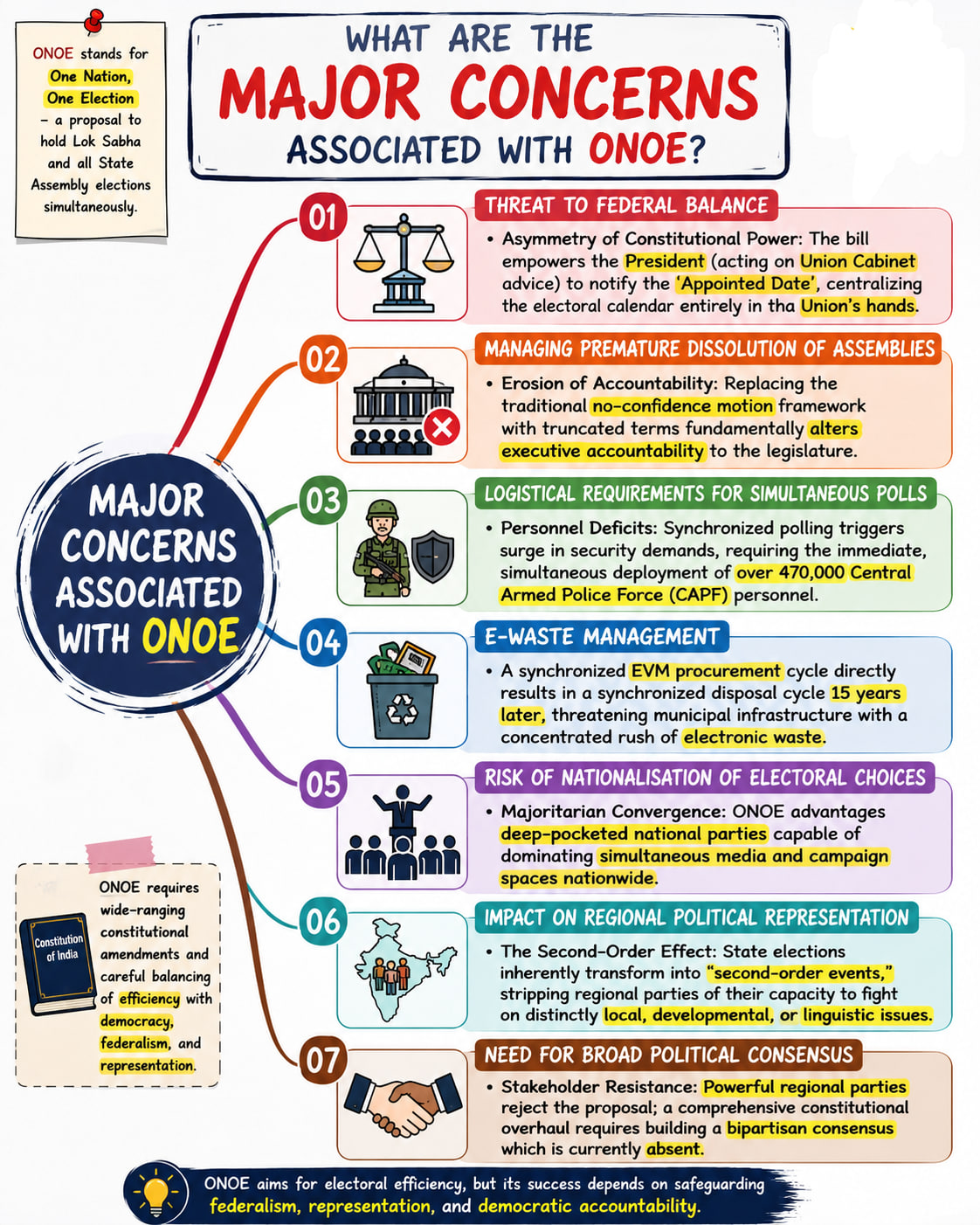
Major concerns revolve around the severe threat to federalism by centralizing the electoral calendar, the "coattail effect" where national issues drown out regional representation, the massive logistical cost of procuring EVMs/VVPATs, and the democratic deficit caused by forcing "truncated terms" on mid-term elected governments.
© 2026 iasgyan. All right reserved