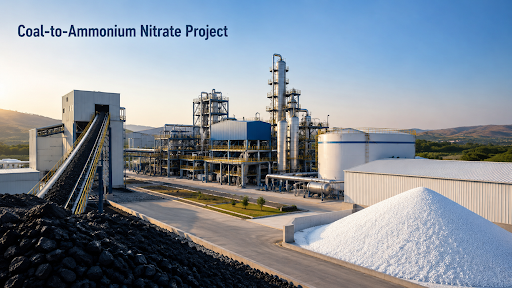
India’s first commercial-scale coal-to-ammonium nitrate project is a massive ₹25,016 crore facility in Lakhanpur, Odisha. Developed by a BHEL and Coal India joint venture, it uses indigenous coal gasification to produce 2,000 tonnes of ammonium nitrate daily, boosting domestic chemical production and energy self-reliance.
Why In News?
The Prime Minister laid the foundation stone for the nation’s first commercial-scale Coal-to-Ammonium Nitrate project at Lakhanpur, Odisha.
What is the Coal-to-Ammonium Nitrate Project?
Joint Venture Execution: The Bharat Coal Gasification and Chemicals Limited (BCGCL)—a strategic partnership between BHEL and Coal India Limited (CIL)—spearheads the facility.
Conversion Process: The plant utilizes Pressurised Fluidised Bed Gasification (PFBG) reactors to convert high-ash domestic coal into syngas through controlled thermo-chemical breakdown.
Ammonia Synthesis: The system cleans raw syngas of impurities and adjusts the hydrogen-to-nitrogen ratio to synthesize ammonia.
Final Production: The facility oxidizes ammonia into nitric acid, which then reacts with remaining ammonia to produce 0.66 Million Tonnes Per Annum (MTPA) of chemical-grade ammonium nitrate.
What is Ammonium Nitrate?
Chemical Properties: Ammonium Nitrate (NH₄NO₃) functions as a white, highly soluble, and hygroscopic crystalline compound. It acts as a strong oxidizer and remains thermally unstable, melting at 170°C.
Industrial Utility: It serves as the primary ingredient in Ammonium Nitrate Fuel Oil (ANFO), which accounts for 80% of explosive blasting requirements in the mining and quarrying sectors.
Agricultural Role: Farmers utilize it as a high-nitrogen fertilizer with an NPK ratio of 34-0-0, ensuring efficient nitrogen release.
Strategic Significance
Import Substitution: The project reduces reliance on imported natural gas and methanol, helping bridge the gap for the 13-15% of ammonia and 90% of methanol currently imported by India.
National Coal Gasification Mission: The facility serves as a commercial model to achieve the target of gasifying 100 Million Tonnes (MT) of coal by 2030.
Economic Catalysis: The government anticipates ₹2.5 to ₹3 lakh crore in investments across 25 upcoming projects, creating 50,000 direct and indirect jobs.
Technological Sovereignty: The use of 100% indigenous technology reinforces the Aatmanirbhar Bharat initiative by successfully processing challenging, high-ash Indian coal.
Source: PIB
|
PRACTICE QUESTION Q. With reference to India's Coal Gasification initiatives, consider the following statements:
Which of the statements given above are correct? A) 1 and 2 only B) 2 and 3 only C) 1 and 3 only D) 1, 2, and 3 Answer: B Explanation: Statement 1 is incorrect: Coal gasification does not involve direct combustion in excess oxygen. Instead, it is a thermo-chemical process where coal is partially oxidized under controlled, limited oxygen and steam at high temperatures to convert it into a gaseous form. Direct combustion in excess oxygen describes the process used in conventional coal-powered thermal plants. Statement 2 is correct: The primary product of coal gasification is syngas (synthesis gas), which mainly consists of a mixture of carbon monoxide and hydrogen . Statement 3 is correct: To incentivize clean coal technologies and meet national targets under the National Coal Gasification Mission, the Ministry of Coal offers a 50% rebate in revenue share in its commercial coal block auction policies for coal used strictly for gasification purposes. |
The Coal-to-Ammonium Nitrate Project is India’s first commercial-scale, ₹25,016-crore surface facility developed by a BHEL-CIL joint venture in Lakhanpur, Odisha, designed to transform domestic raw coal into high-value chemical feedstocks to eliminate import dependencies.
Coal gasification operates as a thermo-chemical process that reacts high-ash coal under extreme heat and pressure with steam and oxygen to break the solid fuel down into synthesis gas (syngas), a highly versatile mixture of carbon monoxide and hydrogen.
Ammonium nitrate is highly essential because it serves as the critical base material for manufacturing commercial mining explosives used extensively in resource extraction and infrastructure development, while also acting as a key ingredient in nitrogen-rich agricultural fertilisers.
The primary environmental concerns involve the massive carbon dioxide footprint generated during gasification and synthesis stages, high water resource consumption, and the challenging task of managing hazardous trace ash and chemical wastewater discharge.


© 2026 iasgyan. All right reserved