The Battery Minerals Processing Scheme targets the massive "midstream gap" in India's clean energy supply chain. By aggressively subsidizing urban mining and hydrometallurgical refining of lithium and cobalt, India aims to permanently neutralize its import dependency on Chinese battery cells.
Why In News?
The Ministry of Mines approves 58 companies under the ₹1,500 crore Incentive Scheme for Promotion of Critical Mineral Recycling to accelerate domestic battery mineral processing.
What is the Battery Minerals Processing Scheme?
Core Objectives: The government builds a resilient circular economy by targeting the extraction and refining of strategic minerals from secondary sources, including e-waste, spent lithium-ion batteries (LIB), and industrial scrap. This strategy reduces India’s current 85%+ import dependence on battery components.
Financial Support Mechanism: The scheme operates over a six-year tenure (FY 2025–26 to FY 2030–31) with a ₹1,500 crore budget.
Capex Subsidy: The state provides a 20% direct subsidy on eligible capital expenditure for projects meeting production timelines.
Opex Subsidy: The government links financial support to incremental sales, disbursing 40% in Year 2 and 60% in Year 5.
Company Categorization: The framework divides participants into Group A (Global Manufacturing Revenue ≥ ₹200 crore; ₹50 crore ceiling) and Group B (GMR < ₹200 crore; ₹25 crore ceiling).
Urban Mining Focus: The initiative prioritizes the recovery of high-value elements from catalytic converters, permanent magnets, and degraded battery packs, bypassing the long gestation periods of traditional mining.
Why are Battery Minerals Important?
Electric Vehicle Industry: India targets 30% EV penetration by 2030, requiring 115 GWh of annual Lithium-ion demand. Local production prevents the transition from 85% crude oil dependency to 100% Chinese battery cell dependency.
Renewable Energy Storage: Battery Energy Storage Systems (BESS) stabilize solar and wind grids, supporting India’s mandate to achieve 50% non-fossil fuel electricity capacity by 2030.
Energy Transition Goals: Securing these materials operationalizes India’s UNFCCC commitment to slash emissions intensity by 45% by 2030 and reach Net-Zero emissions by 2070.
Key Minerals Covered
Lithium: As domestic extraction from 5.9 million tonne reserves in Reasi (J&K) remains 8–10 years away, recycling provides the only immediate supply.
Cobalt: Essential for thermal stability, domestic refining prevents the loss of value from exporting raw "black mass" (e.g., 350 tonnes exported in one year).
Nickel: Critical for NMC (Nickel Manganese Cobalt) batteries, secondary recovery from scrap serves as a national security imperative.
Graphite: As the primary anode material, it remains vulnerable to geopolitical export controls.
Rare Earth Elements: Essential for EV motors and wind turbines, these elements require rapid recycling to counter China’s 85-90% global refining monopoly.
Role of Recycling in Critical Mineral Security
Circular Economy: NITI Aayog projects India will generate 128 GWh of recyclable batteries by 2030.
Resource Efficiency: Advanced hydrometallurgy recovers 90-97% of critical metals at high purity, consuming less energy than traditional pyrometallurgy.
Reducing Import Dependence: Domestic production substitutes imports, blocking an annual foreign exchange outflow exceeding ₹80,000 crore.
Significance of the Scheme
Strengthening Supply Chains: The initiative resolves the "midstream gap" by building local processing and refining capacity.
Supporting Make in India: The scheme unlocks a projected ₹16,000 crore circular economy market by 2030.
Enhancing Energy Security: A closed-loop ecosystem insulates India from global supply shocks and export bans.
Promoting Green Manufacturing: The framework shifts the industry toward zero-emission operations, suppressing toxic acid-leaching practices.
Linkages with National Critical Mineral Mission (NCMM)
Strategic Alignment: The Battery Minerals Processing Scheme acts as a financial pillar under the ₹34,300 crore NCMM.
Value Chain Synchronization: It complements upstream efforts by Khanij Bidesh India Limited (KABIL), ensuring that minerals extracted from overseas blocks (e.g., Catamarca, Argentina) remain within the Indian loop.
Infrastructure Development: The incentive funds the capital expenditure required for specialized mineral processing parks and Centres of Excellence.
Challenges
Technology Gaps: Facilities struggle to process LFP (Lithium Iron Phosphate) batteries profitably due to low intrinsic metal value.
Limited Availability: The ACC PLI scheme has only delivered 2.8% of its 50 GWh target, limiting the volume of end-of-life batteries.
Infrastructure Deficit: Current capacity stands at ~2 GWh, requiring a 40x scale-up to manage projected waste.
Informal Sector: Fragmented networks utilize hazardous extraction methods, disrupting formal supply chains.
Raw Material Flight: The export of "black mass" causes an annual value loss of approximately ₹300 crore.
Way Forward
Enforcement: The Central Pollution Control Board (CPCB) must enforce Battery Waste Management Rules (BWMR) 2025, mandating 90% material recovery by FY 2026-27.
Policy Upgrades: Policymakers should introduce Production-Linked Incentives (PLI) for midstream refining and reduce GST on recyclables to 5%.
International Partnerships: India must pursue "Mineral Security Partnerships" with nations like Australia and Japan for technology transfers.
Digital Traceability: The government must deploy a blockchain-enabled platform to track battery lifecycles via QR codes.
Export Restrictions: The Ministry of Commerce must implement tariffs or bans on black mass exports to retain critical minerals domestically.
Conclusion
By scaling domestic recycling and midstream refining through the Battery Minerals Processing Scheme, India transforms electronic waste liabilities into strategic assets, effectively neutralizing import dependence and securing geopolitical autonomy in the clean energy transition.
Source: DOWNTOEARTH
|
PRACTICE QUESTION Q. Examine the technological and infrastructural bottlenecks restricting India's capacity to process and recycle Lithium-ion batteries. (150 Words, 10 Marks) |
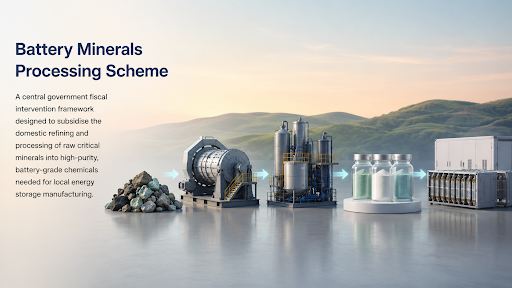
The Battery Minerals Processing Scheme is a central government fiscal intervention framework designed to subsidise the domestic refining and processing of raw critical minerals into high-purity, battery-grade chemicals needed for local energy storage manufacturing.
Battery minerals are strategically critical because they form the foundational architecture of clean energy technologies, and securing their supply insulates national manufacturing from severe cross-border supply chain shocks and geopolitical monopolies.
Recycling strengthens mineral security by recovering high-purity lithium, cobalt, and nickel from spent batteries, creating a secondary, domestic supply loop that drastically reduces dependence on foreign mining imports.
Critical minerals serve as the indispensable physical building blocks of the green transition, acting as the core components required to manufacture electric vehicle motors, high-capacity grid storage batteries, and wind turbines.



© 2026 iasgyan. All right reserved