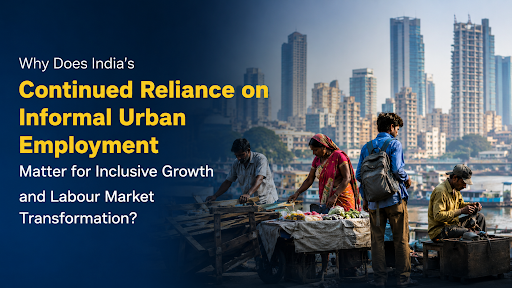
The ASUSE 2025 report by MoSPI highlights robust expansion in India's informal economy, creating 7.45 million jobs. However, it exposes structural challenges like low wages, declining capital investment, and low productivity, perpetuating a "job-heavy, value-light" model.

The Annual Survey of Unincorporated Sector Enterprises (ASUSE) 2025 report shows India added 5.8 million small businesses and 7.5 million jobs in one year.
The Annual Survey of Unincorporated Sector Enterprises (ASUSE) is a nationwide survey conducted by the Ministry of Statistics and Programme Implementation (MoSPI).
It measures the operational and economic characteristics of unincorporated non-agricultural establishments, focusing on the manufacturing, trade, and other services sectors.
|
What are Unincorporated Sector? The sector consists of small-scale businesses that are not legally incorporated as separate entities.
|
The survey captures data like Gross Value Added (GVA), employment figures, digital adoption, and assets to aid in policymaking, national accounts compilation, and MSME support.
Establishment Expansion: Total number of businesses grew by 7.97%, rising from 7.34 crore in 2023-24 to 7.92 crore establishments in 2025.
Job Creation: The sector witnessed a 6.18% growth in employment, adding 74.52 lakh new jobs to reach a total workforce of 12.81 crore workers.
Economic Output Growth: Gross Value Added (GVA) surged by 10.87% to reach Rs. 19.92 lakh crore, driven heavily by a 16.77% growth in the trade sector.
Labor Productivity Improvements: The GVA per worker rose by 4.54% to Rs. 1,56,539 annually. Similarly, the GVA per establishment increased to Rs. 2,52,699.
Wage Gains vs Low Pay: Average emoluments rose 3.88% to Rs. 1,46,550 annually. However, monthly pay of Rs. 12,000–13,000 remains below most state minimum wages.
Surge in Digitalization: Internet usage for business operations increased from 26.7% to 39.4%, highlighting rapid digital transformation.
Rise in Women Entrepreneurship: Female-owned proprietary establishments increased to 27%, with women constituting 29% of the total workforce.
Falling Capital Investment: Enterprises reported a 14% decline in net addition to fixed assets, indicating reduced capacity or willingness to invest in business expansion.
Financial Vulnerability: Many small businesses face limited capital and remain stuck in a debt trap, lacking the adequate financial support needed to upgrade machinery or adopt new technology.
Enhancing Financial Inclusion: Institutionalizing better credit access and financial support mechanisms to help businesses escape debt traps and invest in technological expansion.
Bridging the Digital Divide: Integrating unincorporated firms into the Digital India ecosystem to future-proof businesses and improve market reach.
Empowering Women Entrepreneurs: Providing targeted support and de-risking the environment for female business owners through initiatives like Social Impact Funds.
Focus on Data-Driven Policy: Utilizing real-time monitoring, such as the newly introduced Quarterly Bulletins (QBUSE), to design timely and precise MSME interventions.
To ensure equitable prosperity, India must implement structural reforms in wages, credit, and productivity to transform the informal sector from a "job-heavy, value-light" industry into a high-value economic engine.
Source: DOWNTOEARTH
|
PRACTICE QUESTION Q. Consider the following statements regarding the Annual Survey of Unincorporated Sector Enterprises (ASUSE):
Which of the statements given above is/are correct? (a) 1 only (b) 2 only (c) Both 1 and 2 (d) Neither 1 nor 2 Answer: b Explanation: Statement 1 is incorrect: The National Statistical Office (NSO) under the Ministry of Statistics and Programme Implementation (MoSPI) conducts the ASUSE. Statement 2 is correct: The survey covers unincorporated non-agricultural establishments in the manufacturing, trade, and other services sectors (excluding construction). |
ASUSE is a nationwide survey capturing the economic and operational characteristics of India's unincorporated non-agricultural enterprises, specifically focusing on manufacturing, trade, and other services.
The survey is compiled and published by the National Statistics Office (NSO) under the Ministry of Statistics and Programme Implementation (MoSPI).
The sector saw a robust 6.18% growth in employment, adding approximately 74.52 lakh jobs in a single year, bringing the total workforce in this sector to 12.81 crore workers.





© 2026 iasgyan. All right reserved