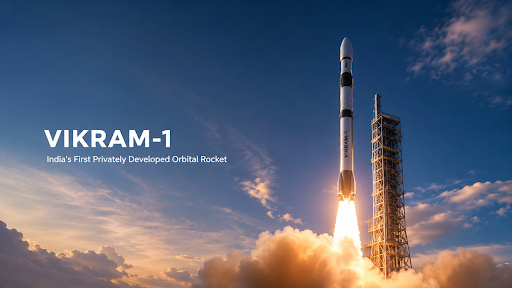
Vikram-1, developed by Skyroot Aerospace, is India's first privately built orbital rocket. Launching in 2026, it showcases indigenous 3D-printed engines and carbon-composite structures. This milestone highlights India's accelerating space commercialisation, supported by reforms like the Indian Space Policy 2023.
Why In News?
Skyroot Aerospace is scheduled to launch Vikram-1, India's first privately developed orbital-class rocket, between July 12 and August 4, 2026, from the Satish Dhawan Space Centre (SDSC).
What is Vikram-1?
Vikram-1 is an orbital-class launch vehicle and India’s first privately built rocket designed to deploy small satellites into orbit.
Objectives
What are the Key Features of Vikram-1?
Physical Specifications: The vehicle stands 20 metres tall with a 1.7-metre diameter and utilizes a four-stage configuration.
Payload Capacity: It carries up to 350 kg into Low Earth Orbit (LEO) and 260 kg into Sun-Synchronous Orbit (SSO).
Advanced Manufacturing: The all-carbon-fibre composite structure and 3D-printed engines reduce engine weight by 50% and production time by 80%.
Operational Efficiency: Its modular design enables assembly and launch within a 24-hour turnaround time.
Propulsion System: It features three solid-fuel stages, including the Kalam-1200 motor generating 120 tons of peak thrust, and a liquid-fueled fourth stage powered by the Raman Engine cluster.
Significance
Space Commercialisation: It captures the global small-satellite market, retaining value previously lost to foreign vendors.
Startup-Led Innovation: It proves that Indian startups possess the technical prowess to execute complex orbital missions independently.
Technological Self-Reliance: It demonstrates mastery over 3D-printed liquid engines and high-thrust solid-fuel boosters, reducing import dependency.
Global Competitiveness: It positions India as a cost-effective alternative to global giants like SpaceX and Rocket Lab.
Economic Growth: It accelerates India’s trajectory to increase its current 2% share in the global space economy.
ISRO Resource Optimization: It shifts routine commercial launches to private players, allowing ISRO to focus on deep-space missions like Chandrayaan-4, the Venus Mission, and Gaganyaan.
Source: THEHINDU
|
PRACTICE QUESTION Q. Consider the following statements regarding the ‘Vikram-1’ launch vehicle: 1. It is a four-stage rocket completely powered by solid-propellant engines. 2. It is India’s first privately developed orbital-class rocket built by Skyroot Aerospace. 3. It utilizes 3D-printed engines and a carbon-composite structure to reduce weight. Which of the statements given above is/are correct? A) 1 and 2 only B) 2 and 3 only C) 1 and 3 only D) 1, 2, and 3 Answer: B Explanation: Statement 1 is incorrect: The Vikram-1 launch vehicle is a four-stage rocket, but it is not completely powered by solid-propellant engines. Its first three stages utilize solid fuel boosters (Kalam series), while its fourth (upper) stage is powered by liquid fuel. The upper stage uses a cluster of four liquid-fueled Raman hypergolic engines to ensure highly precise orbital adjustments. Statement 2 is correct : It is officially recognized as India’s first privately developed orbital-class rocket. It was meticulously designed and built by the Hyderabad-based space-tech startup Skyroot Aerospace. Statement 3 is correct : To optimize efficiency and mass, the vehicle is built using a lightweight all-carbon composite structure instead of traditional metals. It uses advanced, indigenously developed 3D-printed liquid engines (the Raman series) in its upper stage to dramatically reduce weight and manufacturing turnaround time. |
Vikram-1 is a four-stage, orbital-class small-lift launch vehicle designed to carry payloads of up to 350 kg into Low Earth Orbit (LEO). It utilizes an all-carbon composite structure and 3D-printed engines.
It was developed by Skyroot Aerospace, a Hyderabad-based private space startup founded in 2018 by former ISRO scientists Pawan Kumar Chandana and Naga Bharath Daka.
It is India's first privately developed orbital rocket. Its successful launch demonstrates India's indigenous private capability in cutting-edge aerospace technology, marking a historic shift towards space commercialisation and reducing ISRO's commercial launch burden.
The Indian National Space Promotion and Authorisation Centre (IN-SPACe) is an autonomous government agency that acts as a single-window clearinghouse to promote, authorize, and regulate the space activities of private companies in India.




© 2026 iasgyan. All right reserved