Sickle Cell Disease is a genetic blood disorder heavily impacting India's tribal populations. The National Sickle Cell Anaemia Elimination Mission aims to screen 7 crore individuals and eradicate the disease by 2047 through aggressive genetic counseling, hydroxyurea therapy, and emerging CRISPR-Cas9 gene-editing solutions.
Why In News?
President Droupadi Murmu commemorates International Sickle Cell Day by highlighting India’s achievement of screening over 6 crore individuals.
What is Sickle Cell Disease (SCD)?
Genetic Blood Disorder: SCD acts as a chronic, inherited condition that alters the structure of haemoglobin, the vital oxygen-carrying protein within red blood cells.
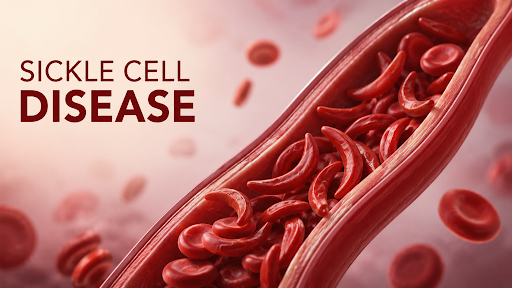
Cell Mutation: Normal, flexible, disc-shaped red blood cells mutate into rigid, crescent, or sickle shapes, which drastically impede blood flow.
HBB Gene Defect: A structural genetic mutation in the HBB gene provides faulty instructions for producing beta-globin.
Autosomal Recessive Inheritance: An individual develops SCD only by inheriting two abnormal mutated genes—one from each parent.
Sickle Cell Trait (SCT): Individuals inheriting a single mutated gene remain asymptomatic carriers who risk passing the disease to future generations.
Symptoms and Health Impacts
Chronic Anaemia: Premature destruction of sickled cells (chronic hemolysis) causes a persistent shortage of red blood cells.
Vaso-Occlusive Crises (VOC): Blocked capillaries trigger agonizing, periodic pain in joints, the abdomen, and the chest, necessitating urgent hospitalization.
Organ Damage: Recurrent blood flow blockages cause irreversible micro-infarctions in the spleen, brain, and kidneys, often leading to organ failure or strokes.
Compromised Immunity: Spleen damage leaves children highly vulnerable to infections, requiring strict penicillin prophylaxis and updated vaccinations.
Distribution and Tribal Burden
Disproportionate Impact: Approximately 1 in 86 births among Scheduled Tribes (STs) results in SCD.
Endemic Geography: The disease remains prevalent across 17 Indian states, with high concentrations in Madhya Pradesh, Maharashtra, Gujarat, Chhattisgarh, Odisha, and Rajasthan.
Global Burden: India harbors the world’s second-largest disease burden, with 30,000 to 40,000 children born with the disorder annually.
National Sickle Cell Anaemia Elimination Mission
Mission Rollout: The Prime Minister launched the mission on July 1, 2023, in Shahdol, Madhya Pradesh, to provide universal access to quality healthcare.
Screening Targets: The government mandates the screening of 7 crore individuals aged 0 to 40 years by the financial year 2025-26.
Genetic Counselling: States issue colour-coded health cards to facilitate pre-marital counselling and prevent marriages between two carrier individuals.
Elimination Goal: The mission targets the total eradication of SCD as a public health threat by 2047.
Diagnosis and Treatment
Diagnostic Protocol: Primary healthcare centers utilize Point of Care (POC) tests followed by High-Performance Liquid Chromatography (HPLC) for definitive confirmation.
Hydroxyurea (HU) Therapy: This disease-modifying drug increases fetal hemoglobin (HbF) levels, slashing VOCs and transfusion dependency by nearly 50%.
Advanced Cures: While Bone Marrow Transplants remain limited by donor compatibility (only 18% success), the CRISPR-Cas9 gene-editing drug Casgevy offers a groundbreaking, permanent functional cure.
Source: PIB
|
PRACTICE QUESTION Q. With reference to Sickle Cell Disease (SCD) and its management in India, consider the following statements:
Which of the statements given above is/are correct? A) 1 and 2 only B) 2 and 3 only C) 3 only D) 1, 2, and 3 Answer: B Explanation: Statement 1 is incorrect: Sickle Cell Disease (SCD) is an autosomal recessive disorder. This means a child must inherit two mutated copies of the HBB gene (one from each parent) to develop the severe form of the disease. If a child inherits only one mutated gene, they are considered an asymptomatic carrier (they have the "sickle cell trait"). Statement 2 is correct: Hydroxyurea is a widely prescribed, disease-modifying drug for SCD patients. It works primarily by stimulating the production of fetal hemoglobin (HbF), which prevents red blood cells from sickling and reduces the frequency of painful crises. Statement 3 is correct: Launched by the Government of India, the National Sickle Cell Anaemia Elimination Mission specifically targets the prevention and control of the disease, with the overarching goal to eliminate SCD as a public health problem in India by the year 2047. |
Sickle cell disease is caused by a specific point mutation in the HBB gene on chromosome 11, which results in the production of abnormal hemoglobin S (HbS) that forces flexible red blood cells to stiffen and warp into rigid, crescent-like shapes.
The disease is highly prevalent among tribal communities as an evolutionary survival trait against malaria; individuals carrying a single sickle cell gene possess a natural resistance to malaria, which historically led to the survival and concentrated inheritance of this gene within closed endogamous groups.
The National Sickle Cell Anaemia Elimination Mission—launched in July 2023—is a massive public health campaign executed across 17 high-focus states to completely eradicate the genetic transmission of the disease by the year 2047.
Healthcare providers diagnose the condition using a two-tier blood testing method, beginning with a rapid, field-level solubility screening test to detect abnormal hemoglobin, followed by advanced High-Performance Liquid Chromatography (HPLC) or hemoglobin electrophoresis to definitively confirm the disease.



© 2026 iasgyan. All right reserved