The Union Health Ministry amended Schedule K of the Drugs Rules, 1945, withdrawing retail licensing exemptions for cough syrups in small villages. This crucial regulatory shift curbs the unchecked sale of contaminated medicines, balancing rural healthcare accessibility with stringent public health safety and accountability.
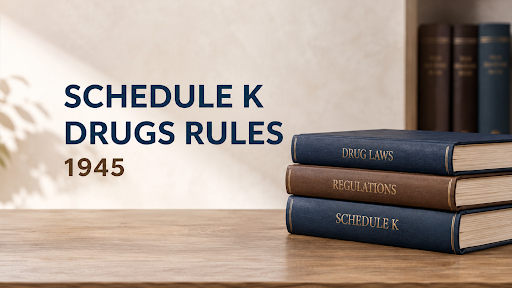
The Union Ministry of Health and Family Welfare amends the Drugs Rules, 1945 to omit "Syrup" from Schedule K, to prevent contamination-related fatalities.
Schedule K functions as a specialized annexure under the Drugs Rules, 1945, governed by Rule 123.
Regulatory Mechanism: It provides targeted regulatory relief by exempting specific drugs from the stringent provisions of Chapter IV of the Drugs and Cosmetics Act, 1940.
Exempted Classes: The schedule lists 33 items, including household remedies like aspirin, paracetamol, analgesics, antacids, and disinfectants such as Dettol and Lizol.
OTC Facilitation: It serves as the legal foundation for the Over-The-Counter (OTC) framework, allowing sales without a Registered Medical Practitioner (RMP) prescription.
Conditional Relief: Exemptions from Form 19, 20, 20A (retail licenses) or manufacturing licenses remain strictly contingent upon compliance with specific storage, packaging, and sourcing conditions.
Legal Framework
Drugs and Cosmetics Act, 1940: Chapter IV dictates standards for manufacture, sale, and distribution. The Jan Vishwas (Amendment of Provisions) Act, 2023 amends Section 32-B to decriminalize minor offenses, allowing the compounding of penalties under Section 27(d).
Drugs Rules, 1945: Rule 123 mandates that exempted drugs must still adhere to quality standards prescribed in the Second Schedule.
Regulatory Authorities: The Central Drugs Standard Control Organization (CDSCO) and State Licensing Authorities provide dual oversight.
Conflict of Authority: The Maharashtra State Pharmacy Council notes that dispensing Schedule K drugs via non-pharmacists violates Section 42 of the Pharmacy Act, 1948, which restricts dispensing to registered professionals.
Categories Covered Under Schedule K
Government Institutions: Authorizes supply by Community Health Officers, nurses, Auxiliary Nurse Midwives (ANMs), and Lady Health Visitors at PHCs.
Household Remedies: Covers non-prescription analgesics, Paracetamol 500mg, and topical solutions like Povidone Iodine.
Public Health Programmes: Enables ASHAs and Anganwadi Workers to distribute essential medicines at the village level.
Fatal Loopholes: Lack of inspection frameworks led to the deaths of 22 children in Chhindwara, Madhya Pradesh, due to contaminated cough syrups.
Quality Control: Small units bypass checks by procuring solvent bases like Propylene Glycol (PEG) from open markets, risking Diethylene Glycol (DEG) and Ethylene Glycol (EG) contamination.
Medication Errors: Unqualified dispensing increases risks; medical errors cause over 2,50,000 deaths annually globally according to Johns Hopkins University.
Antimicrobial Resistance (AMR): Unregulated dispensing fuels irrational antibiotic use, compromising national AMR efforts.
Pharmacy Onboarding: State Licensing Authorities must mandate that rural outlets selling liquid formulations transition into compliant pharmacies.
Solvent Procurement: The CDSCO must require that manufacturers procure pharmaceutical-grade solvents in tamper-proof, traceable packaging.
Digital Tracking: Implement barcode/QR-code supply chain tracking to eliminate open-market procurement of ingredients.
Regulatory Review: The Drug Consultative Committee (DCC) must conduct data-driven reviews to strip exemptions from high-risk drug classes.
OTC Classification: The Ministry must amend the Drugs and Cosmetics Act to formally define OTC drugs and establish clear distribution regulations.
Harmonizing Statutes: Parliament must reconcile Rule 123 of the Drugs Rules with Section 42 of the Pharmacy Act, 1948 to ensure legal clarity.
Withdrawing the Schedule K cough syrup exemption prioritizes public health over access, helping eliminate contaminated pharmaceutical chains in rural India.
Source: PIB
PRACTICE QUESTIONQ. Consider the following statements regarding Schedule K of the Drugs Rules, 1945:
Which of the statements given above is/are correct? A) 1 and 2 only B) 2 only C) 2 and 3 only D) 1, 2, and 3 Answer: B Explanation: Statement 1 is incorrect. Schedule K lists specific classes of drugs and the extent of their exemption from the provisions of Chapter IV (Manufacture, Sale, and Distribution) of the Drugs and Cosmetics Act, 1940. Entry No. 13 of Schedule K specifically exempts the sale of "household remedies" (which includes basic analgesics like Aspirin and Paracetamol) from the requirement of a sale license in villages with a population of not more than 1,000, subject to certain conditions. Statement 2 is correct. Entry No. 23 of Schedule K exempts "Drugs supplied by health functionaries... including Community Health Volunteers such as Accredited Social Health Activists (ASHAs)" from the requirement of a sale license. Statement 3 is incorrect. The Drugs (Fifth Amendment) Rules, 2026 (based on the 2025 draft) amended Entry No. 13 of Schedule K by omitting the word "Syrups" from the list of exempted household remedies. This change means that cough syrups can no longer be sold in small villages without a valid sale license (i.e., they must now be sold through licensed pharmacies). |
Schedule K is a specialized statutory annexure within India's Drugs Rules, 1945, that itemizes specific classes of drugs exempted from certain strict retail licensing and sales provisions of Chapter IV of the Drugs and Cosmetics Act, 1940.
Exemptions are granted to provide regulatory relief and bypass heavy bureaucratic paperwork for safe, common household remedies (like paracetamol, aspirin, antacids, and household liniments). This allows these low-risk, everyday medicines to be distributed quickly without requiring shops to obtain formal retail drug licenses.
To curb unlicensed distribution abuse, the government mandates strict oversight:
Schedule K serves as a critical bridge for last-mile public health accessibility by allowing small retail shops in remote, rural, or economically isolated villages to stock essential primary medications. This ensures communities lacking registered pharmacies can still instantly access basic, life-saving over-the-counter medical relief.


© 2026 iasgyan. All right reserved