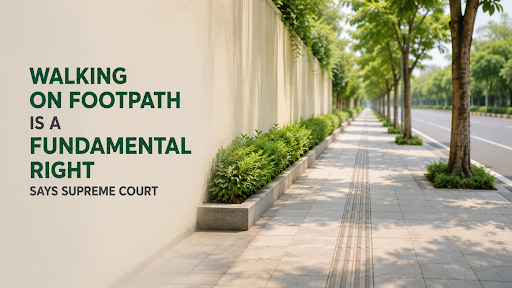
The Supreme Court ruled that walking on demarcated footpaths is a fundamental right under Articles 19 and 21, overriding motorized vehicular privileges. It mandates urban bodies to construct accessible pedestrian infrastructure, creating an enforceable duty independent of the Motor Vehicles Act.
Why In News?
The Supreme Court establishes the "Right to Walk" as a fundamental right under Article 21.
What is the Right to Walk?
Constitutional Mandate: The Court declares that the right to walk on demarcated footpaths is an integral component of Article 21 (Right to Life and Liberty) and Article 19(1)(d) (Right to move freely).
Priority Over Vehicles: The judgment asserts that the right to walk holds primary status, superseding the movement of motorized vehicles in urban planning.
Enforceable Obligation: Authorities, including Urban Development Authorities, Municipal Corporations, Municipalities, and Panchayats, bear a legal duty to construct and maintain safe pedestrian infrastructure.
Independent Remedies: Citizens may now invoke constitutional remedies for restitution and compensation against duty-bearers for violations, independent of the Motor Vehicles Act, 1988.
Constitutional and Legal Basis
Article 21: The Court recognizes safe walking as essential for a dignified life, free from the constant threat of vehicular traffic.
Article 19 Intersections: Walking facilitates rights under Article 19(1)(a), (b), and (c), serving as a historical tool for socio-political reform.
Article 14 (Right to Equality): The Court links footpaths to the Rights of Persons with Disabilities Act, 2016, mandating accessible design to ensure autonomy for all citizens.
Statutory Critique: The Court identifies the Motor Vehicles Act, 1988 as an impediment to safety, noting that it focuses exclusively on vehicle regulation while treating pedestrian interests as incidental.
Importance of Pedestrian Infrastructure
Road Safety: Proper footpaths act as physical buffers, reducing pedestrian fatalities by segregating walkers from high-speed corridors.
Inclusive Mobility: Walking serves as a non-monopolized public good and a critical social equalizer for the "not-so-fortunate."
Universal Accessibility: Adherence to universal design standards—such as tactile paving and dropped kerbs—ensures independence for the elderly and differently-abled.
Environmental Impact: Promoting Non-Motorised Transport (NMT) reduces vehicular CO2 emissions. Better infrastructure mitigates exposure to surface ozone, which contributed to 26,500 deaths from Ischemic Heart Disease (IHD) and from Chronic Obstructive Pulmonary Disease (COPD) in 2024. (Source: IIT Kharagpur)
Transit-Oriented Development (TOD): With India’s urban population projected to reach 51% (814 million) by 2047 (per NITI Aayog), safe walking networks are essential to connect commuters to mass transit and prevent gridlock.
Challenges Facing Pedestrians
Encroachments: Rampant occupation of walkways by street vendors and utility structures violates the right to safe passage.
Illegal Parking: The absence of stringent parking policies allows motorized vehicles to hijack pedestrian spaces.
Vehicle-Centric Design: Municipal bodies historically equate wide expressways with economic growth, neglecting pedestrian comfort.
Discriminatory Infrastructure: Discontinuous and poorly designed footpaths fail to meet the needs of Persons with Disabilities (PwDs).
Significance of the Judgment
Expansion of Jurisprudence: The ruling equates safe urban infrastructure with the constitutional right to live with dignity.
Accountability: By naming specific local bodies as duty-bearers, the Court eliminates bureaucratic ambiguity.
Policy Impetus: The Court directs the Ministries of Housing and Urban Affairs, Rural Development, and Road Transport and Highways, alongside the Law Commission of India, to initiate a comprehensive legal framework.
Way Forward
Integration with Missions: Authorities must integrate footpath maintenance into the Smart Cities Mission and AMRUT.
Anti-Encroachment Drives: Local bodies must permanently remove all obstructions to ensure barrier-free passage.
Universal Standards: States must mandate Indian Roads Congress (IRC) standards and adopt Bombay High Court guidelines for accessible zones.
Dedicated Legislation: Parliament must enact a 'Right to Walk' law that defines pedestrian rights, establishes a central regulatory body, and sets penalties for non-compliance.
Net-Zero Alignment: Scaling up NMT is vital to meet India’s 2070 Net Zero targets.
Conclusion
The Supreme Court’s ruling reorients urban planning toward a citizen-centric model, making pedestrian safety and dignity a constitutional priority.
Source: THEHINDU
|
PRACTICE QUESTION Q. Consider the following statements regarding the Supreme Court's recent judgment on the "Right to Walk":
Which of the statements given above is/are correct? A) 1 and 2 only B) 2 and 3 only C) 1 and 3 only D) 1, 2, and 3 Answer: B Explanation: Statement 1 is incorrect: The right to walk on demarcated footpaths is not explicitly mentioned in the Motor Vehicles Act, 1988. In fact, the Supreme Court noted with concern that the Act largely overlooks pedestrian interests and prioritizes motorized vehicles. Statement 2 is correct: The Supreme Court (in a landmark judgment on the Hemant Jain PIL) declared the freedom to walk safely on well-maintained, demarcated footpaths as a fundamental right. The Court read this into the constitutional rights of movement under Article 19(1)(d) and the right to life under Article 21. Statement 3 is correct: The Court held that when duty bearers—such as urban development authorities, municipal corporations, municipalities, and panchayats—fail to provide safe or encroachment-free footpaths, citizens have the right to claim restitutionary remedies and compensation. This constitutional and legal remedy is independent of any claims made under the Motor Vehicles Act. |
The Supreme Court declared walking on demarcated footpaths a fundamental right because human movement naturally predates motorised transit, and the current car-centric urban design fatally marginalises ordinary citizens.
The ruling links walking to Article 21 (Right to Life and Personal Liberty) by establishing that safe, unencumbered pedestrian infrastructure is an absolute prerequisite to protecting human life from hazardous vehicular traffic.
Municipal corporations, urban development bodies, and panchayats must actively demarcate, construct, maintain, and safeguard footpaths from illegal encroachments, making them judicially enforceable targets for citizen compensation claims.
Pedestrian rights are critical because they dismantle automobile monopolies over public spaces, drastically lower fatal accident rates, and drive the development of highly inclusive, people-centric, and sustainable green cities.




© 2026 iasgyan. All right reserved