Personality rights protect an individual’s identity—including name, image, and voice—from unauthorized commercial exploitation. While Indian courts derive these from Article 21, the absence of a codified law creates challenges in combating AI-driven deepfakes while safeguarding democratic free speech.
Why In News?
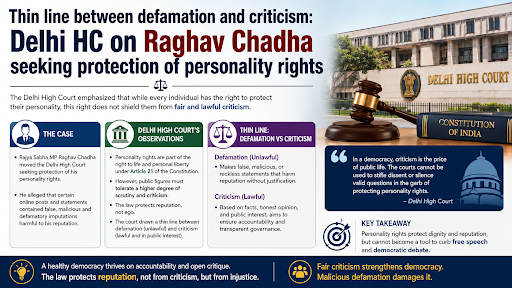
Recently, the Delhi High Court reserved its order on MP Raghav Chadha’s plea seeking protection of his personality rights against AI-generated deepfakes..
What are Personality Rights?
Personality rights refer to the right of an individual to control the commercial and public use of their personal identity, which includes their name, image, likeness, voice, and signature.
Core Objective: These rights prevent the unauthorized commercial exploitation of a person's identity and recognize the economic value attached to one's persona.
Case Study: The Delhi high Court in the Amitabh Bachchan vs Rajat Nagi & Ors (2022) case ruled that nobody can use Amitabh Bachchan’s name, image, voice, likeness, or any other uniquely identifiable personality traits for commercial or personal gain without his express permission.
Right of Publicity v/s Right to Privacy
How are Personality Rights Protected in India?
India lacks a specific, codified statute for personality rights. The judiciary derives protection from a combination of constitutional provisions, statutory laws, and common law principles.
Constitutional Foundations
Article 21: The Supreme Court, in K.S. Puttaswamy vs Union of India (2017), recognized the Right to Privacy as a fundamental right. Courts link personality rights to the right to life and liberty, emphasizing personal autonomy and dignity.
Article 19(1)(a): While individuals protect their persona, this article guarantees freedom of speech, which includes the right to criticize, parody, or satirize public figures.
Statutory Provisions
Copyright Act, 1957:
Trade Marks Act, 1999: Section 14 prohibits the use of personal names without consent. Celebrities frequently register their names or signatures as trademarks to prevent unauthorized commercial use.
Information Technology Act, 2000:
Indian Contract Act, 1872: Used to assess the legitimacy of commercial licenses and determine damages in cases of unauthorized exploitation.
Common Law and Tort Law
Judicial Intervention on Personality Rights
Rajagopal vs State of TN (1994): Known as the Auto Shankar case, it linked personality rights to the Right to Privacy under Article 21.
ICC Development vs Arvee Enterprises (2003): The Delhi High Court held that the Right of Publicity vests solely in the individual and is a commercial right.
DM Entertainment vs Baby Gift House (2010): Restricted the unauthorized sale of dolls resembling singer Daler Mehndi, recognizing the commercial value of a persona.
Titan Industries vs Ramkumar Jewellers (2012): Protected the identities of Amitabh and Jaya Bachchan, ruling that unauthorized association constitutes misappropriation.
Anil Kapoor vs Simply Life India (2023): Issued an injunction against the use of AI, deepfakes, and voice cloning to exploit the actor's persona.
Arijit Singh vs AI Entities (2024): The Bombay High Court protected the singer's vocal traits against unauthorized AI-generated replicas.
Raghav Chadha vs Social Media Entities (2026): The Delhi High Court clarified that political criticism of a leader's decisions in the political arena falls under Defamation law, not a violation of Personality Rights.
What Challenges Exist in Regulating Personality Rights?
Lack of Uniformity: In the absence of a dedicated law, High Courts have varying interpretations, leading to doctrinal uncertainty.
Free Speech vs Protection: Over-broad protection of personality rights might chill legitimate parody, satire, and creative expression.
Gendered Vulnerability: Ordinary citizens, especially women, are disproportionately targeted by deepfakes and revenge pornography, highlighting that personality rights are not just for celebrities.
Technology Gap: AI detection capabilities often lag behind the speed at which synthetic content spreads globally.
Personality Rights in the Era of Generative AI
The rise of Generative Artificial Intelligence has introduced threats to individual identity.
Way Forward
Enact Dedicated Legislation
Make a comprehensive statutory framework to explicitly define and codify personality rights, replacing the current reliance on fragmented judicial doctrines.
Define Identity Attributes
Legally recognize specific identity —including name, voice, signature, facial features, and digital likeness—granting all individuals universal, consent-based control over their digital representations.
Balance Free Speech and Dignity
Adopt a context-based proportionality model that balances a person's right to dignity under Article 21 with the democratic right to freedom of speech and expression under Article 19(1)(a).
Regulate AI and Deepfakes
Mandate AI watermarking and the compulsory labeling of synthetic media to tackle the challenges posed by Generative AI, voice cloning, and digital avatars.
Enforce Graded Intermediary Liability
Impose strict obligations on social media platforms to deploy detection technologies and execute swift takedowns, utilizing a graded liability model that holds platforms accountable without stifling innovation.
Establish Specialized Institutions
Create a dedicated Digital Personality Rights Authority and institute fast-track Intellectual Property (IP) courts to resolve complex technological disputes and cross-border jurisdictional issues.
Conclusion
India requires a codified statutory framework to safeguard personality rights against advanced AI and digital misappropriation, establishing balance between the protection of individual dignity with the preservation of democratic free speech.
Source: THEHINDU
|
PRACTICE QUESTION Q. Consider the following statements regarding 'Personality Rights' in India:
Which of the statements given above is/are correct? A) 1 and 2 only B) 2 and 3 only C) 1 and 3 only D) 1, 2, and 3 Answer: B Explanation: Statement 1 is incorrect: Personality rights in India are not explicitly codified under any single, dedicated statutory framework. There is no specific act passed by the Parliament dedicated solely to "Personality Rights". Instead, these rights have largely evolved through judge-made laws using existing principles of intellectual property, trademarks, and common law. Statement 2 is correct: The Indian judiciary has derived personality and publicity rights from the Right to Privacy and the Right to Live with Dignity under Article 21 of the Constitution. Statement 3 is correct: Personality rights in India protect dual interests:
|
Personality rights refer to the right of an individual to control the commercial and public use of their identity, including their name, image, likeness, voice, and signature, preventing unauthorized economic exploitation.
While privacy rights protect a person's private life from unwarranted public intrusion and safeguard their dignity, personality rights specifically protect the commercial value of an individual's identity and prevent unauthorized business use.
Generative AI and deepfakes can replicate an individual's face, voice, and gestures without consent, creating hyper-realistic synthetic media. This leads to unauthorized digital endorsements, fraud, and severe reputational harm.



© 2026 iasgyan. All right reserved