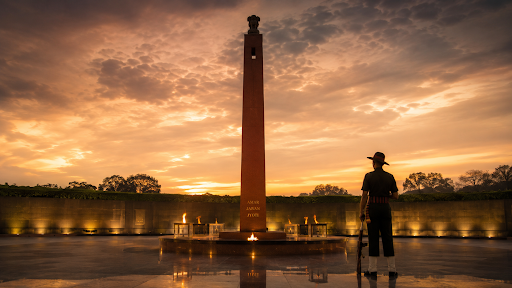
The Indian government officially inscribed the names of six military personnel killed during the May 2025 cross-border Operation Sindoor on the National War Memorial's Tyag Chakra.
Why In News?
The Union government officially inscribed the names of six military personnel killed during the cross-border Operation Sindoor on the Tyag Chakra of the National War Memorial.
What is the National War Memorial?
Inaugurated in 2019, the memorial commemorates all Armed Forces personnel who died in military operations and conflicts post-Independence.
The site honors the supreme sacrifice of the military, ensuring the nation formally recognizes their bravery in permanent history while providing a space for families to pay homage.
Situated near India Gate in New Delhi.
Key Features of the Memorial
Amar Chakra (Circle of Immortality): Symbolizes the eternal spirit of fallen soldiers and ensures their memory never perishes.
Veerta Chakra (Circle of Bravery): Depicts the raw courage exhibited by the Indian Armed Forces in decisive battles and covert operations.
Tyag Chakra (Circle of Sacrifice): Comprises 16 concentric granite walls bearing the names, ranks, and units of the fallen. Wall 3D currently houses the 2025 Roll of Honour.
Rakshak Chakra (Circle of Protection): Represents the protective shield the armed forces provide against external and internal threats.
Tri-Service Representation: The memorial honors all branches equally, featuring personnel from the Indian Army and the Indian Air Force.
About Operation Sindoor
Trigger and Initiation: The Indian Armed Forces launched the operation on the night of May 7-8, 2025, in retaliation to the April 22 Pahalgam terror attack, where terrorists killed 26 civilians.
Joint Tri-Service Strikes: The Army, Navy, and Air Force coordinated 24 missile strikes in a single day, targeting nine terror infrastructure sites in Muridke, Bahawalpur, Sialkot, and Muzaffarabad.
Advanced Weaponry: India deployed SCALP (Storm Shadow) cruise missiles with a 250-kilometer range and HAMMER smart bombs to penetrate reinforced bunkers.
Air Defence Interception: The Indian Air Force utilized the S-400 Triumf system, locally named 'Sudarshan Chakra', to intercept incoming Pakistani drones and missiles at distances up to 400 kilometres, protecting locations like Srinagar, Pathankot, and Amritsar.
Source: THEHINDU
|
PRACTICE QUESTION Q. Consider the following statements regarding the National War Memorial (NWM): 1. It commemorates Indian armed forces personnel who laid down their lives in military operations solely before the 1999 Kargil War. 2. The Tyag Chakra comprises 16 concentric granite walls that bear the names of fallen personnel. 3. The names of soldiers killed in covert cross-border operations are legally barred from being inscribed on the memorial. Which of the statements given above is/are incorrect? A) 1 and 2 only B) 1 and 3 only C) 2 and 3 only D) 1, 2, and 3 Answer: B Explanation: Statement 1 is incorrect: The National War Memorial (India) is dedicated to all Indian armed forces personnel who laid down their lives in the service of the nation in conflicts, battles, and operations since Independence in 1947—not solely those before the 1999 Kargil War. Statement 2 is correct: The Tyag Chakra (Circle of Sacrifice) is a zone in the National War Memorial (India) that consists of 16 concentric granite walls. These walls bear the engraved names, ranks, and units of fallen soldiers in golden letters, a layout inspired by the ancient 'Chakravyuh' military formation. Statement 3 is incorrect: Names of armed forces personnel who are killed in the line of duty during covert cross-border operations are entirely eligible and legally included. |
The National War Memorial is located at the India Gate complex in New Delhi, occupying a 40-acre landscape directly east of the historic canopy.
The memorial features four concentric circles that symbolize a soldier's journey: the outermost Amar Chakra (Circle of Immortality), the Veerta Chakra (Circle of Bravery), the Tyag Chakra (Circle of Sacrifice), and the innermost Rakshak Chakra (Circle of Protection).
The government constructed the memorial to honor and eternalize the supreme sacrifices made by Indian Armed Forces personnel who laid down their lives during post-independence conflicts, including the 1965, 1971, and 1999 wars.
The monument serves as a deeply unifying symbol of national gratitude and remembrance, bringing the names of over 26,000 fallen heroes into a single sacred space and instilling a deep sense of patriotism in all citizens.






© 2026 iasgyan. All right reserved