The S-400 Triumf, recently inducted as 'Sudarshan Chakra', is Russia's advanced surface-to-air missile system. With a 400km engagement range, it secures India against two-front threats, dominating Pakistani airspace while integrating seamlessly into India's indigenous multi-layered air defence architecture.
Why In News?
India received the fourth squadron of the Russian-made S-400 Triumf air defence system.
What Is the S-400 Triumf Air Defence System?
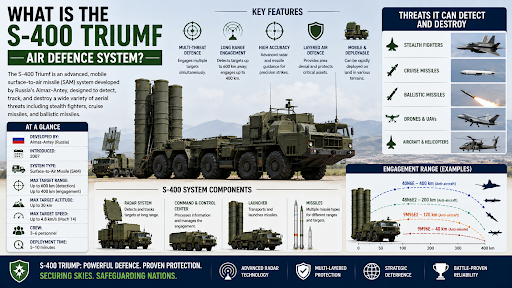
The S-400 Triumf, which the Indian armed forces officially name the 'Sudarshan Chakra', operates as a highly advanced, mobile surface-to-air missile system.
Russia's Almaz-Antey corporation develops and manufactures this world-renowned defense architecture.
India secured a $5.43 billion contract in October 2018 to acquire five S-400 regimental systems.
What Are the Key Features of the S-400 System?
The S-400 delivers a detection range of 600 km and maintains an engagement range of 40 to 400 km.
The sophisticated radar arrays track up to 300 aerial targets simultaneously and actively engage 36 targets at once.
Each standard S-400 squadron deploys 16 vehicles, which include command-and-control units, engagement radars, and multiple Transporter Erector Launchers (TELs).
The system launches four highly specialized interceptor missiles to establish a layered defense: the 40N6 (400 km range), the 48N6E3 (250 km range), the 9M96E2 (120 km range), and the 9M96E (40 km range).
The 40N6 ultra-long-range missile ascends into space up to 30,000 meters before descending to destroy targets over the earth's curvature.
The launchers easily shoot down diverse aerial threats, including stealth fighter jets, surveillance aircraft, drones, cruise missiles, and tactical ballistic missiles.
To ensure total self-reliance, India establishes an indigenous maintenance, repair, and overhaul (MRO) facility with Almaz-Antey, which becomes fully operational by 2028.
How Do CAATSA Sanctions Influence the Indo-Russia S-400 Deal?
The United States enacted the Countering America's Adversaries Through Sanctions Act (CAATSA) in 2017 to punish nations that trade defense equipment with Russia.
The CAATSA secondary-sanction exposure threatens the procurement process and heavily restricts international payment routing.
India bypasses these restrictions by leveraging strong strategic autonomy arguments and refusing to compromise national security interests.
To resolve the payment friction, India institutionalizes rupee-rouble transaction mechanisms and alternative financial channels.
How Does the S-400 Enhance India's Regional Security Dynamics?
India strategically deploys S-400 squadrons towards the Pakistan border (covering Punjab, Rajasthan, and Gujarat) and to protect the Line of Actual Control (LAC) with China.
The system creates a highly formidable 400km strike denial envelope that dominates Pakistani airspace and covers major military installations deep inside adversary territory.
The Sudarshan Chakra proved its decisive combat capability during Operation Sindoor (May 2025) by executing a record-breaking 314 km surface-to-air kill against a Pakistani surveillance aircraft.
The S-400 outclasses Pakistan’s Chinese-supplied HQ-9/P air defense system, which only manages a maximum engagement range of 125 km and engages just 8 to 10 targets simultaneously.
The deployment establishes the outermost layer of India's multi-tiered air defence network, integrating with medium-range systems like the Barak-8 and India's upcoming indigenous Project Kusha.
Source: THEHINDU
|
PRACTICE QUESTION Q. Consider the following statements regarding the S-400 Triumf system:
Which of the statements given above is/are correct? A) 1 and 2 only B) 2 and 3 only C) 1 and 3 only D) 1, 2, and 3 Answer: B Explanation Statement 1 is incorrect: The S-400 Triumf is not indigenously developed; it is a Russian-made system. Project Kusha is a separate, indigenous Indian program by the DRDO to develop a long-range air defense system that will eventually complement or replace systems like the S-400. Statement 2 is correct: The S-400 system is designed to engage up to 36 targets simultaneously. It utilizes a suite of four different missiles to cover an engagement range spanning from approximately 40 km to 400 km. Statement 3 is correct: The Indian Air Force has officially designated its S-400 squadrons as 'Sudarshan' (or 'Sudarshan Chakra'), named after the celestial weapon of Lord Vishnu. |
The S-400 is an advanced, mobile surface-to-air missile (SAM) system developed by Russia's Almaz-Antey, designed to detect, track, and destroy a wide variety of aerial threats including stealth fighters, cruise missiles, and ballistic missiles.
In Indian service, the S-400 has been officially named 'Sudarshan Chakra', inspired by the mythological weapon of Lord Krishna.
The S-400 boasts a radar detection range of 600 km and an engagement range of 40 to 400 km. It can track up to 300 targets simultaneously and engage up to 36 of them at once using four different specialised interceptor missiles.

© 2026 iasgyan. All right reserved