The Supreme Court ruled that menstrual health and hygiene in schools is part of the right to life and dignity under Article 21. It linked poor MHM to inequality and school dropouts, directing schools to provide free sanitary pads, proper toilets, and awareness education to remove stigma.
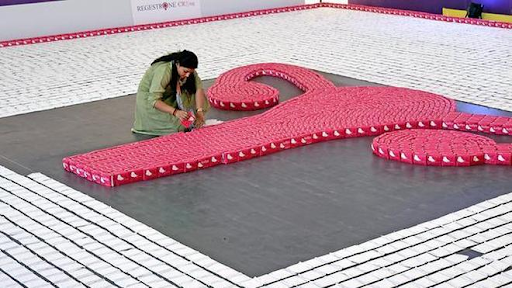
Copyright infringement not intended
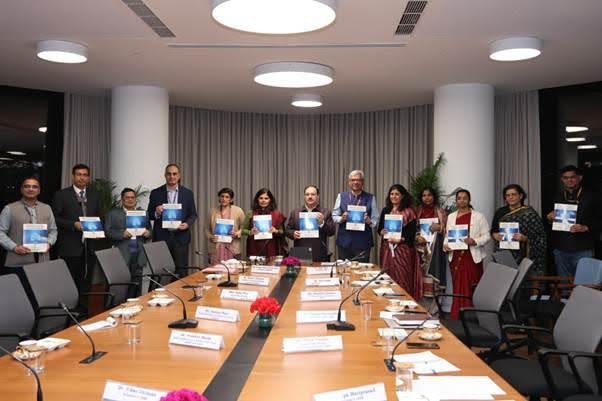
Picture Courtesy: THE HINDU
Context
The Supreme Court declared that the right to menstrual health and access to menstrual hygiene management (MHM) measures in educational institutions is part of the fundamental right to life and dignity under Article 21 of the Constitution.
What is Menstrual Health?
Menstrual health is a state of complete physical, mental, and social well-being in relation to the menstrual cycle.
It is a fundamental human right that impacts a person's dignity, education, and overall quality of life.
Core Components of Menstrual Health
Access to Information: Accurate and age-appropriate knowledge about the menstrual cycle and self-care before, during, and after menstruation.
Essential Products & Facilities: Having affordable, effective menstrual materials (like pads, cups, or tampons) and safe, private facilities for washing, changing, and disposal.
Diagnosis & Care: Timely access to professional medical support for menstrual disorders like severe pain (dysmenorrhea), irregular cycles, or heavy bleeding.
Supportive Environment: A positive social setting free from stigma, shame, and exclusion, allowing individuals to participate fully in work, school, and social activities.
Why It Matters?
Indicator of Overall Health: Changes in menstrual patterns can be an early warning sign of conditions like PCOS, thyroid issues, or anemia.
Prevents Infections: Proper hygiene reduces the risk of urinary tract infections (UTIs) and other reproductive tract infections.
Educational & Economic Participation: Lack of menstrual health resources is a leading cause of school absenteeism for young girls globally.
Fundamental Rights: Recently the Supreme Court ruled that access to menstrual hygiene is an integral part of the right to life and dignity.
SC Judgement on Menstrual Hygiene Management (MHM)
In the case of Dr. Jaya Thakur vs Union of India, the Court declared that the right to menstrual health and access to MHM is an integral part of the fundamental right to life and dignity under Article 21 of the Constitution.
|
Constitutional Provision |
Right Implicated |
Supreme Court's Interpretation |
|
Article 21 |
Right to Life and Dignity |
The Court ruled that inadequate MHM facilities violate the right to a dignified life—including bodily autonomy, privacy, and safe menstrual management—leading to direct humiliation and suffering. |
|
Article 14 |
Right to Equality |
Lack of MHM facilities is a gender-specific barrier to education, denying girls equal participation with boys and violating substantive equality. |
|
Article 21A & RTE Act, 2009 |
Right to Education |
The judgment interprets "free education" under the Right to Education Act as the removal of all barriers, including those related to menstrual health. Schools failing to provide mandatory separate toilets for girls can face severe penalties, including de-recognition. |
The Court observed that a lack of MHM facilities forces female students to choose between their education and their dignity, leading to school absenteeism and high dropout rates.
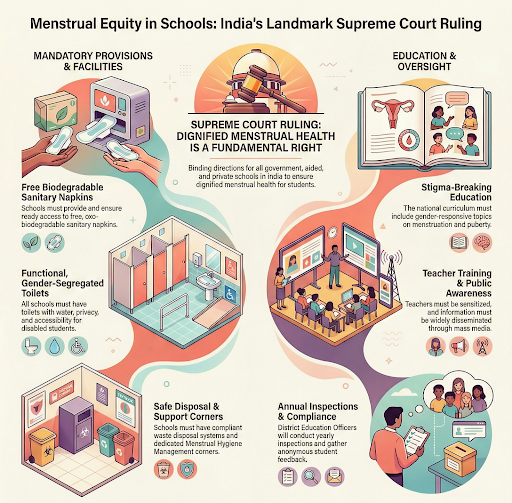
Key Directives of the Supreme Court for all States and Union Territories
Universal Access to Sanitary Products
All schools (government, government-aided, and private) must provide free-of-cost, oxo-biodegradable sanitary napkins to girl students, through vending machines.
Functional and Segregated Toilets
Ensure all schools have functional, gender-segregated, and disabled-friendly toilets equipped with continuous water supply and soap.
Creation of 'MHM Corners'
Schools must establish dedicated MHM corners stocked with essential supplies like spare uniforms, innerwear, and disposal bags to manage emergencies with dignity.
Safe Disposal Mechanisms
Toilets must be equipped with covered waste bins, and schools must ensure regular and hygienic disposal of menstrual waste.
Curriculum and Sensitization
Menstrual health education must be integrated into the school curriculum to educate all students and sensitize male students and teachers, promoting a supportive, stigma-free environment.
The Scale of the MHM Challenge in India
Educational Impact
Poor Menstrual Hygiene Management (MHM) facilities are a major cause of school dropouts, with an estimated 23 million adolescent girls leaving school yearly after puberty. (Source: Dasra Report).
A 2022 study in Delhi revealed that 40% of girls missed school during their periods due to pain, shame, or fear of staining their clothes.
Health Consequences
Unhygienic practices, such as using cloth, ash, or husk, increase the risk of Reproductive Tract Infections (RTIs) and other urogenital diseases (Source: World Health Organization).
While the National Family Health Survey-5 (NFHS-5, 2019-21) indicates that 78% of young women (15-24 years) use a hygienic method, a large portion, especially in rural areas, still relies on unsafe alternatives.
Socio-Economic Barriers
Period Poverty: The inability to afford menstrual products forces low-income families to prioritize other essential expenses over hygiene, directly impacting girls' health and education.
Social Stigma & Lack of Awareness: Deep-rooted taboos hinder open discussion. 71% of adolescent girls were uninformed about menstruation before their first period, fueling myths and hurting self-esteem. (Source: Dasra Report).
Government Initiatives and Existing Gaps
Menstrual Hygiene Scheme (MHS)
Objective: Launched by the MoHFW in 2011 to raise awareness and provide subsidized sanitary napkins in rural areas via ASHA workers.
Gaps: Its impact is limited by inconsistent funding, supply chain disruptions, and a narrow focus on product distribution over comprehensive education and behavioural change.
Swachh Bharat Mission (SBM)
Objective: The 'Swachh Bharat: Swachh Vidyalaya' component aims to improve sanitation infrastructure in schools.
Gaps: Infrastructure improved, with 97.3% of schools having girls' toilets. The focus must shift from construction to functionality: ensuring clean, private facilities with water and proper maintenance. (Source: UDISE+)
State-Level Schemes & Disparities
Kerala and Rajasthan offer free sanitary napkins, but progress is inconsistent. NFHS-5 data highlights wide disparities; hygienic method use exceeds 95% in some states but is below 60% in Bihar and Meghalaya.
Way Forward
Robust Monitoring
Establish a clear accountability mechanism, under the National Commission for Protection of Child Rights (NCPCR), to conduct regular inspections and enforce compliance.
Sustainable Supply Chains
Develop uninterrupted supply chains for eco-friendly sanitary napkins, empowering local Self-Help Groups (SHGs) for production to boost the rural economy.
Comprehensive Education
Integrate MHM into the school curriculum for all genders and train teachers and frontline health workers (ASHAs, Anganwadi workers) to be effective educators.
Community Engagement
Launch mass media and grassroots campaigns to engage parents, community leaders, and men to normalize conversations around menstruation and dismantle taboos.
Focus on Eco-Friendly Solutions
Promote awareness and access to reusable and sustainable alternatives like menstrual cups and cloth pads to manage the environmental burden, as single-use pads generate an estimated 113,000 tons of waste annually in India. (Source: Central Pollution Control Board report)
Learn Lessons from Global Best Practices
Scotland: The Period Products (Free Provision) Act, 2020 made Scotland the first country to make period products universally free.
Kenya: Its 2017 Education Act amendment legally mandates the provision of free, quality sanitary towels in all public schools.
New Zealand: The government provides free period products in all schools after a successful pilot program.
Conclusion
The Supreme Court declared menstrual hygiene as a fundamental right, mandating state responsibility for gender justice and educational equity in India, now the success depends on effective implementation.
Source: THE HINDU
|
PRACTICE QUESTION Q. Discuss the 'domino effect' of menstrual poverty on the right to education (Article 21A) for adolescent girls in rural India. 150 words |
The Supreme Court, in its judgment on January 30, 2026, declared that the right to menstrual health and access to Menstrual Hygiene Management (MHM) in schools is a fundamental right, integral to the right to life and dignity under Article 21 of the Constitution.
The Court directed all schools (government, aided, and private) to provide free sanitary napkins, ensure functional and segregated toilets with water and soap, establish 'MHM corners' for emergencies, implement safe disposal mechanisms, and integrate menstrual health into the curriculum.
'Period Poverty' refers to the inability of individuals and households to afford essential menstrual products due to financial constraints. This economic burden forces many to choose between hygiene and other necessities like food or education, disproportionately affecting low-income families.


© 2026 iasgyan. All right reserved