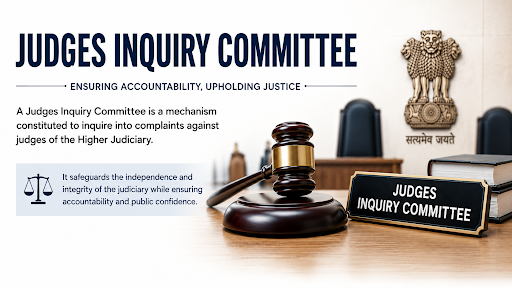
The Judges Inquiry Committee is a vital three-member statutory tribunal formed under the Judges Inquiry Act 1968 to investigate charges of proved misbehaviour or incapacity against a judge, ensuring strict accountability while safeguarding judicial independence from arbitrary, frivolous political interference.
Why In News?
The Judges Inquiry Committee submitted its investigation report concerning Justice Yashwant Varma to Lok Sabha Speaker Om Birla, under the Judges (Inquiry) Act, 1968.
About Judges Inquiry Committee
Constitutional and Statutory Framework
The Constitution of India mandates the removal of a Supreme Court or High Court Judge exclusively on the grounds of proved misbehaviour or incapacity under Article 124(4) and Article 217(1)(b) / 218.
The Judges (Inquiry) Act, 1968 provides the statutory procedure for investigating these charges and presenting an address to the President.
The Act aims to insulate the judiciary from frivolous political attacks while simultaneously ensuring accountability for judicial misconduct.
Initiation and Admission of the Motion
Members of Parliament introduce an impeachment motion in either the Lok Sabha (requires support from at least 100 MPs) or the Rajya Sabha (requires support from at least 50 MPs).
The Speaker (Lok Sabha) or the Chairman (Rajya Sabha) exercises independent discretion to either admit or refuse the motion after consulting relevant persons and materials.
The Speaker or Chairman keeps the motion pending upon admission and immediately proceeds to constitute the Judges Inquiry Committee.
The Presiding Officers constitute a Joint Committee only if both Houses admit notices of motion on the exact same day.
Composition of the Committee
The Committee functions as a high-level, ad-hoc statutory judicial tribunal comprising exactly three members.
The Speaker or Chairman selects the members from the following categories:
Functions and Powers
The Committee formulates definite charges of misconduct or incapacity against the accused judge.
The Committee exercises the powers of a Civil Court, which empowers it to summon witnesses, examine individuals on oath, and demand the discovery and production of documents.
The Committee enforces the principles of natural justice by serving formal charges and allowing the judge to submit a written statement of defence, cross-examine witnesses, and adduce evidence.
The Committee establishes a Medical Board to conduct an examination if the motion alleges physical or mental incapacity.
Reporting and Parliamentary Action
The Committee submits a conclusive, evidence-backed investigation report to the Speaker or Chairman stating its findings on each charge.
Parliament immediately halts all further steps and drops the motion if the Committee finds the judge not guilty.
Parliament takes up the motion and the report for debate and consideration if the Committee finds the judge guilty.
Both Houses must pass the motion by a special majority—an absolute majority of the total membership and at least two-thirds of the members present and voting.
The President of India issues the final removal order after receiving the passed motion from both Houses in the same session.
Source: PIB
|
PRACTICE QUESTION Q. Consider the following statements about the Judges (Inquiry) Act, 1968:
Which of the statements given above is/are correct? A) 1 and 2 only B) 2 and 3 only C) 1 and 3 only D) 1, 2, and 3 Answer: A Explanation: Statement 1 is correct: A motion for removal must be signed by at least 100 members of the Lok Sabha or 50 members of the Rajya Sabha and delivered to the Speaker or Chairman, respectively. Statement 2 is correct: If the motion is admitted, a three-member committee is formed to investigate the charges. This committee must consist of a Supreme Court Judge, a Chief Justice of a High Court, and a distinguished (eminent) jurist. Statement 3 is incorrect: The Presiding Officer (Speaker of the Lok Sabha or Chairman of the Rajya Sabha) has the discretionary authority to admit or refuse the motion after considering whether it is in order. The Secretariat does not perform a substantive assessment of the merits of the allegations; rather, the substantive investigation is the responsibility of the statutory three-member inquiry committee once the motion is admitted. |
It is a high-level, ad-hoc statutory judicial tribunal constituted under the Judges (Inquiry) Act, 1968, to independently investigate specific allegations of proved misbehaviour or incapacity against a judge.
The committee is constituted by the Speaker of the Lok Sabha or the Chairman of the Rajya Sabha immediately after a motion for the removal of a judge is admitted in their respective House.
If the committee's report concludes that the judge is not guilty, the statutory process ends immediately, and the pending motion in Parliament is dropped without further steps.



© 2026 iasgyan. All right reserved