Explore the critical reforms in water governance, highlighting the Jal Jeevan Mission 2.0 extension to 2028, AMRUT 2.0 urban infrastructure strategies, digital IoT monitoring frameworks, and socio-economic impacts to comprehensively prepare for the upcoming UPSC examinations.
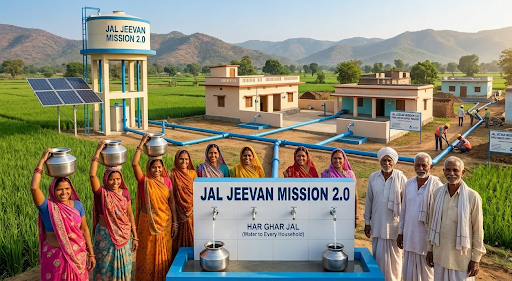
Mizoram and Ladakh signed reform-linked MoUs with the Union Government under Jal Jeevan Mission 2.0.
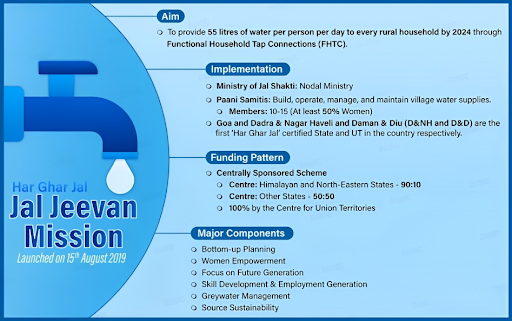
Jal Jeevan Mission was launched on August 15, 2019, as a Centrally Sponsored Scheme implemented by the Ministry of Jal Shakti.
Objectives: Ensure safe, sufficient drinking water (55 liters/person/day) via individual household taps (FHTC) for every rural home nationwide.
Jal Jeevan Mission 2.0 extends the original goal to December 2028, targeting 100% saturation for 19.36 crore rural homes with a ₹8.69 lakh crore outlay.
Sujalam Bharat Digital Framework: A national digital platform mapping the water supply chain from source to tap, providing each village a 'Sujal Gaon/Service Area ID' for real-time monitoring and transparency.
Jal Arpan Initiative: Empowers Gram Panchayats (GPs) and Village Water & Sanitation Committees (VWSCs) to take ownership of commissioning and maintaining water schemes.
Har Ghar Jal Certification: A Gram Panchayat can self-certify as 'Har Ghar Jal' after ensuring that adequate local Operation and Maintenance (O&M) mechanisms are in place.
Jal Utsav: An annual community-led event created to review the functioning of water systems and promote water sustainability at the village level.
Coverage Growth: Rural tap water coverage has exponentially increased from 17% (3.23 crore households) in 2019 to over 81.6% (15.80 crore households) by early 2026. (Source: PIB)
Public Health Improvements: According to WHO, Universal tap water access can prevent an estimated 400,000 diarrheal deaths annually, and a pilot intervention demonstrated a 93% reduction in waterborne diseases. (Source: Tata Trusts)
Women's Empowerment: The mission has reduced the drudgery of fetching water, saving women a collective 5.5 crore hours daily. (Source: WHO)
Employment Generation: The mission is projected to create 59.9 lakh person-years of direct employment and 2.2 crore person-years of indirect employment. (Source: International Labour Organization)
Data vs Functionality Gaps: National Sample Survey reveal a disparity between infrastructure and usage; only 39% of rural households use taps as their primary source.
Water Quality Issues: Rural habitations face severe groundwater contamination from arsenic, fluoride, iron, nitrate, and heavy metals.
Substandard Infrastructure Quality: Post-pipeline public infrastructure restoration and construction have been found to be of substandard quality in many States and UTs.
Weak Operation & Maintenance (O&M): Gram Panchayats and local committees often lack the financial resources and technical capacity required to maintain water schemes over the long term.
Corruption and Irregularities: Widespread issues involving inflated contracts and the use of substandard materials have hampered mission progress and led to action against officials.
Source Sustainability Threats: Depleting groundwater levels and drying water sources pose a severe long-term threat to the viability and sustainability of established water supply schemes.
Strengthen Institutional Capacity: Build the financial and technical capabilities of Gram Panchayats and VWSCs through targeted training in O&M and financial management.
Ensure Source Sustainability: Integrate JJM with initiatives like MGNREGS and Atal Bhujal Yojana to promote continuous water conservation, rainwater harvesting, and aquifer recharge.
Implement Strict Monitoring: Institutionalize independent, third-party audits to verify the actual functionality of connections rather than just their installation.
Prioritize Water Quality Testing: Empower local communities with Field Testing Kits (FTKs) and ensure mandatory regular testing by Gram Panchayats to build public trust.
Adopt a 'User Pays' Principle: Establish a rational and equitable water tariff structure to generate necessary revenue for O&M and ensure financial self-sustainability.
Performance-Based Financing: Link contractor and state payments strictly to the quality and timeliness of results to incentivize efficiency.
Decentralized Water Management: Adopt the Water Safety Plan (WSP) approach to empower local communities to manage their water supplies holistically from source to tap.
Jal Jeevan Mission 2.0's success depends entirely on transitioning from infrastructure creation to sustainable, community-owned, and digitally monitored service delivery.
Source: PIB
|
PRACTICE QUESTION Q. With falling groundwater levels, can Jal Jeevan Mission (JJM) succeed without a massive push for rainwater harvesting and aquifer recharge? Critically Analyze. 150 words |
JJM 2.0 extends the mission to provide functional household tap connections to all 19.36 crore rural households by December 2028, backed by an enhanced total financial outlay of ₹8.69 lakh crore.
It is a national digital framework introduced to map the entire water supply chain from source to tap, assigning a unique 'Sujal Gaon/Service Area ID' to each village for complete transparency and real-time monitoring.
It is a community-driven initiative that formally empowers Gram Panchayats and Village Water & Sanitation Committees (VWSCs) to take ownership of the commissioning, handover, and maintenance of local water schemes.





© 2026 iasgyan. All right reserved