India, the world’s largest groundwater user, faces a deepening crisis due to unchecked extraction, weak regulation, and distorted subsidies. Despite CGWA and Atal Bhujal Yojana, depletion persists. Sustainable solutions need demand-side management, stronger laws, and community-led, decentralised groundwater governance.
Copyright infringement not intended
Picture Courtesy: DOWNTOEARTH.
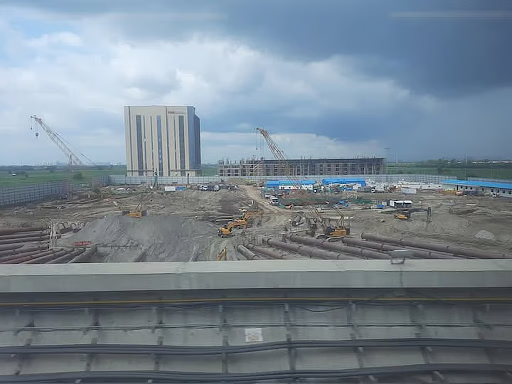
Authorities in Uttar Pradesh have issued a notice to a Microsoft project in Greater Noida for allegedly extracting groundwater without the legally required permissions.
Unauthorized Groundwater Extraction refers to the withdrawal of groundwater without a valid No Objection Certificate (NOC) from the Central Ground Water Authority (CGWA) or relevant State Ground Water Authorities.
Under the Environment (Protection) Act, 1986, extracting groundwater for commercial or industrial use without authorization is considered a criminal offense.
Regulatory bodies like the National Green Tribunal (NGT) have mandated strict enforcement to prevent rapid water table depletion.
The National Compilation on Dynamic Ground Water Resources of India, 2025, published by the Ministry of Jal Shakti, provides the most recent data on the status of groundwater units (Blocks/Talukas/Mandals).
|
Category |
Number of Assessment Units |
Percentage of Total |
Description |
|
Over Exploited |
730 |
10.80% |
Extraction exceeds the annually replenishable groundwater recharge. |
|
Critical |
201 |
2.97% |
Extraction is between 90% and 100% of the annual recharge. |
|
Semi-Critical |
758 |
11.21% |
Extraction is between 70% and 90% of the annual recharge. |
|
Safe |
4946 |
73.14% |
Extraction is less than 70% of the annual recharge. |
|
Saline |
127 |
1.88% |
Groundwater is contaminated with saline water. |
Demand-Side Pressures
Agricultural Dependence
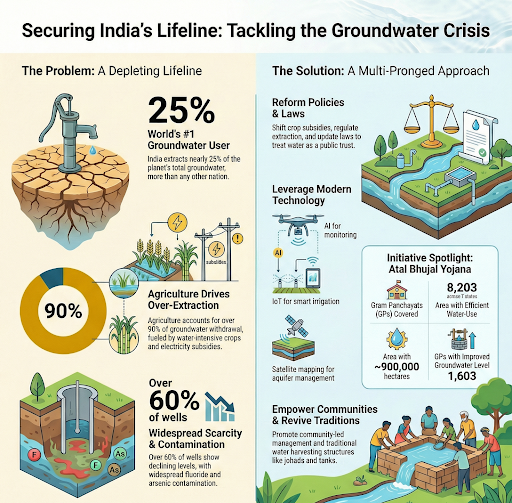
Agriculture accounts for nearly 90% of groundwater extraction, driven by policies like MSP that incentivize water-intensive crops such as paddy and sugarcane, particularly in states like Punjab and Haryana.
Urbanization & Industrialization
Rapid urban growth and industrial expansion create concentrated pockets of high water demand, leading industries and real estate projects to depend on unauthorized extraction to bypass regulatory delays and costs.
Population Growth
Increasing population directly translates to higher demand for drinking water and food, putting immense pressure on groundwater reserves.
Governance and Policy Gaps
Outdated Legal Framework
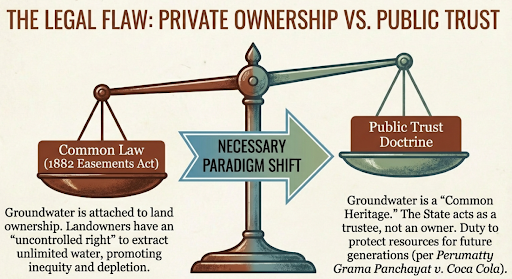
The Indian Easement Act of 1882 grants private groundwater ownership linked to land, hindering state regulation and leading to overexploitation.
Weak Enforcement
Understaffed Central Ground Water Authority (CGWA) and state bodies lack resources for effective monitoring and enforcement, resulting in widespread non-compliance.
Perverse Subsidies
Free/subsidized agricultural electricity leads to excessive water pumping, depleting aquifers and increasing power use.
Lack of Data & Monitoring
The lack of real-time aquifer data and extraction monitoring hinders the implementation of targeted water conservation.
Environmental Consequences
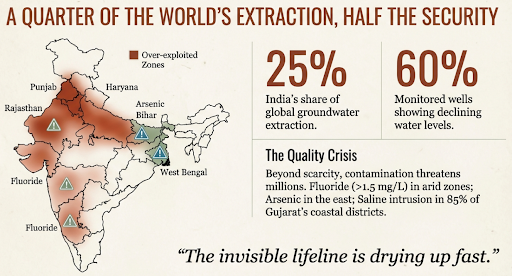
Declining Water Tables: Millions of wells have dried up, forcing farmers to drill deeper, which increases pumping costs and energy consumption.
Land Subsidence: Over-extraction in alluvial regions causes the land to sink, damaging infrastructure like buildings, roads, and bridges.
Water Quality Degradation: Deeper aquifers often have higher concentrations of contaminants like arsenic and fluoride, leading to severe public health crises. In coastal areas, it results in saltwater intrusion, rendering aquifers unusable.
Ecological Damage: Depletion of groundwater affects wetlands, rivers, and ecosystems that depend on groundwater for sustenance.
Socio-Economic Consequences
Agrarian Distress: Increased costs of pumping, crop failures due to water scarcity, and falling productivity push small and marginal farmers into debt and poverty.
Drinking Water Scarcity: It disproportionately affects marginalized communities who cannot afford to dig deeper wells or buy water from tankers, exacerbating social inequity.
Health Crises: Water-borne diseases and health issues like fluorosis and arsenicosis increase the burden on public health infrastructure.
Inter-state and Intra-state Conflicts: Scarcity often leads to conflicts over shared water resources between communities and states.
|
Initiative |
Strengths |
Limitations & Challenges |
|
Atal Bhujal Yojana (ATAL JAL) |
Scheme in 7 water-stressed states emphasizes community-led demand-side management to create Gram Panchayat-level Water Security Plans. |
Limited to specific areas, national scalability is challenging. Success relies heavily on slow community participation and behavioral change. |
|
Jal Jeevan Mission (JJM) |
Increased tap water access in rural homes, prioritizing quality-affected areas. |
Focus on providing connections (har ghar jal) needs better integration with source sustainability for long-term water security. |
|
PM-KUSUM Scheme |
Solarizing agricultural pumps reduces the carbon footprint and gives farmers reliable daytime power. |
Solar power is a double-edged sword. Unregulated "free" solar risks groundwater over-extraction. Linking pumps to the grid to sell surplus power encourages conservation but is slowly adopted. |
Strengthening Governance and Regulation
Unified National Law: Enact a robust and uniform national law that delinks water rights from land ownership and establishes groundwater as a public trust resource.
Empowering Local Bodies: Devolve power for groundwater management to local self-governments (Panchayats and Urban Local Bodies) as they are best positioned to regulate local resources.
Technology for Monitoring: Use modern technology like GIS, remote sensing, and smart meters for real-time mapping, monitoring of extraction, and ensuring compliance.
Demand-Side Management (DSM)
Promoting Water-Efficient Agriculture: Shift from 'Per Drop More Crop' to a broader strategy that includes promoting less water-intensive crops (e.g., millets), micro-irrigation (drip and sprinkler), and reforming MSP and electricity subsidy policies.
Industrial Water Efficiency: Mandate and incentivize water audits, recycling, reuse, and Zero Liquid Discharge (ZLD) technologies for industries.
Supply-Side Augmentation
Managed Aquifer Recharge (MAR): Implement large-scale scientific rainwater harvesting and artificial recharge projects to replenish depleted aquifers. The Jal Shakti Abhiyan: Catch the Rain campaign is a key initiative in this direction.
Reviving Traditional Systems: Integrate and revive traditional water conservation structures like johads, talabs, and step-wells into modern water management plans.
Community Participation
Community-Led Management: Schemes like the Atal Bhujal Yojana focus on empowering local communities in 7 water-stressed states to prepare and implement water security plans.
Public Awareness: Promote a culture of water conservation through extensive awareness campaigns, making 'water-wise' behaviour a societal norm.
Unauthorized groundwater extraction demands a shift to integrated management through a robust legal framework, strict enforcement, technology, demand management, and community participation, acknowledging groundwater as a vital shared public resource.
Source: DOWNTOEARTH.
|
PRACTICE QUESTION Q. The Mihir Shah Committee (2016) is frequently mentioned in the context of reforms in: (a) Banking Sector (b) Agricultural Pricing (c) Water Governance (d) Electoral System Answer: (c) Explanation: The Mihir Shah Committee (2016) was appointed to restructure and reform the Central Water Commission (CWC) and the Central Ground Water Board (CGWB). Its recommendations aimed to improve the management of water resources across the country. |
Groundwater is critical for India's water security. It is the dominant source of drinking water, meeting approximately 85% of rural and 50% of urban needs. It also forms the backbone of Indian agriculture by fulfilling the majority of irrigation requirements.
The primary drivers include regulatory gaps and weak enforcement by authorities, perverse incentives like subsidised electricity for agriculture, an MSP regime favouring water-intensive crops, and burgeoning water demand from rapidly growing industries and urban centres.
Atal Bhujal Yojana is a central sector scheme aimed at improving groundwater management through community participation. It is implemented in identified water-stressed states and focuses on strengthening institutions and empowering local communities to create and implement Water Security Plans.



© 2026 iasgyan. All right reserved