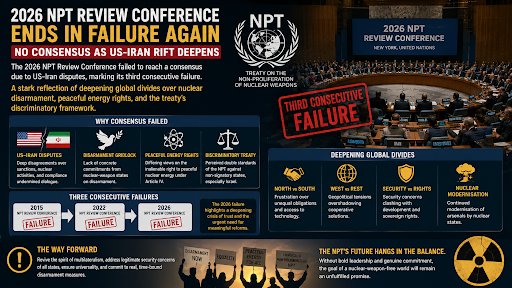
The 2026 NPT Review Conference failed to reach a consensus due to US-Iran disputes, marking its third consecutive failure. This exposes deepening global divides over nuclear disarmament, peaceful energy rights, and the treaty's discriminatory framework against non-signatory states.
Why In News?
The 11th Nuclear Non-Proliferation Treaty (NPT) Review Conference in May 2026 concluded without a consensus outcome.
What is Nuclear Non-Proliferation Treaty (NPT)?
The NPT serves as the foundation of the international nuclear non-proliferation and disarmament regime.
It is the only multilateral binding treaty that commits Nuclear-Weapon States (NWS) to disarmament.
Timeline: Approved by the UN General Assembly in 1968; entered into force in 1970.
Three Pillars: The treaty operates on three central principles:
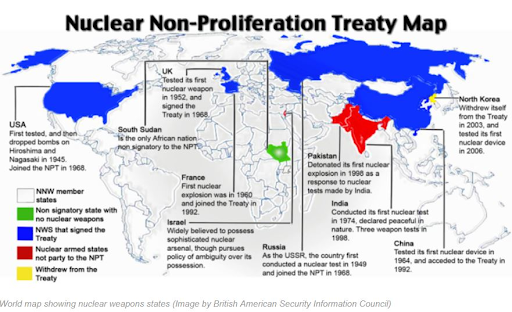
Definition of Nuclear-Weapon States (NWS): The treaty recognizes only those countries that possessed nuclear weapons before January 1, 1967. These include the USA, UK, France, China, and Russia (formerly USSR).
Membership: Currently comprises 191 member states.
Monitoring Authority: The International Atomic Energy Agency (IAEA) monitors compliance through comprehensive safeguards agreements and Additional Protocols.
Article X (Withdrawal): Grants states the right to withdraw if "extraordinary events" jeopardize their "supreme interests." This requires a three-month notice provided to all parties and the UN Security Council.
Why Did Member States Fail to Reach Consensus during the 11th NPT Review Conference?
The 11th Review Conference (RevCon), held in New York, failed to adopt a final consensus document, marking the third consecutive time (following 2015 and 2022) the conference ended without agreement.
Key Reasons for Failure
The "Iran Issue": Consensus stalled primarily due to unresolved issues regarding Iran's nuclear program.
US vs Russia Perspectives:
Geopolitical Friction: Rising nuclear rhetoric, the modernization of nuclear arsenals, and deep international tensions made bridge-building between NWS and Non-Nuclear Weapon States (NNWS) increasingly difficult.
India's Position on the NPT and Nuclear Policy
India is one of only five countries (alongside Pakistan, Israel, North Korea, and South Sudan) that has not signed the NPT.
Strategic Objections to the NPT
Discriminatory Nature: India views the treaty as "discriminatory" because it legitimizes the monopoly of five nuclear powers while denying the same rights to other states.
"Nuclear Club": India argues the NPT creates a group of "nuclear haves" and "nuclear have-nots" rather than pursuing universal, comprehensive disarmament.
Sovereignty: India maintains that its nuclear program is essential for national security given the regional security environment.
India’s Nuclear Doctrine
No First Use (NFU): Formally adopted in 2003. India pledges not to use nuclear weapons first but maintains a posture of credible minimum deterrence.
Retaliation Policy: India promises staggering and punitive retaliation if a nuclear attack occurs on Indian territory or its forces anywhere.
Global Disarmament Commitment: Despite staying outside the NPT, India remains committed to a nuclear-free world through a non-discriminatory, time-bound action plan.
Source: INDIANEXPRESS
|
PRACTICE QUESTION Q. Consider the following statements regarding the Treaty on the Non-Proliferation of Nuclear Weapons (NPT):
Which of the statements given above is/are correct? (a) 1 and 2 only (b) 2 and 3 only (c) 1 and 3 only (d) 1, 2, and 3 Answer: (b) Explanation: Statement 1 is incorrect: While India, Pakistan, and Israel are prominent nations that never signed the NPT, they are not the only ones. South Sudan also never signed the treaty following its independence. Statement 2 is correct: Under Article IX of the NPT, a "nuclear-weapon state" is strictly defined as one that manufactured and exploded a nuclear weapon or other nuclear explosive device prior to January 1, 1967. This legally restricts the recognized status to exactly five nations: the United States, Russia, China, France, and the United Kingdom. Statement 3 is correct: North Korea is the only nation that has officially withdrawn from the NPT (doing so in 2003) to subsequently test and develop nuclear weapons. (India, Pakistan, and Israel are also outside the treaty but they never signed it to begin with). |
The 11th NPT Review Conference ended without a final consensus document primarily due to a deadlock over Paragraph 15, which stemmed from a rigid dispute between the United States and Iran over Tehran's nuclear program and recent military strikes.
The NPT operates on a three-pillar framework: (1) Non-proliferation (preventing the spread of nuclear weapons), (2) Disarmament (reducing and eliminating existing nuclear arsenals), and (3) Peaceful use of nuclear energy (sharing nuclear technology for civilian purposes).
India considers the NPT to be fundamentally flawed and discriminatory. The treaty creates an arbitrary divide between "nuclear haves" (states that tested nuclear weapons before 1967) and "nuclear have-nots," placing restrictions on the latter while lacking enforceable, time-bound disarmament obligations for the former.






© 2026 iasgyan. All right reserved