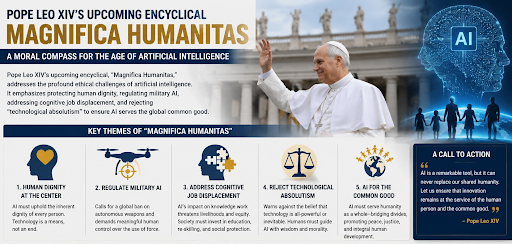
Pope Leo XIV’s upcoming encyclical, "Magnifica Humanitas," addresses the profound ethical challenges of artificial intelligence. It emphasizes protecting human dignity, regulating military AI, addressing cognitive job displacement, and rejecting "technological absolutism" to ensure AI serves the global common good.
Why In News?
Pope Leo XIV to publish his first encyclical "Magnifica Humanitas" to establish global ethical guardrails for Artificial Intelligence to safeguard human dignity against technological absolutism.
What is Magnifica Humanitas?
It is a foundational theological and policy document addressing the protection of the human person in a digital age.
Core Objectives: Preserving human dignity, objective truth, and workers' rights in the rapidly evolving age of artificial intelligence (AI).
Strategic Collaboration: The Vatican invited, co-founder of the AI safety company Anthropic, to speak at the encyclical's presentation, signaling a desire for dialogue between the Church and Silicon Valley .
Global Reach: The document functions as an invitation to interreligious cooperation, calling on Jewish, Muslim, Buddhist, and Hindu traditions to contribute to a global ethical consensus on AI.
What are the Ethical Concerns Raised by Artificial Intelligence
The encyclical and associated Vatican commentaries identify several critical areas where AI poses risks to the human person and the common good.
Reduction of the Human Person to Data
Data-Driven Metrics: AI systems function through data extraction, reducing complex human behavior to measurable and predictable profiles.
Erosion of Mystery: The Pope warns against a "digital technocracy" that compresses human complexity into datasets, potentially ignoring moral growth and interiority.
Objectivity vs Truth: The "aura of objective authority" surrounding generated information can obscure the truth about the human good, which requires subjective perception and prayer.
Existential Crisis of Human Labor
Cognitive Displacement: Unlike previous automation that replaced physical labor, AI threatens cognitive and creative professions, including law, education, and journalism.
Loss of Meaning: Work provides identity and social participation; the delegation of intellectual activity to machines risks a global crisis of meaning.
Market Calculations: The Church asserts that humans are not "disposable components" and that work has intrinsic value beyond economic productivity.
Accountability in Warfare and Surveillance
Lethal Autonomous Weapons: The Pope expresses concern over delegating life-and-death decisions to algorithms, which undermines moral responsibility.
Multilateralism: The Vatican defends multilateralism and international law as fragile but necessary defenses against algorithmic military decision-making.
Ecological and Planetary Impact
Infinite Computation: AI development depends on physical systems that consume vast amounts of electricity, water, and rare earth minerals .
Environmental Degradation: Data centers supporting advanced AI models require energy levels comparable to entire nations, posing a threat to intergenerational justice.
Social Fabric and the Human Voice
Generated Summaries: The Pope warns against using AI to summarize complex spiritual or social discourses, as this "flattens" communication and manufactures rage.
Manipulation of Truth: The human voice is easily eclipsed by anonymous algorithms and "side eddies" of social media commentary.
Source: VATICANNEWS
|
PRACTICE QUESTION Q. With reference to the global discourse on Artificial Intelligence (AI) ethics and the upcoming papal encyclical "Magnifica Humanitas", consider the following statements:
Which of the statements given above is/are correct? A) 1 only B) 1 and 3 only C) 2 and 3 only D) 1, 2, and 3 Answer: B Explanation: Statement 1 is correct: The encyclical was signed to mark the 135th anniversary of Rerum Novarum (Pope Leo XIII's 1891 encyclical on capital and labor). Pope Leo XIV explicitly draws parallels between the industrial disruptions of the 19th century and the "anthropological and labor disruptions" caused by the AI revolution today, warning that mass unemployment would be a "social calamity". Statement 2 is incorrect: It strongly critiques the "technocratic paradigm" and the "Tower of Babel" mentality, arguing that technology must be subordinate to human dignity and not left to determine the future of civilization on its own. It calls for "slowing things down" and ensuring AI remains a tool rather than a "godless god". Statement 3 is correct: The encyclical highlights the physical costs of digital technology, warning that the "frenzied race" for computing power involves massive energy and water consumption, as well as the extraction of rare earth elements, which risks accelerating environmental degradation. |
It is the first encyclical by Pope Leo XIV, set to be published on May 25, 2026, which focuses on safeguarding the human person and human dignity in the age of Artificial Intelligence.
The key concerns include the reduction of human beings to quantifiable behavioral data, the displacement of meaningful cognitive labor, the massive ecological costs of data computation, and the delegation of lethal decision-making to autonomous military systems.
It is the belief that technological capability should inevitably determine the future direction of civilization, treating innovation as a force beyond democratic or moral control.





© 2026 iasgyan. All right reserved