India established the International Big Cat Alliance to protect seven global big cat species. Despite postponing its first summit due to Ebola, IBCA serves as a vital platform for wildlife conservation, transboundary cooperation, and climate resilience.
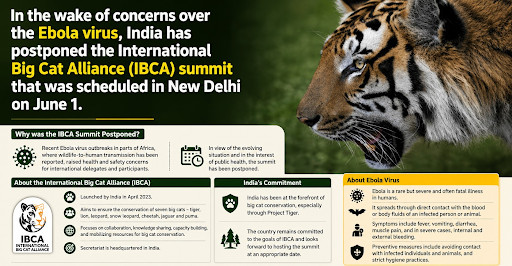
The first International Big Cat Alliance (IBCA) Summit, initially scheduled for June 1–2, 2026, at the Bharat Mandapam in New Delhi, has been postponed.
The International Big Cat Alliance (IBCA) functions as a treaty-based intergovernmental organization and the first global multi-agency coalition dedicated to the conservation of big cats.
Launch: Prime Minister Narendra Modi launched the initiative in April 2023 to commemorate the 50th anniversary of Project Tiger.
Legal Status: It officially became an international legal entity on January 23, 2025, after receiving formal Union Cabinet approval in February 2024.
Headquarters: Permanent headquarters in New Delhi, India.
Inspiration: The IBCA follows a strategic model similar to the International Solar Alliance (ISA), positioning India as a leader in global wildlife diplomacy.
The Seven Major Big Cats
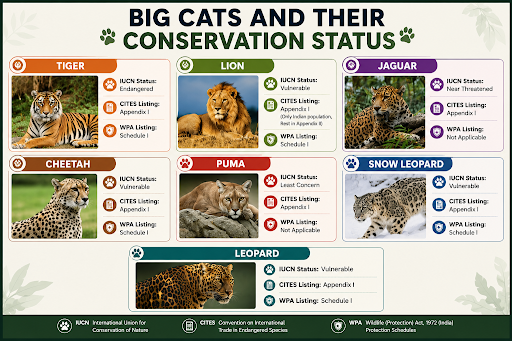
The alliance focuses on the protection and conservation of seven principal big cat species and their habitats:
India is home to five of these species: Tiger, Lion, Leopard, Snow Leopard, and Cheetah (reintroduced). India does not naturally host Jaguars and Pumas.
Membership and Participation
Objectives and Implementation
The IBCA aims to transform big cat conservation into a global sustainability and ecological security agenda:
First International Big Cat Alliance (IBCA) Summit 2026
Source: THEHINDU
|
PRACTICE QUESTION Q. Consider the following statements about the International Big Cat Alliance (IBCA):
Which of the statements given above is/are correct? A) 1 and 2 only B) 2 only C) 2 and 3 only D) 1, 2, and 3 Answer: B Explanation: Statement 1 is incorrect: While the alliance aims to conserve seven major big cat species—Tiger, Lion, Leopard, Snow Leopard, Cheetah, Jaguar, and Puma—not all are naturally found in India. Specifically, Jaguar and Puma do not naturally occur in the wild in India. India is naturally home to only five of these species. Statement 2 is correct: The International Big Cat Alliance (IBCA) officially became a treaty-based intergovernmental organization In January 2025. Its permanent headquarters and secretariat are located in New Delhi, India. Statement 3 is incorrect: Membership is not strictly limited to range countries. While it reaches out to the 95–97 range countries where these cats are naturally found, membership is open to all UN member states, including non-range countries and various international organizations interested in big cat conservation. |
The IBCA is the world's first intergovernmental global alliance launched by India to protect and conserve the world's major big cat species and their ecosystems through collaborative international efforts.
The IBCA focuses on protecting seven major big cat species: the Tiger, Lion, Leopard, Snow Leopard, Cheetah, Jaguar, and Puma.
The summit, originally scheduled for June 1-2, 2026, in New Delhi, was deferred due to an Ebola outbreak in Africa to ensure full and active participation from all African range countries.


© 2026 iasgyan. All right reserved