India and Cyprus elevated bilateral ties to a Strategic Partnership. Key agreements emphasized defence exports, UPI-TIPS fintech integration, counter-terrorism, and maritime trade expansion via IMEC, firmly positioning Cyprus as India's strategic gateway to Europe.
Why In News?
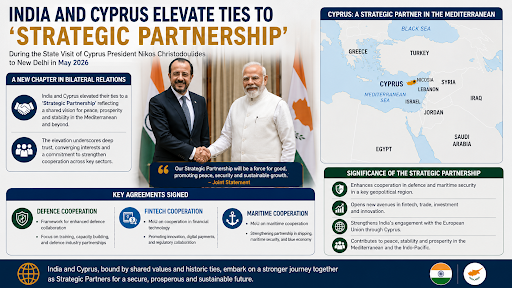
India and Cyprus recently elevated their bilateral ties to a 'Strategic Partnership' during the State Visit of Cyprus President Nikos Christodoulides to New Delhi.
India-Cyprus Strategic Partnership
Historical Foundations: Diplomatic relations between the Republic of Cyprus (RoC) and India began in 1962.
Leadership Legacy: Partnership rests on the foundation laid by RoC’s first President, Archbishop Makarios, and India’s first Prime Minister, Pandit Jawaharlal Nehru. Both were pioneers of the Non-Aligned Movement (NAM).
Support for Sovereignty: India supports the Cypriot struggle against colonialism and its territorial integrity. In return, Cyprus supported India during the 1974 crisis and continues to support India's stance on Jammu and Kashmir.
Strategic Elevation: In May 2026, Prime Minister Narendra Modi and President Nikos Christodoulides elevated bilateral ties to a Strategic Partnership.
Key Institutional Mechanisms: Relations are maintained through annual Foreign Office Consultations (FOC) and the Joint Economic Committee (JEC) established in 1989.
|
About Cyprus Geographic Profile: Cyprus is the third largest and third most populous island in the Mediterranean Sea, located off the coast of the Levant mainland in West Asia. Strategic Division: The island is partitioned by a United Nations Buffer Zone (Green Line) into the internationally recognized Republic of Cyprus (south) and the Turkish Republic of Northern Cyprus (north), the latter recognized only by Turkey. British Legacy: Cyprus was a British colony from 1914 until it gained independence in 1960. The UK retains two Sovereign Base Areas: Akrotiri and Dhekelia. Economic Status: It is a developed country with a high-income economy, member of the European Union and the eurozone. |
Why is Cyprus Important to India?
Strategic Location: Cyprus sits at the crossroads of Europe, Africa, and Asia, making it a vital component of the India-Middle East-Europe Economic Corridor (IMEEC).
EU Gateway: Cyprus currently presides over the Council of the European Union and serves as a critical investment gateway for Indian companies entering the European market.
Multilateral Support: Cyprus advocates for India’s permanent membership in the UN Security Council (UNSC) and supports India in the Nuclear Suppliers Group (NSG).
Geopolitical Buffer: Stronger ties with Cyprus serve as a diplomatic response to the Turkey-Pakistan nexus, particularly Ankara's opposition to India's sovereignty over Jammu and Kashmir.
Areas of Cooperation
|
Sector |
Key Initiatives |
|
Defense & Security |
5-year Roadmap for Defense Cooperation (2026-2031). Cyprus is keen to procure Indian military hardware, including drones and missiles tested during Operation Sindoor. |
|
Economy & Finance |
Cyprus is India’s 9th largest source of FDI, with cumulative inflows of USD 16 billion from April 2000 to June 2025. (Source: MEA) Aim to double Cypriot investment in India over the next five years, focusing on infrastructure, energy, and agriculture. |
|
Financial Connectivity |
Implementation of UPI (Unified Payments Interface) in Cyprus is scheduled for 2027. Cyprus to open a Trade Center in Mumbai to facilitate B2B engagement. |
|
Institutional Presence |
Establishing Indian university campuses in Cyprus and exploring a Cypriot campus in GIFT City to enhance faculty and student exchanges. |
|
Maritime Security |
Cyprus joined the Indo-Pacific Oceans Initiative (IPOI) and co-chairs the pillar on trade connectivity and maritime transport. |
|
Technology & Space |
Establishment of a Cyber Security Dialogue and a Joint Working Group on Counter-terrorism. Both nations celebrated India-Cyprus Space Day in May 2026. |
|
Multilateralism |
India provided three Force Commanders for the UN Peacekeeping Force in Cyprus (UNFICYP) since 1964. |
What are the Challenges in India-Cyprus Relations?
The Turkey Factor: Turkey’s military support for Pakistan, including the provision of Axisguard Songar drones used against Indian installations in 2025, complicates regional stability.
Northern Cyprus Occupation: The illegal occupation of Northern Cyprus remains a diplomatic hurdle, as India refuses to recognize the Turkish-controlled entity while Turkey continues to challenge Indian sovereignty in international forums.
Geopolitical Uncertainty: Ongoing conflicts in Ukraine and West Asia create economic volatility that impacts trade routes and investment flows within the Mediterranean.
Trade Imbalance: Bilateral trade stood at USD 140.47 million in 2024-25, showing room for significant growth compared to the high levels of investment.
Way Forward for Strengthening Relations
Migration and Mobility: Expeditious finalization of the Migration and Mobility Partnership Agreement (MMPA) and a Social Security Agreement to benefit the 16,000 Indians residing in Cyprus.
IMEEC Integration: Strengthening the connectivity dialogue to ensure Cyprus acts as a primary Mediterranean node for the India-Middle East-Europe Economic Corridor.
Trade Expansion: Operationalize the Mumbai Trade Center to facilitate cross-border partnerships.
Financial Interoperability: Establish a framework for UPI interoperability with the European Central Bank's Target Instant Payment Settlement (TIPS) system.
Direct Connectivity: Work toward establishing direct air links to facilitate business and investment ties
Consular Engagement: Launch a Consular Dialogue to address the needs of the growing movement of people.
Conclusion
The elevation of ties to a Strategic Partnership transforms a historical friendship into a modern, security-oriented alliance that secures India's interests in the Mediterranean and the European Union.
Source: PIB
|
PRACTICE QUESTION Q. The term "Green Line", frequently seen in international news, is associated with which one of the following? A) A maritime boundary dispute in the South China Sea. B) A United Nations-patrolled buffer zone dividing Cyprus. C) An ecological corridor planned across the Sahel region of Africa. D) The de facto border separating Israel and Lebanon. Answer: B Explanation: The "Green Line" is a demilitarized zone that has stretched approximately 180 km across Cyprus since 1974. It divides the Republic of Cyprus (predominantly Greek Cypriot) in the south from the self-declared Turkish Republic of Northern Cyprus in the north, and is strictly monitored by the United Nations Peacekeeping Force in Cyprus. |
India and Cyprus elevated their Comprehensive Partnership to a Strategic Partnership during the May 2026 State Visit of President Nikos Christodoulides.
Cyprus is situated in the eastern basin of the Mediterranean Sea. It lies approximately 65 kilometers south of Turkey, 100 kilometers west of Syria, and about 770 kilometers southeast of mainland Greece.
Geographically, Cyprus is located in Western Asia / Middle East due to its proximity to the Anatolian peninsula and the Levant. Politically and culturally, however, it is considered a European nation and has been a member of the European Union since 2004.

© 2026 iasgyan. All right reserved