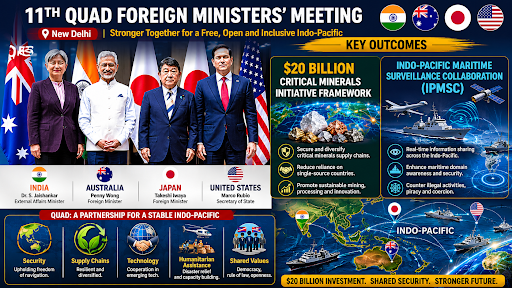
The May 2026 Quad Foreign Ministers’ Meeting in New Delhi focused on securing the Indo-Pacific. Key outcomes include a $20 billion Critical Minerals Initiative to build resilient supply chains, enhanced maritime surveillance through IPMSC, and a new energy security framework.
Why In News?
The 11th Quad Foreign Ministers' Meeting, held in New Delhi resulted in the launch of a $20 billion Critical Minerals Initiative Framework to secure supply chains and the Indo-Pacific Maritime Surveillance Collaboration (IPMSC).
What is Quad?
The Quad (Quadrilateral Security Dialogue) is an informal strategic partnership between India, the US, Japan, and Australia.
Origins & Evolution
Core Objective: The grouping maintains a commitment to a free and open Indo-Pacific that is inclusive and resilient.
Foundational Principles: Members prioritize the rule of law, sovereignty, territorial integrity, and the peaceful resolution of disputes.
Operational Style: The Quad functions as a flexible organization without a formal secretariat, focusing on delivering tangible benefits through practical cooperation.
Strategic Vision: The alliance opposes any unilateral or destabilizing actions that seek to change the status quo through force or coercion.
Key Outcomes of the 11th Quad Foreign Ministers' Meeting (2026)
Hosted by India, the meeting launched several high-impact initiatives to secure regional supply chains, enhance maritime surveillance, and foster technological innovation.
The Quad Critical Minerals Initiative Framework
This is an agreement to secure supply chains for elements essential to semiconductors, electric vehicles (EVs), and defense manufacturing.
Financial Commitment: Quad partners intend to mobilize up to $20 billion in government and private sector support.
Scope of Cooperation: The framework covers the entire lifecycle of minerals: mining, processing, recycling, and recovery.
Strategic Objectives:
Implementation Tools: Use of export credit agencies, development finance institutions, and mechanisms like loans, guarantees, and equity participation.
Maritime and Transnational Security
Ministers emphasized that the prosperity of the Indo-Pacific depends on the uninterrupted flow of commerce and the safety of critical sea lanes.
IPMDA Operationalization: India operationalized the Indian Ocean Region programme of the Indo-Pacific Partnership for Maritime Domain Awareness (IPMDA) via the Information Fusion Centre (IFC-IOR) in Gurugram.
Maritime Surveillance: The launch of the Indo-Pacific Maritime Surveillance Collaboration (IPMSC) aims to share real-time information and surveillance efforts, initially in the Indian Ocean.
Undersea Cable Connectivity: Partners committed to ensuring all Pacific Island Forum countries have undersea cable connections by 2026 to secure their digital futures.
Port Infrastructure: The Quad will coordinate with the Government of Fiji to advance port infrastructure and secure regional trade corridors.
Economic and Energy Security
Indo-Pacific Energy Security Initiative: This new initiative focuses on energy resilience and maintaining open trade flows for essential goods.
Quad Fuel Security Forum: A newly established forum to coordinate high-level discussions on energy market stability.
Supply Chain Diversification: Ministers underscored the need to avoid reliance on any single country for critical industrial sectors.
Critical and Emerging Technology
Advanced Technologies: Continued commitment to 5G, 6G, Artificial Intelligence (AI), and biomanufacturing.
Expand Pax Silica Initiative: India formally joined this US-led initiative to build resilient supply chains for silicon and minerals underpinning the AI era.
Standards Development: Plans include workshops on digital identity standards and a "Track 1.5" on standards workforce development.
Source: THEHINDUBUSINESSLINE
|
PRACTICE QUESTION Q. Discuss the strategic significance of the Quad Critical Minerals Initiative Framework in reducing global supply chain vulnerabilities and countering China's dominance in rare earth elements. 150 words |
It is a framework launched by India, the US, Australia, and Japan to mobilize up to $20 billion in government and private sector support to strengthen critical mineral supply chains, encompassing mining, processing, and recycling.
The IPMSC is a new Quad initiative that leverages advanced technology to augment maritime surveillance and share real-time information, focusing initially on the Indian Ocean Region.
It is a US-led initiative, which India formally joined in February 2026, aimed at building secure and resilient supply chains for foundational AI technologies, silicon, and critical minerals.


© 2026 iasgyan. All right reserved