The U.S. exit from the International Solar Alliance is largely symbolic, with limited financial impact on India’s robust solar sector. The greater risk is to developing nations’ projects, placing higher responsibility on India to lead the ISA and champion the Global South’s clean energy transition.
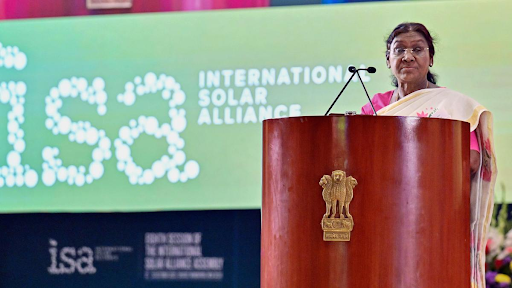
Copyright infringement not intended
Picture Courtesy: THEHINDU
Context
The US withdrawal from 66 international bodies, including the India-headquartered International Solar Alliance (ISA), is expected to affect global climate action, Indian leadership, and the energy transition in the Global South.
|
Read all about: International Solar Alliance l International Solar Alliance Explained l India's global leadership on climate change l India is a Leader in Renewable Energy |
What is International Solar Alliance (ISA)?
Origin
It was launched in 2015 by the Prime Minister of India, Narendra Modi, and the President of France, François Hollande, at the COP21 summit in Paris.
Headquarters
The ISA is the first international organisation headquartered in India at the National Institute of Solar Energy (NISE) in Gurugram, Haryana.
Membership
Originally intended for "sunshine countries" between the Tropics of Cancer and Capricorn, a 2020 amendment opened membership to all United Nations Member States. As of early 2026, it has over 125 member and signatory countries.
Mandate
To scale up the deployment of solar energy technologies, making solar power more affordable and accessible, especially in developing nations. It focuses on mobilizing finance, de-risking investments, and promoting technology adoption.
The "Towards 1000" Strategy
The ISA operates under a flagship roadmap to achieve four major milestones by 2030:
Flagship Initiatives
Governance
How will the U.S. exit affect the ISA?
The U.S. exit poses both practical and symbolic challenges, though its direct financial impact is expected to be minimal.
|
Impact |
Details |
|
Financial Impact |
Minimal. The U.S. contributed $2.1 million (about 1% of total funds) to the ISA over three years after joining in 2021. Indian officials confirm USA withdrawal will not affect core operations. |
|
Investor Confidence |
Significant. The withdrawal of the largest global economy could negatively impact financial institutions and private investors, leading to increased caution and slowing solar project funding and implementation in risk-sensitive developing nations. |
Impact on Indian solar industry
The Indian domestic solar ecosystem is largely insulated from the immediate effects of the U.S. withdrawal due to its strong internal fundamentals.
Robust Manufacturing Growth
India has scaled up its domestic solar manufacturing. By late 2025, solar module manufacturing capacity is projected to reach 144 gigawatts (GW), a jump from 63 GW in 2024 (Source: Ministry of New and Renewable Energy).
Policy-Driven Self-Reliance
Government policies like the Production Linked Incentive (PLI) scheme have successfully catalyzed investments across the solar value chain, promoting self-reliance
Stable Investment Pipeline
Investments in the solar sector are driven by strong domestic demand and long-term Power Purchase Agreements (PPAs). The U.S. is not a primary source of funding for Indian solar projects.
Key Risks for the Global South
The true economic risk of the U.S. exit is concentrated in developing nations, particularly in Africa, Least Developed Countries (LDCs), and Small Island Developing States (SIDS).
Dependence on International Finance
These regions depend heavily on multilateral development banks and international cooperation for concessional financing to de-risk solar projects; less multilateral commitment increases investment risks.
Existing Barriers to Adoption
Developing nations already struggle with high upfront costs, poor grid infrastructure, and technical expertise gaps, issues that a less cooperative global climate could exacerbate.
Impact on ISA's Role
The ISA is vital for African energy access, as the continent has 60% of global solar resources but only 1% of solar capacity. Investment cuts threaten key projects like solar pump installations in Senegal and Uganda, and Mali's 500 MW Solar Park. (Source: International Solar Alliance
Implications for India's Global Leadership
The U.S. withdrawal elevates India's responsibility and provides an opportunity to solidify its leadership in global climate action.
ISA as a Diplomatic Tool: The ISA is a core element of India's foreign policy, highlighting commitment to South-South cooperation and reflecting the nation's broader vision of "One Earth, One Family, One Future."
Increased Onus on India: The responsibility to steer the alliance, mobilize funds, and maintain momentum now falls heavily on India and France.
Opportunity to Cement Influence: Navigating this challenge successfully will solidify India's reputation as a dependable global leader, able to build coalitions and provide global public goods.
Way Forward For India
Diversify Funding
Lead efforts to broaden the ISA's funding base by engaging other major economies, development banks, and the private sector to create innovative financing solutions.
Strengthen South-South Cooperation
Use platforms like the G20 to enhance technical assistance and capacity-building programs for ISA member countries.
Champion the OSOWOG Vision
Accelerate the "One Sun One World One Grid" initiative to create large-scale, bankable regional grid interconnection projects that attract investors
Build a Resilient Domestic Industry
Build a complete domestic solar manufacturing ecosystem, from polysilicon to modules, to secure India's energy future and establish it in the global solar supply chain.
Conclusion
The U.S. withdrawal from the ISA challenges climate cooperation but offers India a strategic opportunity to lead the Global South by strengthening the alliance's capacity and its domestic solar industry.
Source: THEHINDU
|
PRACTICE QUESTION Q. "The U.S. withdrawal from international climate platforms creates a leadership vacuum that India is uniquely positioned to fill." Discuss. 150 words |
The ISA is an international, treaty-based organization launched by India and France in 2015. Headquartered in Gurugram, India, its primary goal is to promote solar energy to reduce dependence on fossil fuels, aiming to mobilize over $1 trillion in investments for 1,000 GW of solar capacity by 2030.
India's solar project costs are not dependent on U.S. equipment. The country has a robust domestic solar module manufacturing ecosystem, supported by government initiatives like the Production Linked Incentive (PLI) scheme, which keeps costs competitive.
The most significant risk is not financial but symbolic. The exit of a major economy could erode investor confidence in the global climate finance landscape, making private lenders more cautious. This could slow down funding for crucial solar projects in developing nations in Africa and Asia that rely on multilateral support.



© 2026 iasgyan. All right reserved