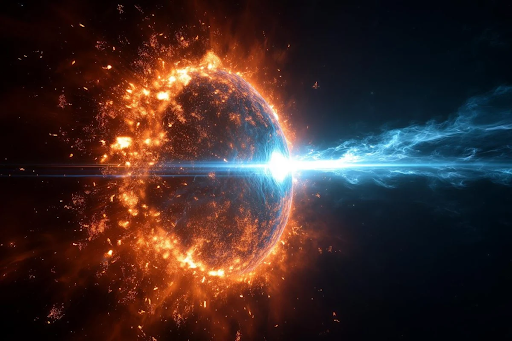
Launched in 2021, the James Webb Space Telescope (JWST) is the world's most powerful infrared observatory. It peers through cosmic dust to study the first stars, ancient galaxies, and exoplanet atmospheres, revealing the 13.5-billion-year history of the universe.
Copyright infringement not intended
Picture Courtesy: SCITECHDAILY
Context
The James Webb Space Telescope (JWST) has detected evidence of extremely massive early-universe stars known as “monster stars.”
What is James Webb Space Telescope (JWST)
It is the largest, most powerful infrared space observatory ever built, launched in 2021, by NASA, the European Space Agency (ESA), and the Canadian Space Agency (CSA).
It orbits the Sun 1.5 million km from Earth, using a 6.5-meter gold-plated mirror to peer 13.5 billion years back in time to study the first galaxies, stars, and exoplanets.
Key Aspects of the JWST
Purpose: To observe the earliest stars and galaxies, study the formation of planetary systems, and examine the atmospheres of exoplanets for potential signs of life.
Infrared Technology: Unlike the Hubble Space Telescope, which sees mostly visible light, JWST observes in infrared, allowing it to pierce through cosmic dust and see the very first, highly red-shifted light.
Unprecedented Sensitivity: It is about 100 times more sensitive than Hubble and can detect objects much fainter and farther away.
Recent Achievements (2025–2026)
Galaxy MoM-z14: Confirmed as one of the most distant galaxies ever seen, appearing as it was only 280 million years after the Big Bang.
Exoplanet K2-18b: Detected possible chemical signatures of biological activity (like dimethyl sulphide) in the atmosphere of this distant "Hycean" world.
Planetary Defense: In March 2026, Webb observations were used to successfully rule out any chance of the asteroid 2024 YR4 impacting the Moon in 2032.
3D Auroras on Uranus: Mapped the vertical structure of the ionosphere and auroras on Uranus for the first time.
What are "Monster Stars"?
"Monster stars" are recently discovered primordial, supermassive stars that existed in the early universe, weighing 1,000 to 10,000 times the mass of the Sun.
These objects explain the rapid, early formation of supermassive black holes. They left a distinct chemical signature (high nitrogen, low oxygen) from intense core burning.
Key details about monster stars:
Source: SCITECHDAILY
|
PRACTICE QUESTION Q. With reference to the James Webb Space Telescope (JWST), consider the following statements:
Which of the statements given above is/are correct? A) 1 only B) 1 and 2 only C) 2 and 3 only D) 1, 2 and 3 Answer: A) 1 only Explanation: Statement 1 is correct: The JWST is a major international collaboration led by NASA, with significant contributions from the European Space Agency (ESA) and the Canadian Space Agency (CSA). Statement 2 is incorrect: Unlike the Hubble Space Telescope, which observes primarily in the ultraviolet and visible light spectrum, the JWST is designed to observe the universe primarily in the infrared spectrum (near-infrared and mid-infrared). Statement 3 is incorrect: The JWST does not orbit the Earth. Instead, it is located at the Sun-Earth Second Lagrange Point (L2), which is approximately 1.5 million kilometres away from Earth. In contrast, the Hubble Space Telescope orbits the Earth at a much lower altitude of about 570 km. |
They are a theorized first generation of stars formed in the early universe from primordial hydrogen and helium. They are believed to have been exceptionally massive, ranging from 1,000 to 10,000 times the mass of our Sun.
JWST analyzed the chemical composition of a very distant galaxy, GS 3073, and detected an unusually high ratio of nitrogen to oxygen. This specific chemical signature matches theoretical models of the chemical enrichment produced by "monster stars."
Due to their immense gravitational pull, monster stars do not explode in a supernova when they die. Instead, they collapse entirely inward under their own gravity to form a black hole, preserving most of their enormous mass in the resulting "seed."



© 2026 iasgyan. All right reserved