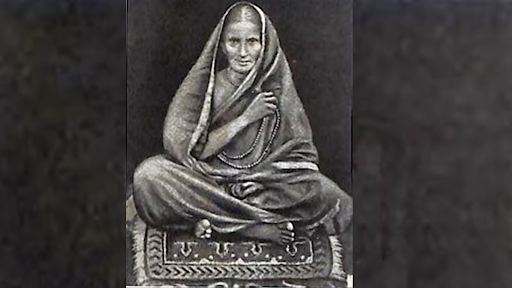
Rassundari Devi (c. 1809–1890) was a 19th-century Bengali woman who wrote Amar Jiban (1876), the first autobiography by an Indian woman. Despite strict patriarchal restrictions against female literacy, she secretly taught herself to read, driven by a deep desire to read religious texts.
Copyright infringement not intended
Picture Courtesy: INDIANEXPRESS
Context
Rassundari Devi’s story has gained attention as an example of women’s resistance to patriarchal restrictions in 19th-century India.
Who was Rassundari Devi?
Rassundari Devi (1800–1890) was the author of the first full-length autobiography in the Bengali language.
The Autobiography: Amar Jiban (My Life)
Historical Significance: Published in 1876, Amar Jiban broke the silence of the private domestic sphere, providing a rare first-person account of a woman's life in 19th-century Bengal.
Literary Structure: The book is divided into two parts; the first consists of 16 'rachanas' (compositions) detailing her childhood, marriage, and spiritual awakening.
The Struggle for Literacy
Societal Taboos: During her time, it was a widespread superstition that a literate woman would bring bad luck or become a widow.
Secret Learning: Married at age 12 into a conservative zamindar family, she taught herself to read in secret by stealing pages from her husband's religious books and matching letters to the words she heard during prayers.
The Catalyst: Her primary motivation for learning was her deep religious desire to read the Chaitanya Bhagavata, a hagiography of the saint Chaitanya Mahaprabhu.
Legacy and Impact
Feminist Icon: She is regarded as a precursor to modern Indian feminism, proving that the domestic kitchen could also be a site of intellectual rebellion.
Historical Source: Her work serves as a primary source for historians to understand the social history of Bengal, the condition of the zamindari system, and the "Antapur" (inner quarters) of the 1800s.
Source: INDIANEXPRESS
|
PRACTICE QUESTION Q. Consider the following statements regarding Rassundari Devi: 1. Amar Jiban is widely considered the first full-length autobiography written by an Indian woman. 2. Rassundari Devi was formally educated at the Bethune School established by Ishwar Chandra Vidyasagar. Which of the above statements is/are correct? (a) 1 only (b) 1 only (c) Both 1 and 2 (d) Neither 1 nor 2 Answer: (a) Explanation: Statement 1 is Correct: Amar Jiban (My Life), published in 1876, is widely recognized as the first full-length autobiography written by an Indian woman. It provides a rare and intimate account of the domestic life and struggles of a woman in 19th-century Bengal. Statement 2 is Incorrect: Rassundari Devi did not receive a formal education at any institution. She was a self-taught scholar who learned to read and write in secret, often hiding pages of books while performing her domestic chores. |
Rassundari Devi (1809-1900) was a Bengali woman from a rural zamindar family who, despite being denied formal education due to restrictive social norms, secretly taught herself to read and write. She authored 'Amar Jiban' ('My Life'), the first autobiography written by an Indian woman.
The primary barriers included deep-seated patriarchal beliefs that education was a sin for women, superstitions that a literate woman would become a widow, and social customs like child marriage and the purdah system, which confined women to the domestic sphere.
Driven by a desire to read a religious text, she secretly took a page from her husband's book and a leaf from the kitchen. Over many years, she painstakingly taught herself the alphabet by comparing the letters on the page with those she


© 2026 iasgyan. All right reserved