The Kavaratti OTEC project in Lakshadweep will use ocean thermal gradients to generate clean electricity and desalinate seawater, reducing reliance on diesel and scarce freshwater sources. Part of India’s Deep Ocean Mission, it supports the Blue Economy and offers a sustainable model for island territories.
Copyright infringement not intended
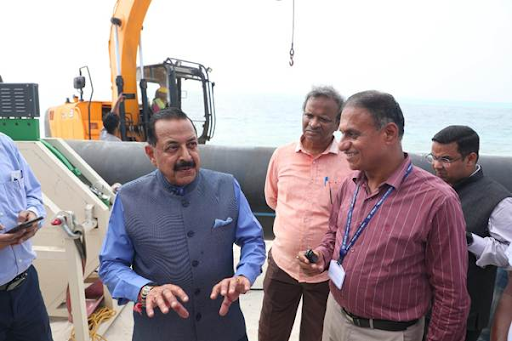
Picture Courtesy: PIB
Context
India is developing an Ocean Thermal Energy Conversion (OTEC) plant in Kavaratti, Lakshadweep, under the Deep Ocean Mission, to generate clean energy and fresh drinking water.
What is Ocean Thermal Energy Conversion (OTEC)?
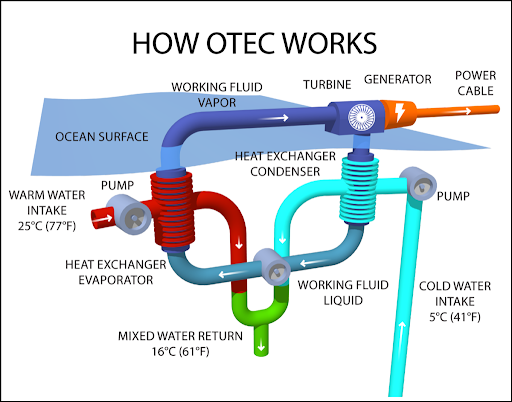
OTEC is a renewable energy technology that generates electricity by using the natural temperature difference between the warm surface water of the ocean and the cold deep-sea water.
How does it operate?
Kavaratti OTEC Plant
The Kavaratti plant uses a closed-cycle system to generate power and desalinate water:
What are the Benefits of the OTEC Project?
Socio-Economic Benefits
Water & Energy Security: Provides a stable, continuous supply of freshwater and electricity, improving the quality of life for residents.
Economic Savings: Reduces the high costs associated with transporting diesel fuel to the remote islands.
Boost to Blue Economy: The nutrient-rich deep seawater discharged from the plant can be used for aquaculture and marine biotechnology, creating new economic opportunities, similar to the "Kumejima Model" in Japan.
Environmental Benefits
Clean Energy: Offers a clean, renewable alternative to fossil fuels, significantly reducing the islands' carbon footprint.
Baseload Power: Unlike solar or wind, OTEC provides consistent, 24/7 power, which is crucial for stable electricity supply.
Ecosystem Support: The OTEC platform can act as an artificial reef, attracting marine life and potentially supporting coral restoration efforts.
Implementation Challenges
Technological & Engineering
Laying a deep-sea cold-water pipeline is complex due to the difficult seabed (coral, rocks). The project has high initial capital costs due to the need for large, specialized equipment.
Logistical
Construction and maintenance are limited to a narrow window due to the monsoon season and rough sea conditions.
Environmental
The discharge of cold, nutrient-rich water could alter the local marine ecosystem. Careful management is needed for biocides (like chlorine) used to keep pipes clean. Installation could also cause localized habitat damage.
Way Forward
Continued R&D: Investing in research to improve efficiency and reduce the high capital costs of OTEC plants.
Environmental Monitoring: Establishing a strong framework to monitor long-term environmental impacts and ensure sustainability.
Skill Development: Creating a skilled workforce in ocean engineering to support the expansion of India’s Blue Economy.
International Collaboration: Partnering with global leaders in OTEC to share knowledge and accelerate technological advancement.
Conclusion
The Lakshadweep OTEC project provides a holistic solution for climate resilience, energy security, and economic growth in its strategically important and ecologically sensitive island territories.
Source: PIB
|
PRACTICE QUESTION Q. With reference to Ocean Thermal Energy Conversion (OTEC), consider the following statements:
Which of the statements given above is/are correct? A) 1 only B) 1 and 2 only C) 2 and 3 only D) 1, 2 and 3 Answer: B Explanation: Statement 1 is correct: Ocean Thermal Energy Conversion (OTEC) uses the temperature difference (thermal gradient) between warm tropical surface waters and cold, deep ocean waters to generate electricity. Statement 2 is correct: OTEC systems generally require a minimum temperature difference between the surface and deep water to operate efficiently. Statement 3 is incorrect: Unlike solar photovoltaic plants, OTEC can operate 24 hours a day, providing a continuous, baseload power supply because the temperature difference remains relatively constant, regardless of sunlight. |
OTEC is a renewable energy technology that generates electricity by using the temperature difference between warm surface ocean water and cold deep ocean water to run a heat engine.
The Deep Ocean Mission is an ambitious Indian government initiative (2021-2026) with a budget of ₹4,077 crore. It aims to develop technologies for exploring and sustainably harnessing deep-sea resources, including minerals and ocean energy. The Kavaratti OTEC plant is a key project under this mission.
The main challenges include high initial capital costs, complex engineering hurdles like laying deep-sea pipelines in difficult terrain, logistical constraints due to weather, and potential environmental impacts on marine ecosystems that require careful management.



© 2026 iasgyan. All right reserved