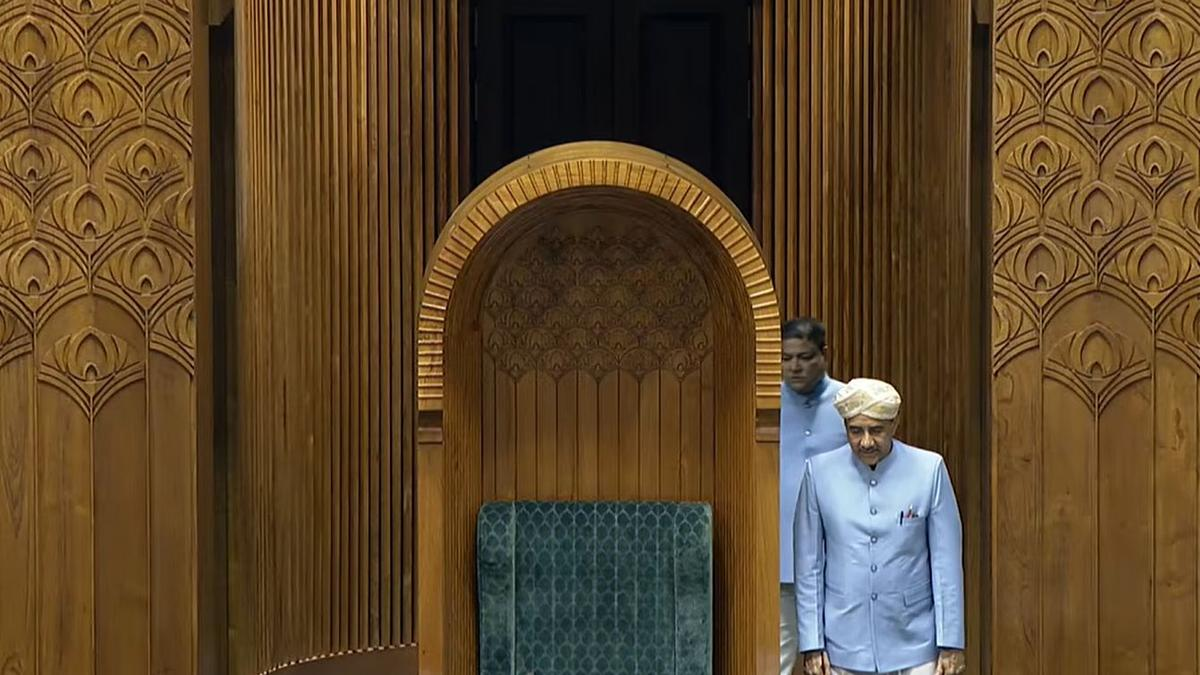
The Lok Sabha Speaker, as presiding officer, maintains decorum, regulates proceedings, and interprets parliamentary rules. Elected by MPs, the Speaker holds constitutional authority, including certifying money bills, presiding over joint sittings, and ruling on member disqualifications. They act as the impartial guardian of parliamentary privileges.
Copyright infringement not intended
Picture Courtesy: THEHINDU
Context
The no-confidence motion against the Lok Sabha Speaker has initiated a debate on the constitutional role and impartiality of the office, which is vital for the orderly functioning of Indian democracy.
|
Read all about: Post of Speaker l Removal of Lok Sabha Speaker |
Why is the Lok Sabha Speaker a Pillar of Parliamentary Democracy?
The Speaker is the head of the Lok Sabha and its principal spokesperson. Their authority is derived from the Constitution, the Rules of Procedure of the House, and parliamentary conventions.
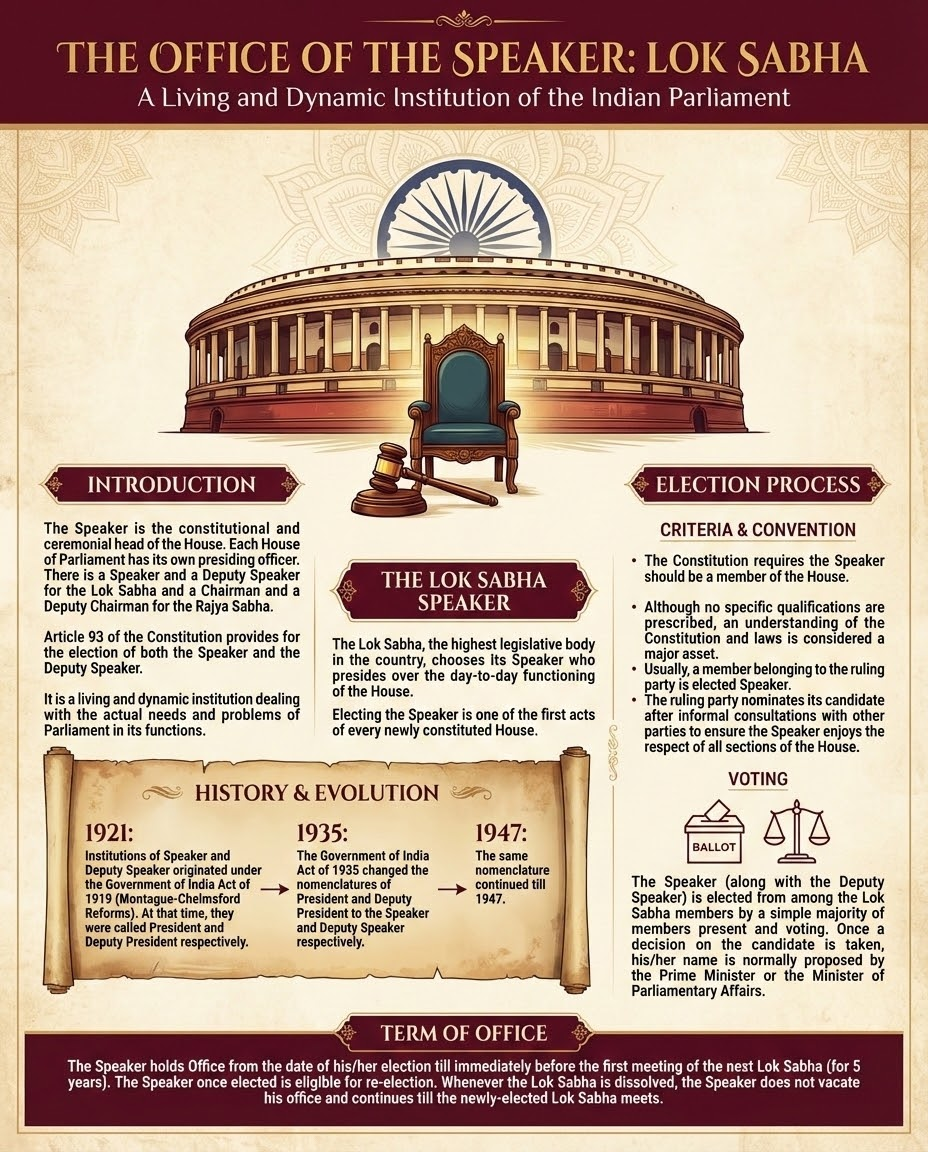
Key functions include:
Guardian of Order: The Speaker's primary duty is to maintain discipline and decorum in the House, ensuring that legislative business is conducted smoothly.
Final Interpreter of Rules: Within the House, the Speaker's interpretation of the Constitution, rules of procedure, and parliamentary precedents is final.
Protector of Members' Rights: They are responsible for safeguarding the rights and privileges of all members of the House, regardless of their political affiliation.
Quasi-Judicial Powers: The Speaker holds significant adjudicatory powers:
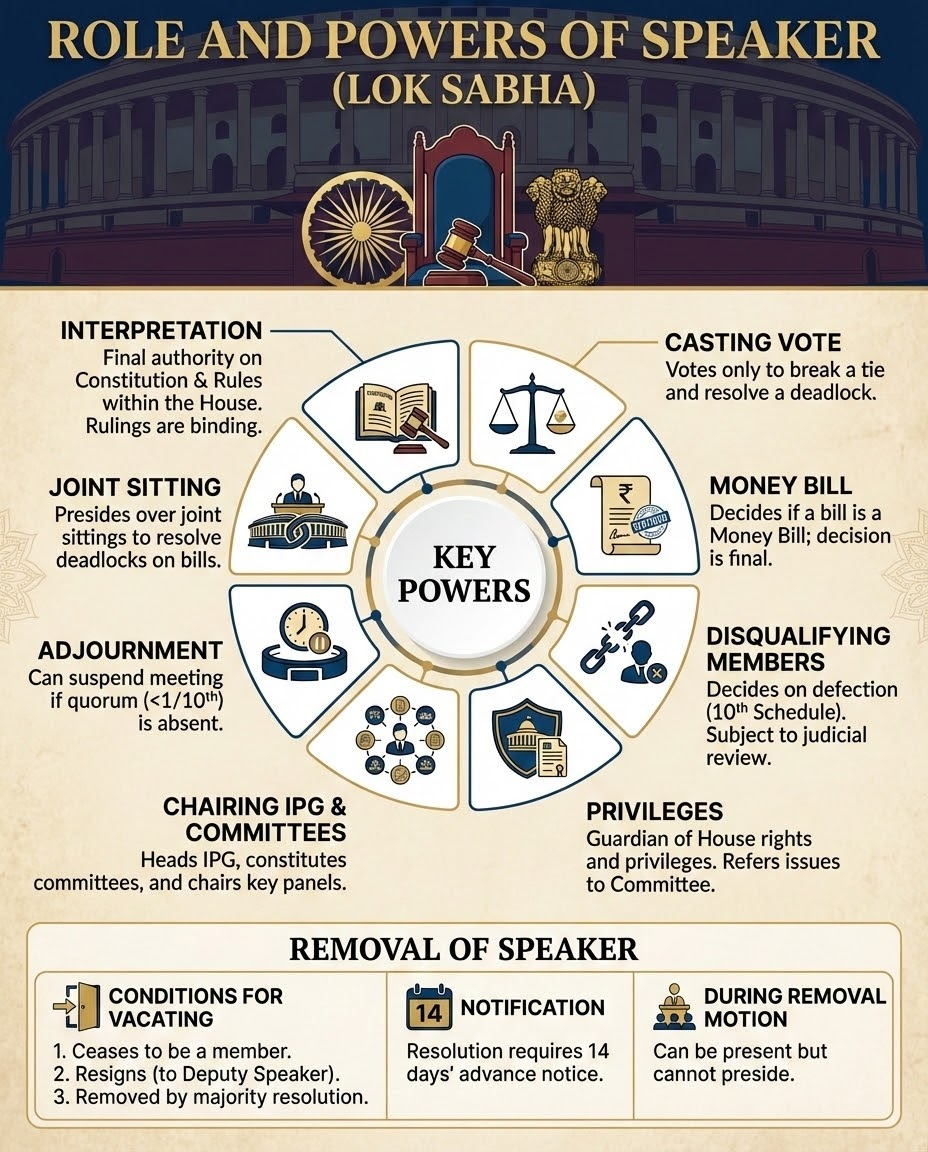
Constitutional Procedure for the Speaker's Removal
The process for removing the Speaker is intentionally rigorous to ensure stability and protect the office from political pressure.
Historical Attempts at Removal
Motions to remove the Speaker are very rare in Indian parliamentary history, and none have ever been successful.
|
Speaker |
Year |
Outcome |
|
G.V. Mavalankar |
1954 |
The first motion, debated and decisively defeated. |
|
Hukam Singh |
1966 |
The motion failed at the introduction stage as it did not get the support of 50 members. |
|
Balram Jakhar |
1987 |
The motion was debated on the floor of the House and was defeated. |
Challenges to the Speaker's Impartiality
Continuing Party Affiliation
Unlike the UK, the Indian Speaker does not formally resign from their political party after being elected. This creates a potential conflict of interest and reliance on the ruling party for re-election.
Controversial Rulings
Anti-Defection Law: Speakers have been accused of delaying or hastening decisions on disqualification petitions to benefit the ruling party.
Certification of Money Bills: The classification of important bills like the Aadhaar Bill as 'Money Bills' has been criticized as a tactic to bypass the scrutiny of the Rajya Sabha.
Suppressing Opposition Voice: Allegations include disallowing debates and questions from the opposition and unfairly suspending members, which stifles democratic discussion.
Way Forward to Strengthen the Office
Adopt the UK Convention
Political parties should build a consensus for the Speaker to formally resign from their party upon election to ensure visible neutrality.
Independent Adjudication
Implement the Supreme Court's suggestion to create an independent tribunal, to decide on defection cases under the Tenth Schedule.
Enhance Transparency
The Speaker should provide clear, public reasoning for crucial decisions, such as certifying Money Bills or disallowing debates, to build trust and reduce perceptions of bias.
Promote Dialogue
Regular, structured dialogue between the Speaker and leaders of all parties can help build consensus on procedural matters and reduce friction within the House.
Learn Lessons from Global Best Practices
The United Kingdom's convention for its Speaker offers a robust model for ensuring impartiality:
Conclusion
The Speaker, as the custodian of parliamentary sanctity, must maintain impartiality, and strengthening the neutrality of this high office through reforms and consensus is crucial for public trust in the legislative body.
Source: THEHINDU
|
PRACTICE QUESTION Q. With reference to the removal of the Speaker of the Lok Sabha, consider the following statements: 1. A resolution for the removal of the Speaker can be moved only after giving at least 14 days' advance notice. 2. During the proceedings for their removal, the Speaker cannot preside over the House but has the right to speak and participate in the proceedings. Which of the statements given above is/are incorrect? A) 1 only B) 2 only C) Both 1 and 2 D) Neither 1 nor 2 Answer: D Explanation: Statement 1 is correct: According to Article 94(c) of the Constitution, a resolution to remove the Speaker can only be moved after giving at least 14 days' advance notice of the intention to move such a resolution. Statement 2 is correct: Under Article 96(1), when a resolution for their removal is under consideration, the Speaker cannot preside over the House. However, Article 96(2) explicitly grants them the right to speak, participate in the proceedings, and be present in the House during such discussions. |
The Speaker is the presiding officer of the Lok Sabha, responsible for maintaining order and decorum, interpreting constitutional provisions and rules of the House, and safeguarding the rights and privileges of its members.
As per Article 94(c) of the Constitution, the Speaker can be removed by a resolution passed by an 'effective majority' (a majority of all the then members of the House). A 14-day advance notice must be given, and the motion needs the support of at least 50 members to be introduced.
An 'effective majority' means more than 50% of the effective strength of the House, which is calculated as the total strength of the House minus the number of vacant seats. It is a higher threshold than a simple majority of members present and voting.



© 2026 iasgyan. All right reserved