Under Article 94(c), the Lok Sabha Speaker can be removed by an effective majority after 14 days’ notice. Despite key powers over Money Bills and Tenth Schedule cases, party affiliation raises bias concerns. Judgments like Nabam Rebia and Kihoto Hollohan fuel calls for neutral reforms.
Copyright infringement not intended
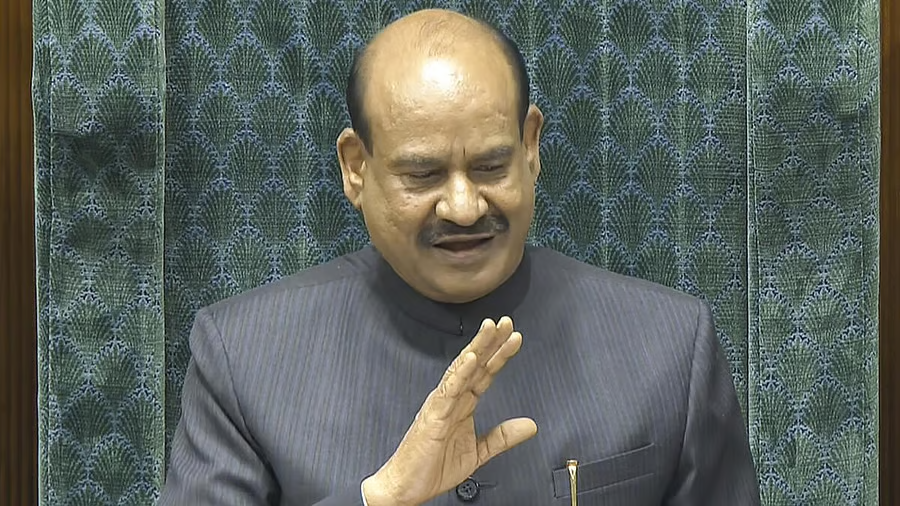
Picture Courtesy: DECCANHERALD
Context
Opposition parties are moving to remove Lok Sabha Speaker Om Birla, claiming he acted "blatantly partisan," leading him to step aside from chairing proceedings pending resolution.
|
Read all about: Post of Speaker l Lok Sabha Speaker accepted a no-confidence motion |
How is the Speaker of the Lok Sabha Removed from Office?
The procedure for removing the Lok Sabha Speaker is governed by Article 94 of the Constitution and Rules 200–203 of the Lok Sabha Rules of Procedure.
Constitutional Procedure for Removal
Initiation of Motion: To remove the Speaker, a resolution requires at least 14 days' advance notice, signed by a minimum of 50 Lok Sabha members.
Majority Required: Resolution must be passed by an Effective Majority.
Speaker's Role During Proceedings: As per Article 96, the Speaker cannot preside over the House sitting when a resolution for their removal is under consideration.
As of February 2026, No Lok Sabha Speaker has ever been removed from office; however, removal motions were initiated against G.V. Mavalankar (1954), Hukam Singh (1966), and Balram Jakhar (1987).
About the Office of Speaker
Authority: The Speaker is the highest authority of the Lok Sabha and its presiding officer.
Election: Elected by a simple majority of the members of the House.
Precedence: Ranks 6th in the Indian order of precedence, alongside the Chief Justice of India.
Powers and Constitutional Role of the Speaker
|
Power/Role |
Constitutional/Legal Basis |
Details |
|
Guardian of the House |
Rules of Procedure and Conduct of Business in Lok Sabha |
The Speaker is the final interpreter of the Constitution and rules in the House, and their procedural decisions are generally final and cannot be challenged in court. |
|
Certifying Authority for Money Bills |
Article 110(3) |
The Speaker's decision on a bill being a Money Bill is final. The Supreme Court (Aadhaar Judgment, 2018) allows judicial review only if the decision is a "colourable exercise of power." |
|
Quasi-Judicial Role (Anti-Defection) |
Tenth Schedule (Anti-Defection Law) |
The Supreme Court, in Kihoto Hollohan vs Zachillhu (1992), upheld the Speaker's power to decide on member disqualification for defection but made the final decision subject to judicial review. |
What are the concerns raised over the Speaker's Role?
Partisanship vs Impartiality
The Speaker's continued membership in a political party creates a conflict of interest, unlike the UK convention where the Speaker resigns, potentially compromising impartiality.
Role under the Tenth Schedule
The Speaker's quasi-judicial power to decide on disqualification cases has been a major source of controversy.
The 'Nabam Rebia' Judgment Conundrum (2016)
The Supreme Court ruled that a Speaker cannot begin disqualification proceedings against members under the Tenth Schedule while a resolution for the Speaker's own removal is pending, a tactic used by defecting legislators (such as in the 2022 Maharashtra crisis) to stall their disqualification.
Way Forward
Ensuring Impartiality
Adopting the British convention—where the Speaker resigns from their party upon election—would be a significant step. The Page Committee also recommended that a re-elected House member be automatically considered the Speaker.
Relieving the Speaker of Adjudication
Disqualification under the Tenth Schedule should be decided by an independent authority like the Election Commission or a separate tribunal, as suggested by the Supreme Court in the Keisham Meghachandra Singh case.
Codifying a Code of Conduct
The National Commission to Review the Working of the Constitution (2002) recommended a "Code of Conduct" to regulate the discretionary powers of the Speaker, ensuring they are exercised based on objective criteria.
Speaker's Role in India and Other Democracies
|
Country |
Model of Speakership |
Key Features |
|
United Kingdom |
Impartial / Non-Partisan |
The Speaker resigns from their political party upon election and severs all party ties. They are re-elected unopposed in general elections, ensuring complete political neutrality. |
|
United States |
Partisan |
The Speaker of the House of Representatives is an active and leading member of the majority party. |
|
India |
Hybrid / Quasi-Partisan |
The Speaker must be impartial but is not required to resign from their party. This structural flaw frequently creates a conflict between their constitutional duty and political obligations. |
Conclusion
Constitutional provisions for removing the Speaker are vital checks. However, frequent partiality claims show a deep systemic flaw. Insulating the Speaker's office from politics, as the 2nd Administrative Reforms Commission (ARC) suggested, is key to strengthening Indian democracy.
Source: DECCANHERALD
|
PRACTICE QUESTION Q. Do you agree with the view that the Speaker in India should resign from their political party to ensure impartiality? 150 words |
The Speaker can be removed by a resolution passed by a majority of "all the then members of the House." This is technically called an Effective Majority, calculated as the Total Strength of the House minus Vacancies.
Under Article 96, the Speaker has the right to vote in the first instance when a resolution for their removal is under consideration. However, they cannot exercise a casting vote in the case of a tie (equality of votes).
In the Nabam Rebia (2016) judgment, the Supreme Court ruled that a Speaker is disabled from deciding disqualification petitions under the Tenth Schedule (Anti-Defection Law) if a notice for their own removal is pending in the House.



© 2026 iasgyan. All right reserved