

Copyright infringement not intended
Picture Courtesy: INDIANEXPRESS
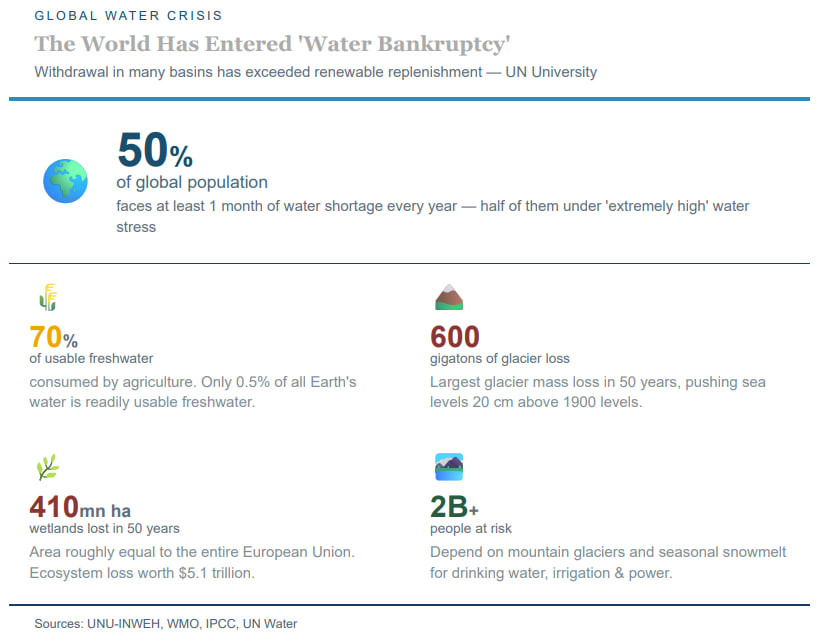
The world is facing "Water Bankruptcy," a severe crisis where water withdrawal exceeds natural replenishment, a term coined by the United Nations University (UNU-INWEH).
Water bankruptcy is an advanced stage of water scarcity. It is characterized by two key conditions:
This contrasts with a 'water crisis', which may be temporary and reversible. Bankruptcy implies a new, permanent reality of managing with fundamentally less water.
Unsustainable Agricultural Practices
Agriculture is the largest consumer of freshwater globally, accounting for approximately 70% of all freshwater withdrawals. (Source: World Bank)
Inefficient Irrigation: Methods like flood irrigation result in massive water loss through evaporation and runoff.
Water-Intensive Crops: Cultivating crops like paddy and sugarcane in arid or semi-arid regions places immense stress on local water sources.
Rapid Urbanization and Industrial Growth
The rapid, often unplanned, growth of cities and industries creates concentrated pockets of high water demand. Currently, 25% of the world's population lives in countries facing extremely high water stress (Source: World Resources Institute).
Destruction of Recharge Zones: Urban sprawl often involves paving over natural recharge areas like wetlands and lakes, preventing rainwater from replenishing groundwater.
Concentrated Demand: Cities require large volumes of water for domestic use, sanitation, and industrial processes.
Pollution of Freshwater Resources
Despite an installed capacity of 44%, operational inefficiencies result in 72% of wastewater being discharged untreated, leading to the contamination of 296 river stretches identified by the Central Pollution Control Board (CPCB).
Climate change intensifies the water crisis in several ways:
Status of Water Resources
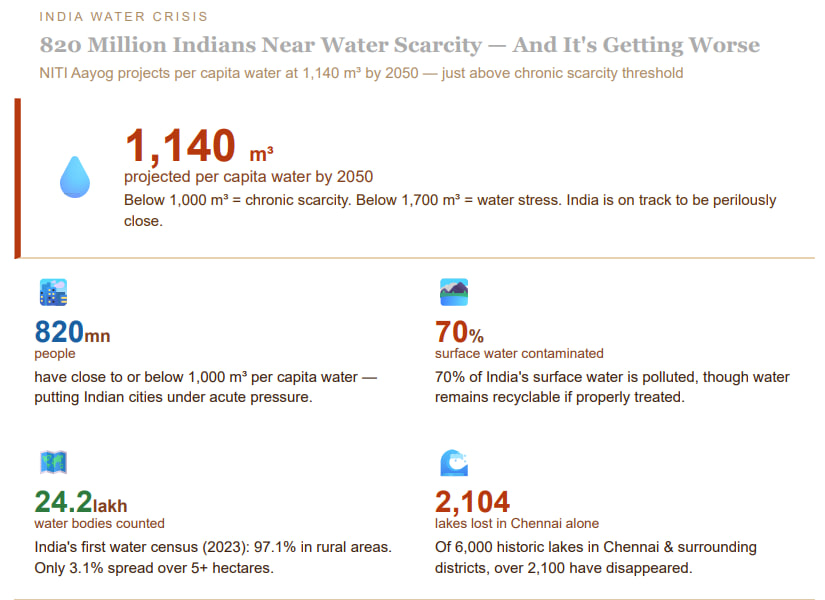
India faces a mismatch between its population and available resources. While the country supports about 18% of the global population, it holds only 4% of freshwater resources.
Per Capita Availability: The Central Water Commission (CWC) assessed India's per capita water availability at 1,513 cubic meters (upward revision from 1,486 m³), which is below the 1,700 cubic meter threshold, classifying India as water-stressed.
Groundwater Depletion
India is the world's largest user of groundwater, abstracting more than the US and China combined. The "Dynamic Ground Water Resources of India" report highlights the severity of this issue:
Agricultural Distress: Water scarcity directly threatens farmer livelihoods and national food security. The World Bank warns that climate-induced water scarcity could cost some regions up to 6% of their GDP by 2050.
Gender Inequality: The burden of collecting water disproportionately falls on women and girls, limiting their access to education and economic opportunities.
Health Impacts: Lack of access to safe drinking water and sanitation contributes to public health crises, including malnutrition. Nearly 35% of children under five in India are stunted, a condition linked to inadequate water and sanitation (Source: NFHS-5).
Conflict and Migration: Competition over shared water resources fuels inter-state disputes (e.g., the Cauvery water dispute) and drives distress migration from rural to urban areas.
Launched in 2019, to Provide Functional Household Tap Connections (FHTCs) to every rural home at 55 litres per capita per day. As of January 2026, over 15.79 crore households (81.57%) have tap water, up from 16.7% in 2019.
It is a World Bank-supported central sector scheme focused on participatory groundwater management, implemented in identified water-stressed areas across seven states to promote sustainable practices at the community level.
A time-bound campaign focused on water conservation and security through citizen participation, emphasizing rainwater harvesting, rejuvenation of traditional water bodies, and promoting water-use efficiency.
Focuses on the rejuvenation of the Ganga river basin through sewage treatment, river-front development, and biodiversity conservation.
Unified Water Governance
Implement the Mihir Shah Committee (2016) recommendation to establish a single National Water Commission (NWC) by integrating the Central Water Commission (CWC) and the Central Ground Water Board (CGWB). This will enable a holistic approach that breaks down the artificial separation between surface and groundwater management.
Adopt a 'One Water' Approach
Cities should adopt Integrated Urban Water Management (IUWM), treating all water sources—rainwater, groundwater, surface water, and wastewater—as a single, interconnected resource. This involves prioritizing wastewater recycling and reuse.
Enhance Water Use Efficiency
Promote micro-irrigation techniques like drip and sprinkler systems, which can reduce water consumption in agriculture. Aligning cropping patterns with regional agro-climatic conditions by reforming subsidies on water-intensive crops is critical.
Data-Driven Management
Invest in a robust, transparent, and publicly accessible national water data system. Using modern technologies like IoT and AI can optimize water distribution, monitor resources in real-time, and improve planning.
Learn from Global Best Practices: The Israel Model
Israel recycles nearly 90% of its wastewater for agricultural use, the highest rate in the world. Its success is built on a tripod of advanced drip irrigation, large-scale desalination, and smart, centralized water management.
India's water crisis, a threat to economic and social stability, demands a structural shift from supply-oriented measures to integrated demand management, conservation, efficiency, and community-driven, data-informed approaches to ensure long-term water security.
Source: INDIANEXPRESS
|
PRACTICE QUESTION Q. “The recurring urban water crises in India are more a manifestation of governance failure than of climatic variability." Critically analyze. (250 words) |
'Water Bankruptcy' is a term introduced by a UN report to describe a severe, post-crisis condition where the amount of water being withdrawn from a basin surpasses the level at which it can be naturally replenished. It signifies that we are depleting our fundamental water capital.
The first census of water bodies enumerated over 2.4 million water bodies, with 97.1% located in rural areas. It found that ponds are the most common type (59.5%). State-wise, West Bengal leads in ponds, Andhra Pradesh in tanks, Tamil Nadu in lakes, and Maharashtra leads in water conservation schemes.
The 'Sponge City' model is an urban planning approach that uses green infrastructure like permeable pavements, green roofs, and rain gardens to absorb, store, and purify rainwater. For Indian cities, adopting this model can help recharge groundwater, mitigate urban flooding, and reduce the strain on centralized water supply systems.
© 2026 iasgyan. All right reserved