India will conduct its first Digital Census in 2027, replacing the 150-year paper system with digital platforms and self-enumeration. It will aid policymaking, delimitation, and welfare targeting, including caste data after 1931. Key challenges include the digital divide, data security, and training over 30 lakh enumerators effectively.
Copyright infringement not intended
Picture Courtesy: PIB
Context
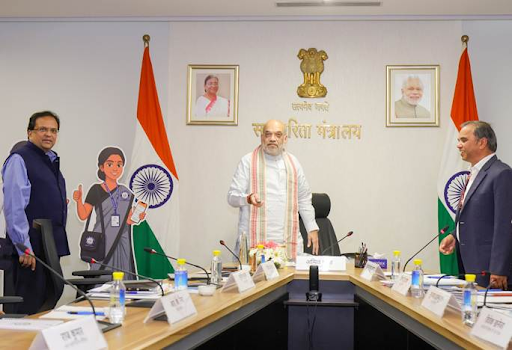
The Union Home Minister launched four digital platforms and unveiled mascots "Pragati" and "Vikas" for the upcoming Census-2027, marking it as India's first-ever digital census with a self-enumeration option.
|
Read all about: India's 2027 Digital Caste Census |
What is the Digital Census?
A Digital Census is a modern approach to population counting where data is collected, transmitted, and processed entirely through electronic means, replacing traditional paper-based methods.
In India, the 2027 Census will be the country's first-ever fully digital census. It aims to ensure faster data availability, higher accuracy through real-time validation, and improved transparency.
Key Features of India’s Digital Census (2027)
Mobile App Data Collection: Approximately 30 lakh field enumerators will use a dedicated mobile application (available on Android and iOS) to record information during door-to-door visits.
Self-Enumeration: For the first time, citizens can choose to fill out their household details themselves via a secure Self-Enumeration Portal before an enumerator visits.
Real-Time Monitoring: A centralized Census Management and Monitoring System (CMMS) portal allows officials to track the progress of enumeration across the country in real-time.
Geo-tagging and Mapping: All buildings (residential and non-residential) will be geo-tagged using satellite imagery and the Houselisting Block (HLB) Creator web map application to ensure complete geographic coverage.
Multilingual Support: Digital tools will be available in 16 regional languages to facilitate inclusive data collection.
Timeline and Phases
The digital census will be conducted in two main stages:
Technological Backbone
The Centre for Development of Advanced Computing (C-DAC) has developed four key digital tools to power the census:
|
Digital Tool |
Details |
|
Houselisting Block Creator (HLBC) |
A web application for charge officers to digitally create enumeration blocks using satellite imagery, ensuring complete geographical coverage. |
|
HLO Mobile Application |
An app for enumerators to collect houselisting data on their mobile devices. It supports 16 languages and allows secure, direct data transmission. |
|
Self-Enumeration (SE) Portal |
A web portal allowing citizens to fill in their census details online for the first time, offering convenience and improving data accuracy. |
|
Census Management and Monitoring System (CMMS) |
A centralized dashboard for real-time management and monitoring of all census activities, enhancing operational efficiency and accountability. |
What are the Advantages of Digitalisation?
Enhanced Efficiency: Reduces the time between data collection and the release of results.
Improved Data Quality: Digital tools with features like geo-referencing and data validation checks minimize manual errors.
Strengthened Governance: The CMMS portal enables real-time monitoring for better management of field operations.
Long-term Cost-Effectiveness: Optimizes resources by reducing expenses on printing, logistics, and manual data entry.
Role in Policy and Governance
Foundation for Welfare Schemes: Accurate population data is essential for implementing schemes like the National Food Security Act and ensuring correct allocation of resources.
Informing Economic Policy: Provides vital data on migration, urbanization, and employment, which helps the RBI calculate inflation weights for the Consumer Price Index (CPI).
Delimitation of Constituencies: Census data is the basis for redrawing parliamentary and assembly constituencies to ensure fair political representation.
Caste Data Collection
|
Arguments For Collection |
Arguments Against Collection |
|
|
|
Case Study: Bihar Caste-Based Survey (2023) - This state-level exercise revealed detailed demographic data, leading to demands for recalibrating reservation quotas and highlighting the potential national impact of collecting such data. |
|
Challenges and Way Forward
|
Challenge |
Way Forward |
|
The Digital Divide |
Leverage Common Service Centres (CSCs) to assist citizens in rural areas. Launch extensive awareness campaigns to educate the public on self-enumeration. |
|
Data Security & Privacy |
Implement a robust data protection framework with protocols for encryption and anonymization. Explore global best practices like "differential privacy" used by the U.S. Census Bureau. |
|
Logistics and Training |
Invest in a comprehensive and standardized training program for the 30 lakh+ enumerators on using digital tools and handling sensitive questions. |
|
Accuracy and Public Trust |
Strengthen public trust through transparency about the census objectives and data usage. |
Conclusion
India's first Digital Census is a monumental and transformative exercise for evidence-based policymaking, but its success depends on balancing technological ambition with inclusivity, robust security, and public trust to address the digital divide, data security, and logistical challenges.
Source: PIB
|
PRACTICE QUESTION Q. What are "Pragati" and "Vikas," recently seen in the news? A) New AI chatbots for digital payments B) Official mascots for the Census 2027 C) High-speed trains launched under Gati Shakti D) Military exercises between India and Japan Answer: B Explaination: "Pragati" and "Vikas" are the official mascots for India's first fully digital population Census 2027. These mascots represent a female enumerator (Pragati) and a male enumerator (Vikas), symbolising equal gender participation in the national mission to build a developed India by 2047 |
The Digital Census-2027 is India's first-ever census to be conducted entirely using digital methods. It replaces the traditional pen-and-paper enumeration with digital tools like mobile apps and web portals, aiming for greater efficiency, accuracy, and faster results.
For the first time in India's 150-year census history, citizens will have the option to fill in their census details online through a dedicated Self-Enumeration (SE) Portal. This offers convenience, reduces the workload on enumerators, and can potentially improve data accuracy by allowing individuals to enter their information directly.
The primary challenges include the digital divide (unequal internet access and literacy between urban and rural areas), ensuring the security and privacy of sensitive personal data against cyberattacks, and the massive logistical task of training over 30 lakh enumerators to use the new digital technology effectively.



© 2026 iasgyan. All right reserved