

Cyberattacks on critical infrastructure during the USA-IRAN Conflict highlight the urgent need to address the widening gap between modern cyber warfare capabilities and global legal accountability frameworks.
|
Read all about: UN Convention Against Cybercrime l Global Risks Report 2026 l Reality of the Changing Dimensions of Warfare |
Cyber Warfare refers to the strategic use of digital attacks by one nation-state against another to disrupt, damage, or gain unauthorized access to critical systems.
It utilizes Information Technology as a weapon for military or political purposes.
State-Sponsorship distinguishes cyber warfare from ordinary criminal hacking; the primary goal is weakening a rival nation’s economy, security, or military capabilities.
Key Targets include critical infrastructure such as power grids, hospitals, financial systems, defense networks, and water supply.
Common Methods involve the use of computer viruses, malware, ransomware, spyware, and Distributed Denial-of-Service (DDoS) attacks.
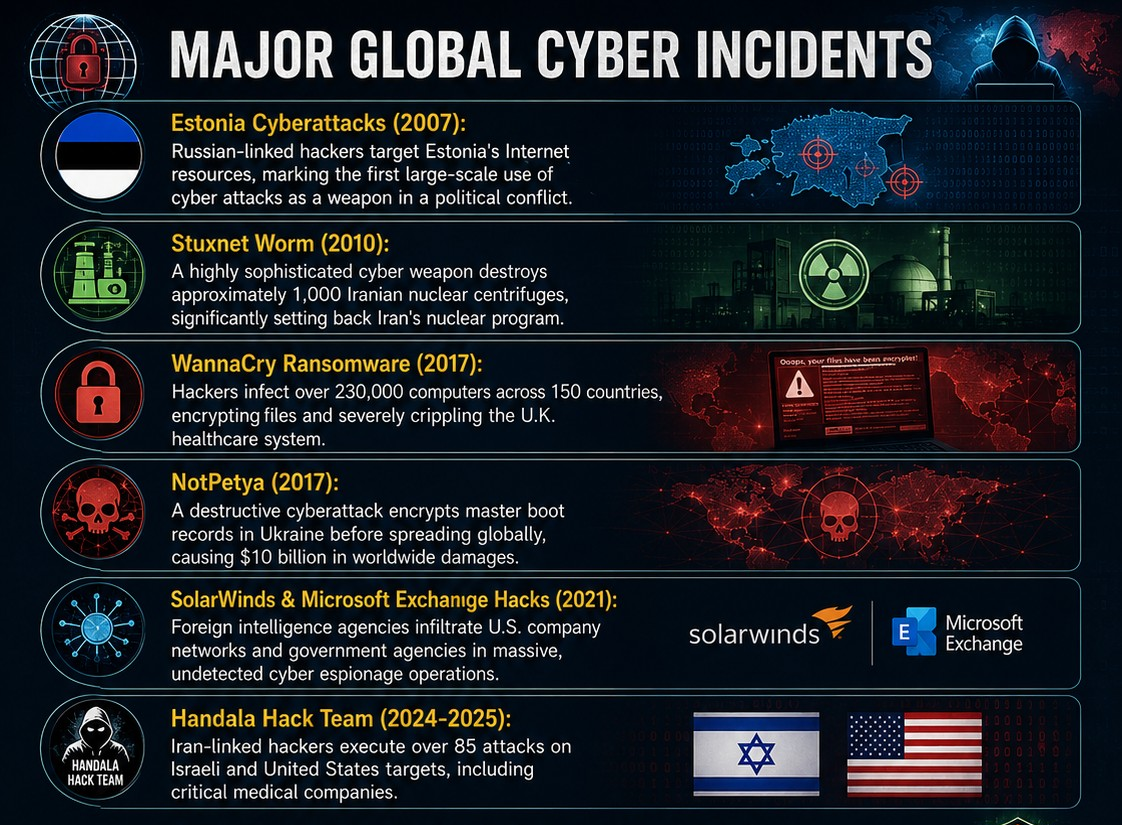 How Cyber Warfare Challenges Traditional Concepts of Warfare?
The Fourth Front: Warfare has moved beyond land, sea, and air into the digital realm, creating a new domain of conflict.
Transcending Borders: Cyber operations bypass physical and virtual borders without the need for traditional troop movements.
Asymmetric Nature: Small nations can exert significant global influence because cyber tools are cheap to launch compared to conventional armaments.
Grey Zone Operations: Attacks often occur below the threshold of an armed attack, making it difficult to trigger traditional self-defense laws.
Non-Discrimination: Much like nuclear weapons, cyber warfare often fails to distinguish between civilians and combatants, impacting entire populations through infrastructure failure.
Domino Effect: Because modern infrastructure is interlinked, a single attack on one sector (e.g., telecommunications) can cause a catastrophic chain reaction across others.
|
Framework / Law |
Status |
Core Function |
|
UN Charter (Art. 2(4)) |
Binding |
Prohibits the use of force; however, the threshold for "cyber force" is legally unclear. |
|
UN Charter (Art. 51) |
Binding |
Recognizes the right to self-defense if an armed attack occurs, including destructive cyber operations. |
|
Tallinn Manual 2.0 |
Non-binding |
An academic guide by NATO experts applying international law to cyber warfare. |
|
Budapest Convention |
Binding (81 States) |
First treaty on cybercrime; covers hacking and fraud but not state-sponsored warfare. |
|
Not yet active |
Global cybercrime treaty allowing disputes to go to the International Court of Justice (ICJ). |
|
|
Schmitt Analysis |
Legal Framework |
Uses seven parameters (Severity, Immediacy, Directness, etc.) to decide if a cyber attack constitutes a "use of force." |
|
Laws of Neutrality |
Customary Law |
Historically used to manage conflict at the fringes of war; provides roots for due diligence in cyberspace. |
The Attribution Problem: Legally proving who executed an attack is difficult. Attackers hide behind proxy servers, fake identities, and multiple jurisdictions.
Plausible Deniability: States fund proxy hacker groups to conduct operations while denying any official involvement.
Lack of Legal Threshold: There is no global consensus on exactly when a digital disruption (e.g., a website outage) crosses the line to become an "act of war."
Ineffective Enforcement: The International Court of Justice (ICJ) requires both states to agree to appear, which rarely happens in cyber disputes.
Disputed Due Diligence: Influential states like the USA and UK have refused to commit to a binding due diligence duty, which would require states to ensure their networks are not used to attack others.
Escalation Risks: Disagreements over a third state's duty to stop an attack routed through its networks can lead to unauthorized "hack-backs" or military escalation.
Critical Infrastructure Failure: Real-world consequences include power blackouts (Mumbai 2020), hospital data wiping, and the sabotage of nuclear facilities (Stuxnet).
Economic Destabilization: Attacks on the financial sector, stock markets, and payment systems threaten global economic trust and stability.
Humanitarian Cost: Cyber operations during armed conflicts can cause significant human harm by disabling essential services like healthcare and water.
Precedent of Impunity: The inability to punish aggressors encourages a cyber arms race and more frequent state-sponsored aggression.
Institutional Frameworks
CERT-In (Indian Computer Emergency Response Team): The nodal agency under the Ministry of Electronics and Information Technology (MeitY) for cyber incident response and threat monitoring.
Defence Cyber Agency (DCyA): A tri-service command for handling offensive and defensive cyber operations.
National Critical Information Infrastructure Protection Centre (NCIIPC): Specifically mandated to protect Critical Information Infrastructure (CII) in sectors like energy and finance.
Legislative Measures
Information Technology Act, 2000: Includes Section 66F (cyber terrorism, punishable with life imprisonment) and Section 70 (protected systems).
Bharatiya Nyaya Sanhita (BNS): Addresses digital offenses like misappropriation and criminal intimidation.
Strategic Initiatives
National Cyber Security Policy 2013: Strategic framework for securing digital infrastructure.
Bharat National Cyber Security Exercise (NCX): Annual exercise to strengthen vigilance and preparedness.
Cyber Swachhta Kendra (CSK): Botnet cleaning and malware analysis center for citizens and organizations.
International Engagement
India participates in the UN Group of Governmental Experts and the Quad Cyber initiative, though it has stayed out of the Budapest and Hanoi conventions due to sovereignty concerns.
Binding UN Norms: The UN must convert voluntary cyber norms into binding, specific standards with enforceable penalties.
Independent Attribution Body: Establish a neutral international agency (modeled after the Organisation for the Prohibition of Chemical Weapons) to investigate major attacks and provide credible evidence for courts.
Codification of Due Diligence: Develop a flexible but reliable due diligence standard based on the "should have known" principle from the Corfu Channel case.
Mandatory Incident Response: Require all nations to establish CERT capabilities to prevent the "no legislation" defense when attacks originate from their territory.
Proactive Network Monitoring: States should implement intrusion monitoring for government networks and critical infrastructure as a legal duty to warn others of threats.
Public-Private Partnerships: Strengthen collaboration between the government and the private sector for threat intelligence sharing and capacity building.
Effective global cyber governance requires transitioning from voluntary norms to a binding legal framework that ensures credible attribution and state accountability.
Source: THEHINDU
|
PRACTICE QUESTION Q. Consider the following statements regarding international cyber law frameworks:
Which of the statements given above is/are correct? (a) 1 only (b) 2 only (c) Both 1 and 2 (d) Neither 1 nor 2 Answer: (d) Explanation: Statement 1 is incorrect: While the Budapest Convention (Convention on Cybercrime) is indeed the first international treaty created to address internet and computer crimes, India is not a ratifying member. India has maintained its distance from the convention due to concerns regarding data sharing and national sovereignty, arguing that it was drafted without its participation. Statement 2 is incorrect: The Tallinn Manual is not a legally binding United Nations treaty. Instead, it is a non-binding, academic study drafted by an international group of independent legal experts. It was invited by the NATO Cooperative Cyber Defence Centre of Excellence (CCDCOE) to analyze how existing international law applies to cyber warfare. |
The Tallinn Manual is an academic, non-binding study produced by international law experts at the NATO Cooperative Cyber Defence Centre of Excellence. It explores how existing international law, including the UN Charter and international humanitarian law, applies to cyber operations and warfare.
The attribution problem refers to the technical and legal difficulty of proving who carried out a cyberattack. Because attackers use proxy servers, fake identities, and operate across multiple jurisdictions, states can maintain "plausible deniability," making legal accountability extremely challenging.
The Defence Cyber Agency is a tri-service command of the Indian Armed Forces. It is tasked with handling cybersecurity threats, formulating cyber doctrine, and managing joint military cyber operations under the Chief of Defence Staff.
© 2026 iasgyan. All right reserved