The Raisina Dialogue 2025 theme “Saṁskāra – Assertion, Accommodation, Advancement” reflects global trends of national assertion, plurilateral cooperation, and technological progress like India’s Digital Public Infrastructure. It showcases India as a “Vishwa Mitra” and Global South voice, though challenges remain in converting dialogue into concrete action.
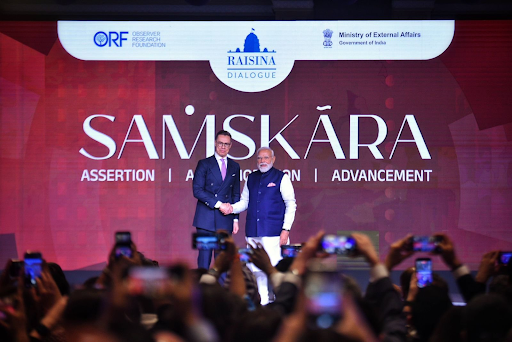
Copyright infringement not intended
Picture Courtesy: PIB
Context
The 11th edition of the Raisina Dialogue in New Delhi is co-hosted by the Observer Research Foundation (ORF) and the Ministry of External Affairs (MEA).
What is Raisina Dialogue?
It is an annual conference dedicated to geopolitics and geo-economics, organised in New Delhi since 2016.
It serves as a multilateral platform for global leaders to address the most pressing issues facing the international community.
Hosts: It is organized by the Observer Research Foundation (ORF), an independent think tank, in partnership with the Ministry of External Affairs (MEA), Government of India.
Naming: The name is derived from Raisina Hill, the elevation in New Delhi that houses the seat of the Government of India, including Rashtrapati Bhavan and the Prime Minister's Office.
Inspiration: It is modeled after high-level global forums such as Singapore’s Shangri-La Dialogue and Germany’s Munich Security Conference.
Purpose and Scope
The dialogue aims to explore opportunities for Asian integration and examine India’s role in shaping a stable global order. Key discussion areas typically include:
Participants
The event attracts a wide range of stakeholders from over 100 countries, including:
Current Edition (2026)
The 11th edition is taking place from March 5 to March 7, 2026, under the theme “Saṁskāra: Assertion, Accommodation, Advancement”. President Alexander Stubb of Finland is the Chief Guest and Keynote Speaker for this edition.
Theme: The 2026 theme is “Saṁskāra: Assertion, Accommodation, Advancement”, focusing on civilisational identity, sovereign assertion, and global progress.
Participants: The forum features representatives from over 110 countries, including ministers, former heads of state, military commanders, and industry leaders.
Major Discussions
New Initiatives: The inaugural Raisina Science Diplomacy Initiative (SDI) was launched to bridge the gap between scientific innovation and global policy.
What is the Geopolitical Significance of the Raisina Dialogue?
Shaping Global Narratives
Support Indian foreign policy to influence global discourse on strategic competition, climate change, etc., transitioning India from a passive rule-taker to an active rule-shaper.
Empowering the Global South
Elevates the voices of developing nations (Africa, Latin America), solidifying India's role as a spokesperson and advocate for necessary reforms in global bodies like the UN Security Council.
Demonstrating Convening Power
Highlights India's diplomatic strength in bringing diverse, sometimes rival, international stakeholders (US, Europe, Russia, Global South) together for open and critical discussions.
What are the Challenges of the Raisina Dialogue?
From Dialogue to Action
A primary challenge is translating the extensive discussions into concrete policy outcomes. Critics question whether the forum can move beyond being an influential debating society to a driver of collaborative action.
Representation and Balance
Discussions are sometimes skewed towards European/Western security (e.g., Ukraine) over other global concerns (e.g., Gaza), making a balanced agenda representing the Global South a continuing challenge.
Inclusivity
The Dialogue, while attracting high-level government and industry leaders, has been criticized by some observers for lacking sufficient representation from non-governmental civil society organizations.
Way Forward
The Raisina Dialogue must shift from merely reflecting global conversations to actively initiating them, translating discussions into practical, collaborative actions to foster a more confident, accommodating, and progressive world order, particularly by advocating for the Global South.
Source: PIB
|
PRACTICE QUESTION Q. While the Raisina Dialogue enhances India's convening power, critics argue it struggles to translate dialogue into concrete action. Discuss. 150 words |
The Raisina Dialogue is India's premier annual conference on geopolitics and geoeconomics. It brings together global leaders, policymakers, journalists, and academics to discuss the most challenging issues facing the international community.
It is jointly organized by the Observer Research Foundation (ORF), an independent think tank, in partnership with the Ministry of External Affairs (MEA), Government of India.
It serves as a primary platform for India to articulate its global vision as a 'Vishwa Mitra' (friend to the world), shape global narratives, showcase its convening power by bringing diverse actors together, and establish itself as a leading power rather than just a balancing one.


© 2026 iasgyan. All right reserved