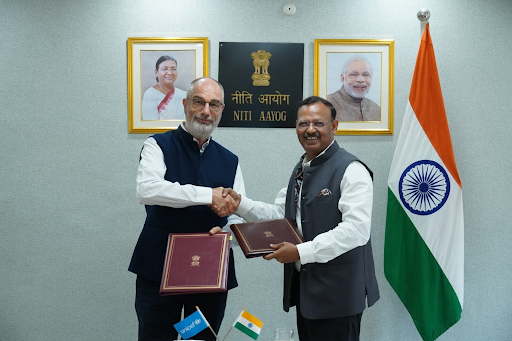
NITI Aayog and UNICEF launched a partnership to tackle malnutrition in Aspirational Districts and Blocks. Using the IMPAct4Nutrition platform, it promotes collaborative governance, CSR funding, data-driven monitoring, and stronger Anganwadi service delivery to reduce stunting, wasting, and anaemia and improve India’s human capital.
Copyright infringement not intended
Picture Courtesy: PIB
Context
The NITI Aayog and UNICEF India signed a Statement of Intent (SOI) to channel strategic interventions into Aspirational Districts and Blocks to improve maternal and child nutrition.
What is the Significance of This Collaboration?
Targeted 'Last-Mile' Delivery
By focusing on Aspirational Districts and Aspirational Blocks, the initiative ensures that interventions are directed towards most developmentally challenged regions, addressing gaps in service delivery.
Mobilising Private Sector Action
Through the IMPAct4Nutrition (I4N) platform, the collaboration engages businesses and public sector enterprises to channel Corporate Social Responsibility (CSR) funds into nutrition-focused initiatives.
Building Capacity of Frontline Workers
UNICEF will bring its technical expertise to train Anganwadi workers and other frontline functionaries, equipping them with the skills needed for effective counselling, growth monitoring, and service delivery.
Promoting Community Engagement and Literacy
The collaboration will support knowledge-sharing platforms and community engagement to increase nutrition literacy and drive behavioural change, thereby improving the uptake of Integrated Child Development Services (ICDS) services.
Ensuring Data-Driven Governance
NITI Aayog's involvement ensures that interventions are monitored through robust data frameworks, enabling evidence-based decision-making and accountability at the district and block levels.
What are the Aspirational Districts and Blocks Programmes?
The Aspirational Districts Programme (ADP) and the Aspirational Blocks Programme (ABP) are initiatives of the Government of India, anchored by NITI Aayog, to fast-track development in the most underserved areas.
The strategy for both programmes is based on the "3Cs" approach:
Aspirational Districts Programme (ADP)
Launched in 2018, this programme aims to transform 112 districts across 27 states that were lagging in key socio-economic indicators.
Aspirational Blocks Programme (ABP)
Building on the ADP's success, the ABP was launched in 2023 to extend this model to the sub-district level. It initially covered 500 blocks across 329 districts, recently expanded to 513 blocks as of 2026.
Why is Malnutrition a Persistent Challenge in India?
The National Family Health Survey-5 (NFHS-5, 2019-21) highlights the severity of the issue:
Several factors contribute to this situation
Implementation Gaps
The ICDS scheme suffers from challenges like irregular supply of supplementary nutrition, poor infrastructure at Anganwadi Centres (AWCs), and overburdened Anganwadi workers.
Socio-Economic Determinants
Poverty, poor maternal health, lack of awareness about nutrition, and inadequate sanitation are significant underlying causes of malnutrition. (Source: NFHS-5)
Service Quality and Uptake
While access to ICDS services is high, the quality of services and their consistent utilisation by the community remain key concerns. NFHS data indicate that service quality has a stronger correlation with nutrition outcomes than mere access.
Way Forward
Effective Ground-Level Coordination: Success will depend on seamless convergence between the Departments of Women & Child Development, Health, and Panchayati Raj at the block level.
Strategic CSR Alignment: Ensure that CSR investments are channelled according to the specific, identified needs of a block rather than being driven solely by corporate priorities.
Sustainability and Scalability: Partnership should aim to create sustainable systems that can function effectively even after the initial project phase.
Conclusion
The NITI Aayog and UNICEF India collaboration is a promising model for strengthening India's fight against child malnutrition by combining strategic oversight, technical expertise, and private sector resources.
Source: PIB
|
PRACTICE QUESTION Q. The Aspirational Districts Programme is often described as being based on a '3C' model. What do the '3Cs' stand for? A) Co-operation, Co-ordination, and Competition B) Convergence, Collaboration, and Competition C) Community, Co-operation, and Consolidation D) Capital, Capacity, and Connectivity Answer: B Explanation: The Aspirational Districts Programme (ADP), launched by the Government of India in 2018 and anchored by NITI Aayog, is built on three core pillars known as the "3Cs":
|
The main objective is to formalize a strategic partnership to improve health and nutrition outcomes, specifically targeting India's most underserved regions through the Aspirational Districts and Aspirational Blocks Programmes.
These are government initiatives led by NITI Aayog aimed at rapidly and effectively transforming districts and blocks that have shown relatively poor progress in key social and economic indicators. The model is based on Convergence, Collaboration, and Competition.
UNICEF will provide high-quality technical support through its IMPAct4Nutrition (I4N) platform. This involves sharing global expertise, aiding in capacity building of frontline workers, and helping to connect corporate partners for CSR funding with specific needs at the district level.


© 2026 iasgyan. All right reserved