A new predatory dinosaur, Spinosaurus mirabilis or “Hell Heron,” was discovered in Niger’s Sahara. Found in inland river deposits, it challenges claims that spinosaurids were fully aquatic, suggesting a semi-aquatic wading hunter. Its crest, fish-trapping teeth, and 3D-modeled fossils highlight modern paleontology.
Copyright infringement not intended
Picture Courtesy: SCITECHDAILY
Context
An international team of paleontologists has discovered a new species of giant predatory dinosaur, Spinosaurus mirabilis, in the Sahara Desert.
What is Spinosaurus mirabilis?
Spinosaurus mirabilis (meaning "astonishing spine lizard") is a newly discovered species of the genus Spinosaurus.
It is only the second confirmed species of Spinosaurus ever discovered, following the first, Spinosaurus aegyptiacus, which was discovered in 1915.
Location: Fossils were unearthed in the remote Jenguebi fossil area of the Sahara Desert in Niger.
Time Period: This predator lived approximately 95 million years ago during the mid-Cretaceous Period.
Habitat: Unlike its relative S. aegyptiacus, which is often found in coastal deposits, S. mirabilis lived deep inland (up to 1,000 km from the ancient sea) in a forested environment filled with freshwater river systems.
Key Physical Features
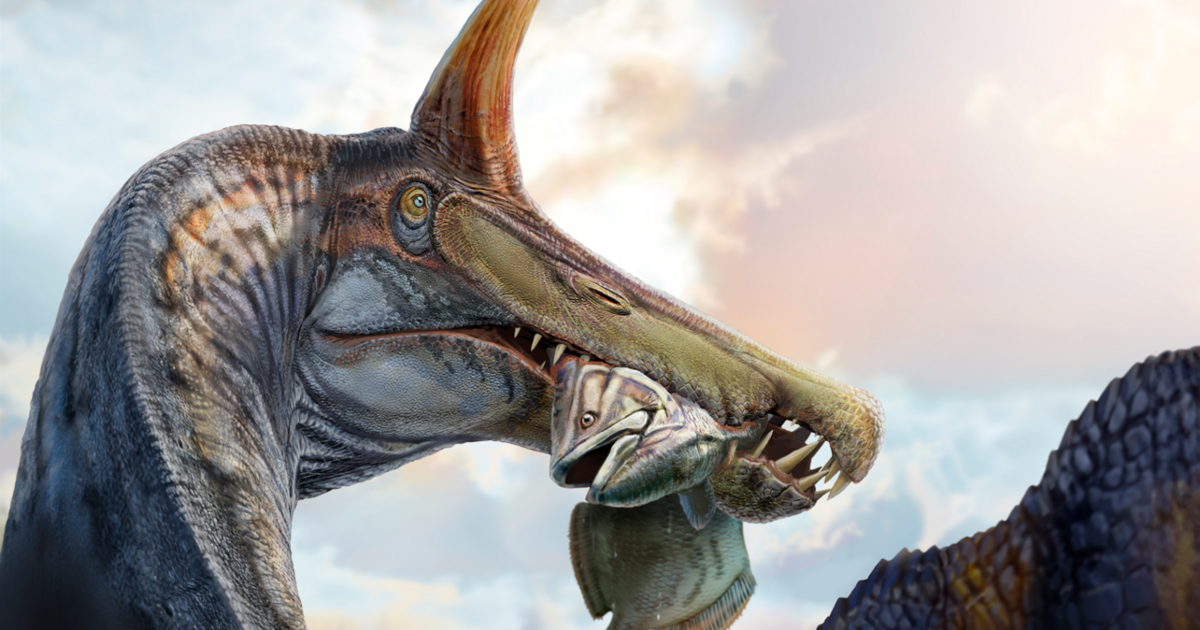
The "Scimitar" Crest: A massive, 20-inch scimitar-shaped bony crest on its skull. Researchers believe it was sheathed in a brightly coloured keratin layer used for social display or mate attraction.
Size and Build: It reached lengths of about 12 metres and weighed between 5 to 7 tonnes.
Specialized Hunting Adaptations:
Scientific Significance
The discovery has shifted the "aquatic vs semi-aquatic" debate, suggesting Spinosaurus mirabilis was a semi-aquatic "hell heron" that waded in shallow, inland rivers to ambush large fish, contrary to earlier theories of it being a fully aquatic deep-water swimmer.
Source: SCITECHDAILY
|
PRACTICE QUESTION Q. With reference to the recently discovered Spinosaurus mirabilis, which of the following best describes the significance of its fossil location? (a) It was found in coastal sediments, confirming its fully marine lifestyle. (b) It was discovered in deep ocean deposits, suggesting it was an apex marine predator. (c) It was unearthed in inland river deposits, challenging the theory of it being a fully aquatic dinosaur. (d) It was found alongside early mammalian fossils, proving a direct predator-prey relationship. Answer: c Explanation: The recently discovered fossils of Spinosaurus mirabilis were found in inland river sediments in Niger, far from ancient marine coastlines. These findings, along with bone density studies, suggest it lived a semi-aquatic lifestyle similar to a "hell heron" or modern crocodilians, rather than being a fully aquatic, deep-water hunter. |
Spinosaurus mirabilis is a newly discovered species of giant predatory dinosaur found in Niger's Sahara Desert. Nicknamed the "Hell Heron," it is distinguished by a large head crest and adaptations for a semi-aquatic, wading lifestyle in ancient river systems.
It earned the nickname "Hell Heron" due to its presumed hunting strategy. Researchers, led by Paul Sereno, envision it stalking the shallows of ancient rivers to prey on fish, much like a modern heron, but on a massive and terrifying scale.
It challenges the prevailing theory that spinosaurids were fully aquatic marine hunters. The fossils of S. mirabilis were found in inland, riverine deposits far from any ancient coastline, providing strong evidence for a semi-aquatic, river-based lifestyle rather than a fully marine one.



© 2026 iasgyan. All right reserved